

Saturday 29 March 2025
The discovery of a massive, Jupiter-sized exoplanet orbiting its host star at an unusually low angle has sent shockwaves through the astronomy community. The find, which was announced earlier this month, provides new insights into the complex dance between stars and their planets.
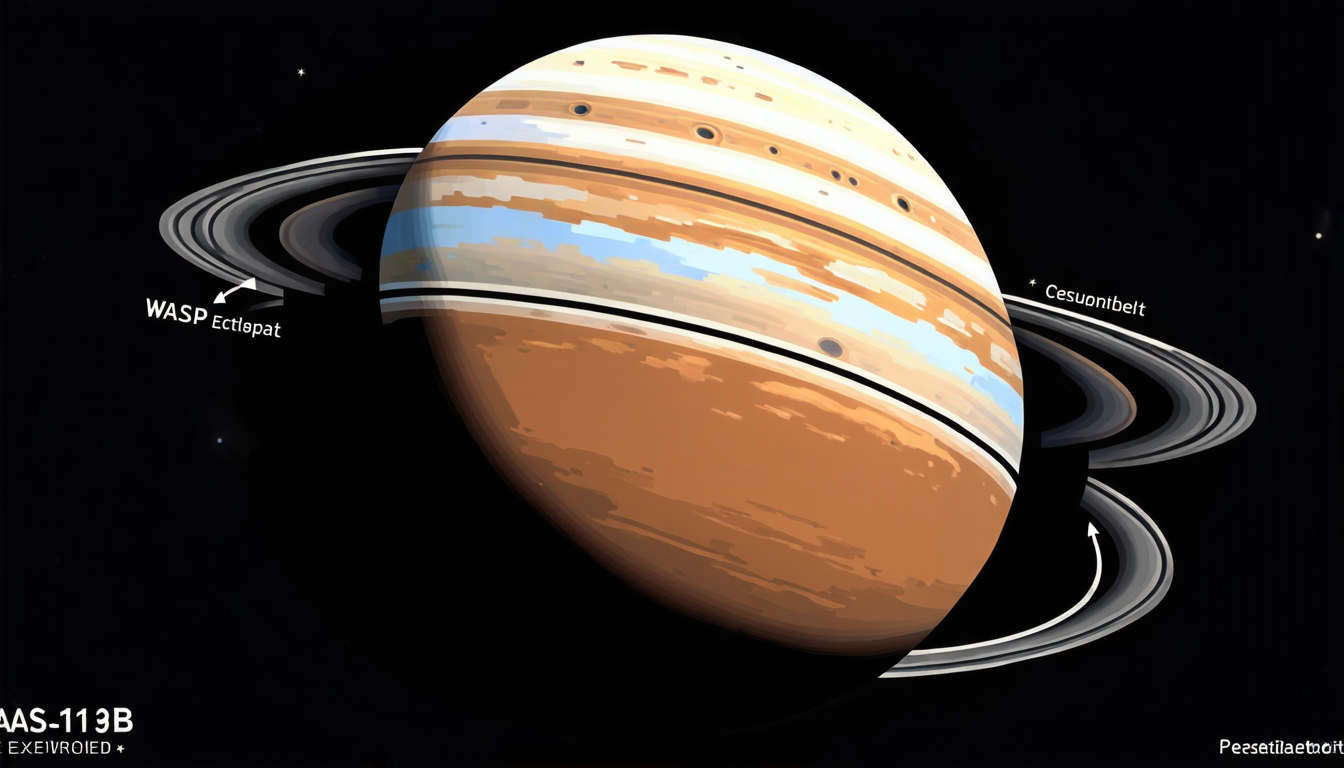
WASP-193b, as it’s known, is one of the most massive planets discovered to date, with a size comparable to that of Jupiter but a mass roughly 20% lower. What makes it truly remarkable, however, is its orbit around its host star, which lies at an angle of just 17 degrees relative to the star’s equator. This alignment is unusual because many exoplanets are found to have orbits tilted at much higher angles.
The discovery was made possible by a combination of observations from the Magellan telescope in Chile and data gathered by NASA’s Transiting Exoplanet Survey Satellite (TESS). By analyzing the subtle changes in the star’s brightness as WASP-193b passes in front of it, astronomers were able to determine the planet’s size and orbit.
The alignment of WASP-193b’s orbit is thought to be a result of gravitational interactions between the planet and its host star over millions of years. As the planet orbits the star, its gravity causes the star to wobble slightly, which in turn affects the planet’s motion. This complex interplay can lead to the formation of stable, aligned orbits like that seen in WASP-193b.
The discovery has significant implications for our understanding of planetary formation and evolution. It suggests that even massive planets like Jupiter-sized bodies can form through a process known as core accretion, where small, solid particles come together to form a large, gas-rich planet.
WASP-193b’s orbit also provides valuable insights into the star itself. By studying the way the star wobbles in response to the planet’s gravity, astronomers can learn more about the star’s internal structure and composition. This information can be used to better understand the life cycles of stars like WASP-193, which are thought to have a relatively short lifespan.
The discovery of WASP-193b is a testament to the power of modern astronomy’s ability to study distant worlds in unprecedented detail. As new exoplanet discoveries continue to shed light on the mysteries of planetary formation and evolution, we’re likely to learn even more about the complex relationships between stars and their planets.
Cite this article: “A Jupiter-Size Exoplanets Unusual Orbit Reveals Secrets of Planetary Formation”, The Science Archive, 2025.
Exoplanet, Jupiter-Sized, Orbit, Alignment, Gravitational Interactions, Planetary Formation, Evolution, Core Accretion, Star Wobble, Tess





