

Sunday 30 March 2025
Black holes are notorious for their ability to warp space and time, creating a region known as the event horizon where nothing, not even light, can escape once it crosses over. But despite their fearsome reputation, scientists have long been fascinated by these cosmic monsters, driven by a desire to understand their inner workings and the secrets they hold.
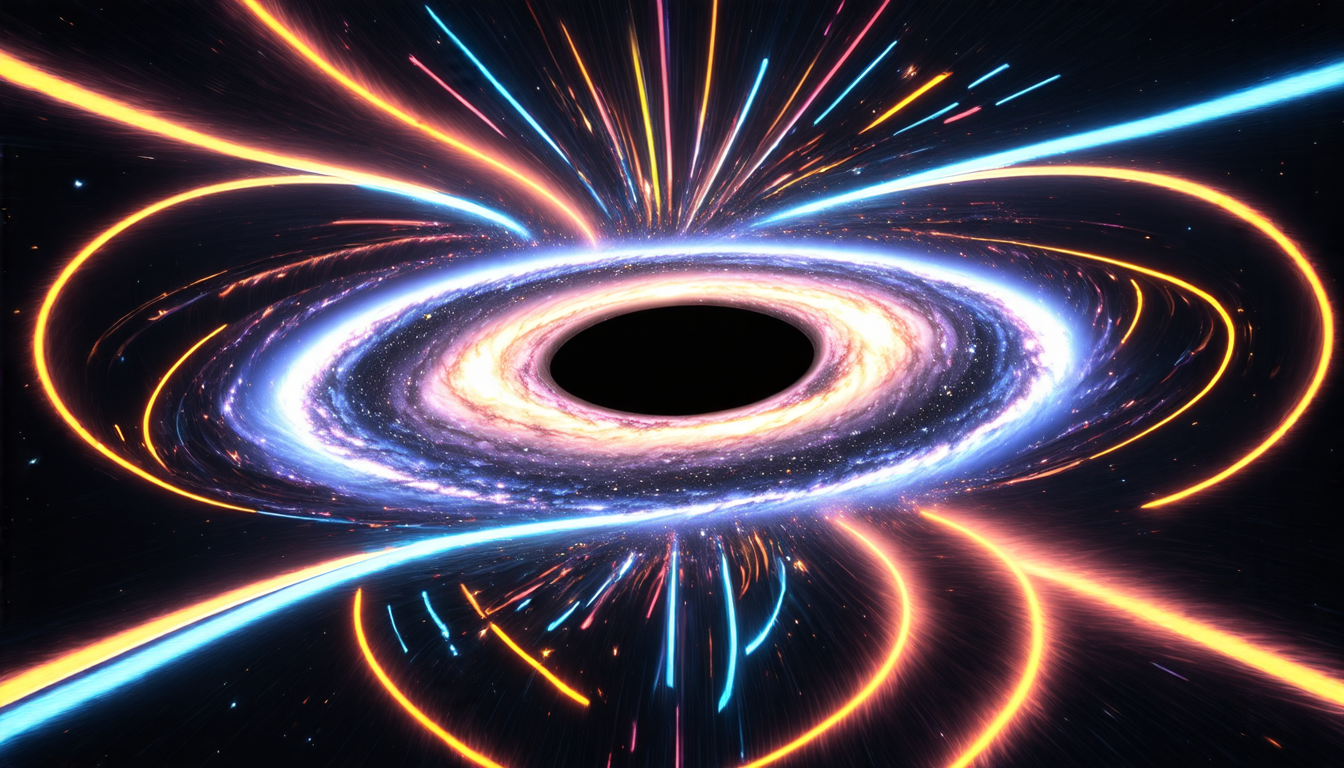
One of the most intriguing aspects of black holes is their ability to distort and bend light around them, creating a phenomenon known as gravitational lensing. This effect can produce stunning visual effects, such as rings and arcs of light that seem to defy explanation. But beyond its aesthetic appeal, gravitational lensing holds great promise for scientists seeking to study the properties of black holes.
In recent years, a team of researchers has been working on developing new methods for analyzing the distortions caused by black holes using observations from powerful telescopes like the Event Horizon Telescope (EHT). By studying these distortions, scientists hope to gain insights into the nature of gravity and the behavior of matter in extreme environments.
The EHT project is a global collaboration that has been working on capturing high-resolution images of black holes using a network of radio telescopes around the world. The team’s most recent achievement was the capture of an image of the supermassive black hole at the center of the galaxy M87, which has sparked widespread interest and excitement.
But while the EHT project has produced some remarkable results, scientists are still working to refine their methods for analyzing gravitational lensing effects. One major challenge is separating the distortions caused by the black hole from those introduced by other factors, such as the motion of nearby stars or the presence of intervening gas and dust.
To address this challenge, researchers have been developing new techniques that take into account the complex interactions between light, matter, and gravity in the vicinity of a black hole. These methods involve sophisticated simulations and analysis tools that can tease apart the various contributions to the observed distortions.
The results are already beginning to pay off, with scientists gaining new insights into the properties of black holes and their role in shaping the surrounding environment. For example, researchers have been able to study the way that light is bent by the strong gravity of a black hole, which can provide valuable information about its mass and spin.
In addition to its scientific significance, gravitational lensing has also become a popular topic among amateur astronomers and enthusiasts.
Cite this article: “Unlocking the Secrets of Black Holes: Gravitational Lensing and Beyond”, The Science Archive, 2025.
Black Holes, Event Horizon, Gravitational Lensing, Telescope, Astronomy, Space, Time, Distortion, Gravity, Eht





