

Sunday 30 March 2025
Scientists have long been fascinated by the way tiny particles move through liquids and gases, a phenomenon known as diffusion. Understanding this process is crucial for fields like medicine, biology, and even finance. But until recently, studying diffusion has been a challenge, especially when it comes to tracking individual particles.
A new technique, developed by a team of researchers from the University of London, uses artificial intelligence (AI) to analyze particle movement with unprecedented precision. The approach, called U-Net 3+, is able to identify and track individual particles in real-time, even in complex environments like living cells.
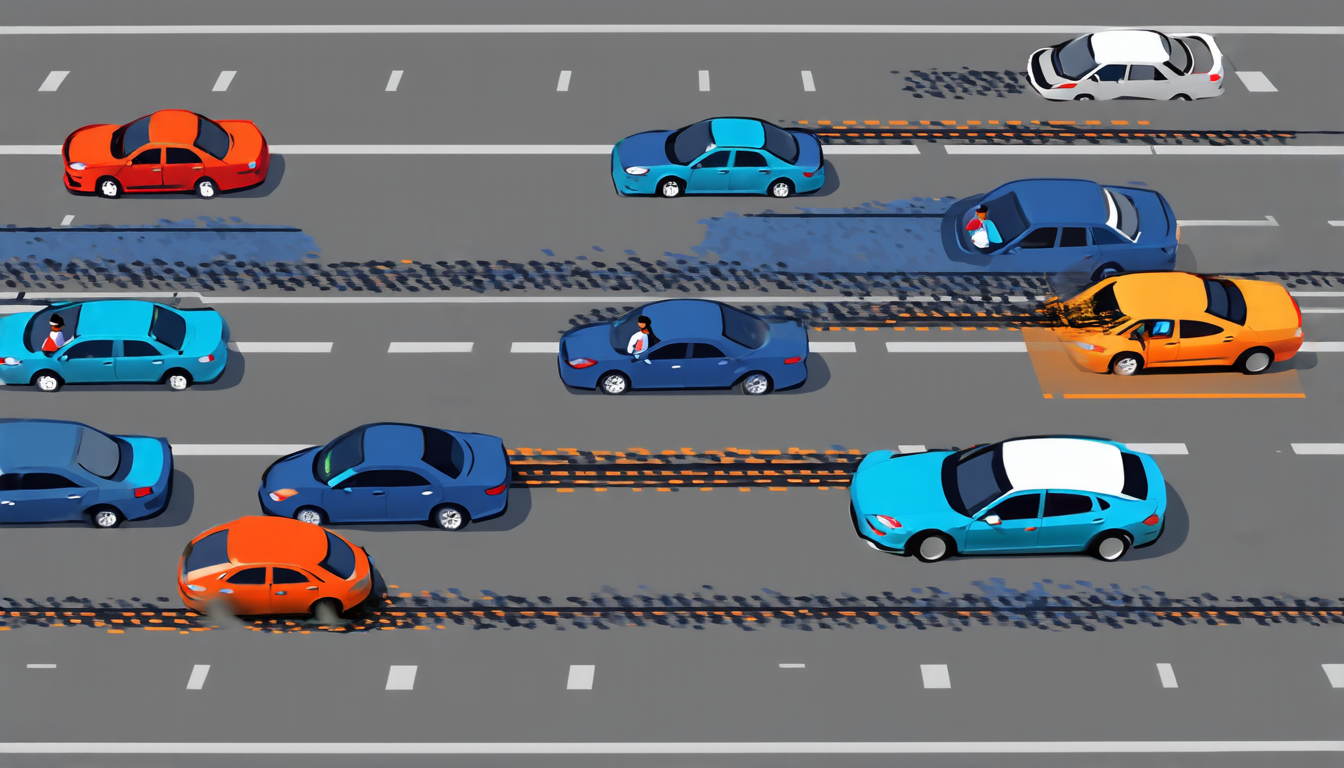
To understand how this works, let’s consider an analogy. Think of a busy highway where cars are moving in all directions. Traditional methods for studying diffusion would be like trying to analyze traffic patterns by looking at the average speed of all the cars on the highway. However, with U-Net 3+, it’s like having a dedicated camera focused on each individual car, allowing researchers to track its exact movements and interactions.
The team used this technique to study the movement of tiny particles called lipids within living cells. They found that these particles exhibit abnormal diffusion patterns, which can be indicative of certain diseases. By tracking individual lipids in real-time, the scientists were able to identify specific signatures associated with different diseases.
This breakthrough has significant implications for medical research. In the future, U-Net 3+ could be used to diagnose and monitor diseases like cancer and Alzheimer’s by analyzing changes in lipid diffusion patterns. The technique also holds promise for understanding complex biological processes, such as cell signaling and protein interactions.
But what about the AI component? The team used a type of neural network called a U-Net to analyze particle movement. This allowed them to process vast amounts of data quickly and accurately. Think of it like having a super-smart traffic engineer analyzing every car’s movements on the highway, identifying patterns and making predictions about where each car will go next.
The beauty of U-Net 3+ lies in its ability to be applied to a wide range of fields beyond biology. The same technique could be used to study stock market fluctuations, track climate change indicators, or even monitor traffic flow. As data becomes increasingly important in our daily lives, the potential applications of this technology are vast and exciting.
In short, U-Net 3+ is a powerful tool that enables scientists to gain deeper insights into complex systems.
Cite this article: “Unlocking the Secrets of Diffusion with AI-Powered Particle Tracking”, The Science Archive, 2025.
Particle Diffusion, Artificial Intelligence, U-Net 3+, Medical Research, Lipid Movement, Disease Diagnosis, Neural Network, Data Analysis, Biological Processes, Traffic Flow





