

Sunday 30 March 2025
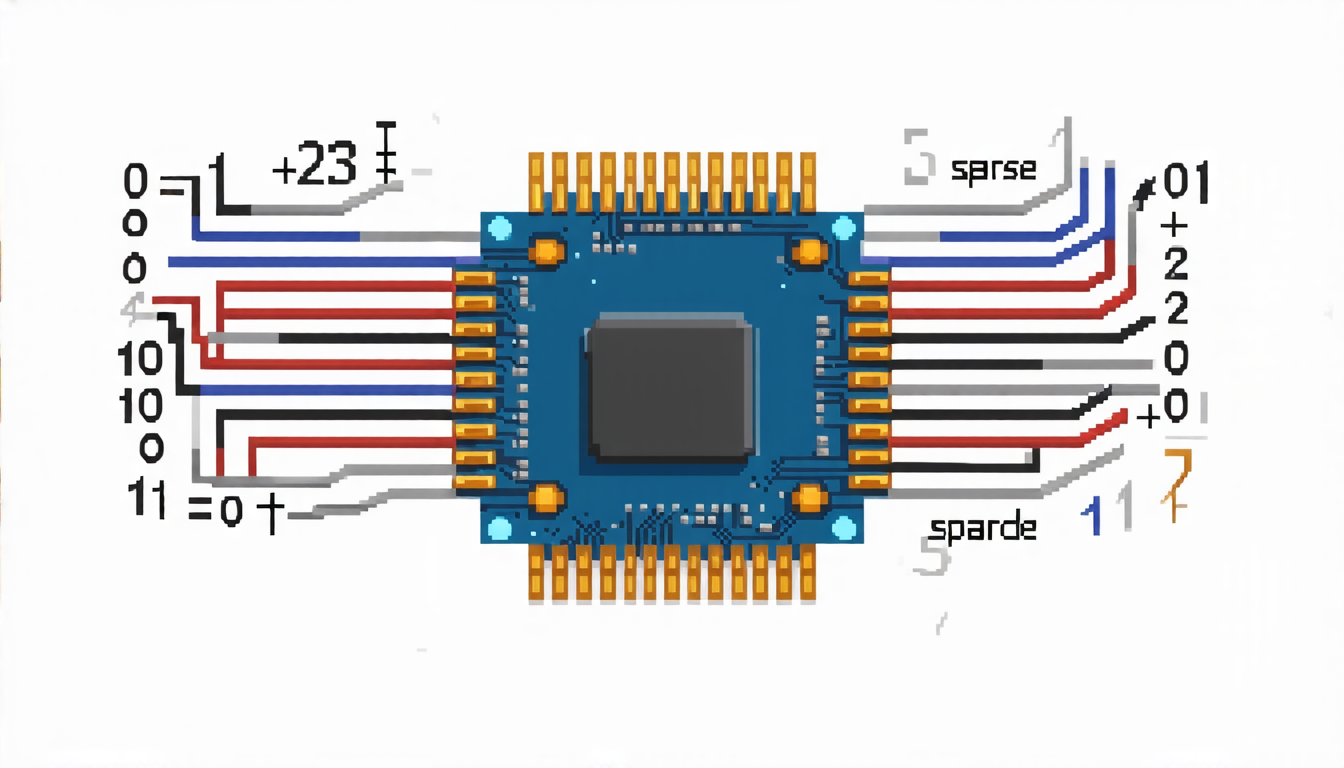
The quest for speed and efficiency in computing has led researchers down a path of innovation, resulting in new algorithms that can tackle complex tasks like never before. A recent study published in a prestigious scientific journal sheds light on the development of six hybrid algorithms designed to optimize parallel sparse matrix-vector multiplication.
In essence, these algorithms aim to make computers work faster by exploiting the unique characteristics of modern machines. The researchers focused on a specific type of problem known as sparse matrix-vector multiplication, which is crucial for many applications in fields like scientific computing and data analysis.
To better understand this concept, let’s break it down: sparse matrices are collections of numerical values with most entries being zero or close to zero. When trying to perform mathematical operations on these matrices, the majority of calculations involve dealing with zeros, which can be quite inefficient. Matrix-vector multiplication is a fundamental operation in many algorithms, and optimizing it is key to unlocking faster processing speeds.
The researchers developed six hybrid algorithms that combine different techniques to improve performance. These include parallelization strategies, storage formats, and ordering methods for sparse matrices. They tested these algorithms on 16 unbalanced square test matrices, which are representative of real-world scenarios.
One notable finding is the impact of machine architecture on algorithm performance. The study shows that the speed of RAM (random access memory) plays a significant role in determining the optimal thread count for a given task. This highlights the importance of considering hardware capabilities when designing algorithms for parallel processing.
Another key takeaway is the effect of matrix density on algorithm performance. Denser matrices tend to perform better with certain algorithms, while less dense matrices require different approaches. This underscores the need for adaptable algorithms that can adjust to varying matrix characteristics.
The study also explores the concept of storage formats for sparse matrices. The researchers found that converting a matrix from its original format to another can significantly impact processing speed. For instance, the Merge Blocking algorithm proved to be faster than others when converting a matrix to a specific storage format.
In addition, the researchers investigated the influence of sorting techniques on performance. They discovered that certain ordering methods, such as Hilbert ordering, can lead to improved results in some cases.
The findings from this study have significant implications for various fields where sparse matrix-vector multiplication is crucial. The development of efficient algorithms can enable faster processing speeds, reduced energy consumption, and enhanced scalability. As computers continue to evolve, researchers will continue to push the boundaries of what’s possible, driving innovation and progress in our understanding of complex systems.
Cite this article: “Hybrid Algorithms for Optimizing Sparse Matrix-Vector Multiplication”, The Science Archive, 2025.
Here Are The Keywords: Sparse Matrix-Vector Multiplication, Parallel Processing, Optimization, Algorithm Development, Scientific Computing, Data Analysis, Machine Architecture, Ram Speed, Thread Count, Matrix Density, Storage Formats, Sorting Techniques.





