

Sunday 30 March 2025
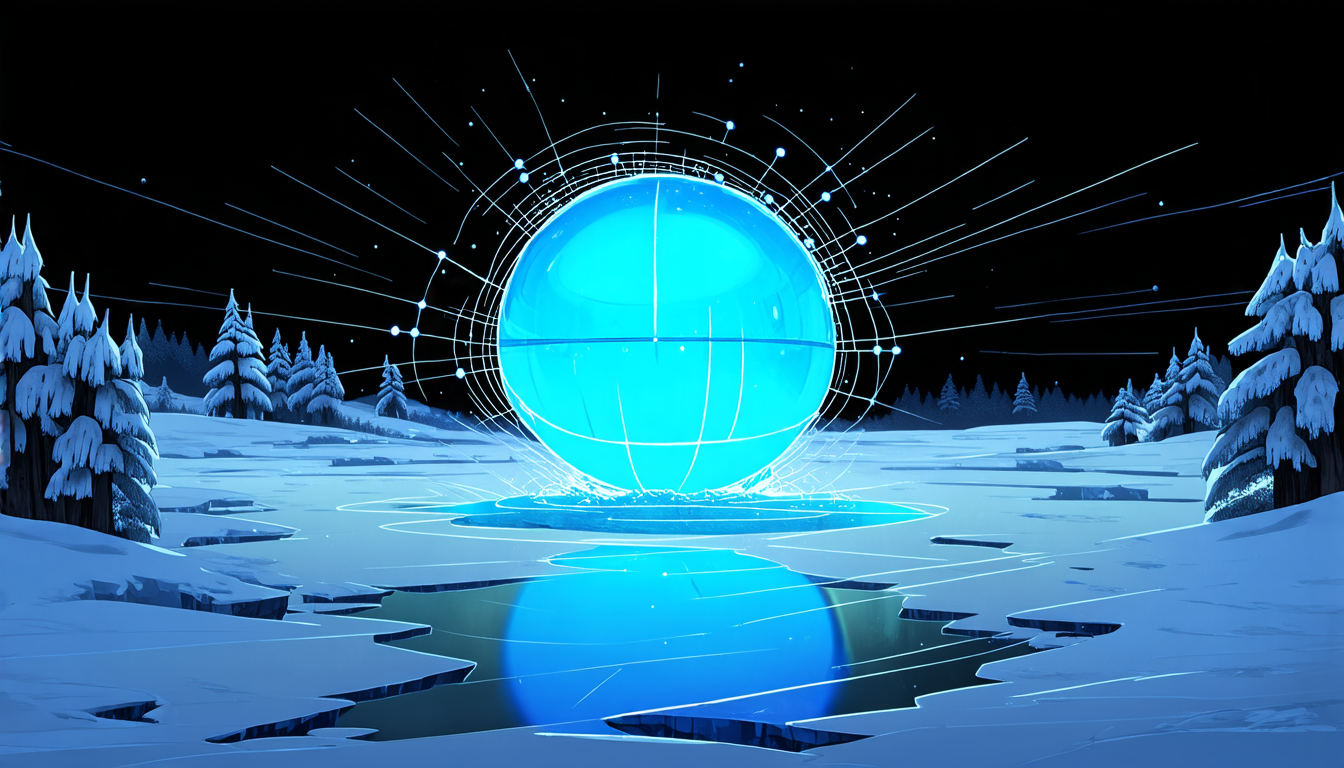
Scientists are one step closer to uncovering the secrets of dark matter, a mysterious substance that makes up about 27% of our universe but has yet to be directly observed. Researchers at the IceCube Neutrino Observatory in Antarctica have used data from high-energy neutrinos to search for signs of a new particle called the Z’ boson, which could help explain the behavior of dark matter.
The Z’ boson is a hypothetical particle that would interact with ordinary matter and dark matter in a way that could be detected by IceCube’s massive array of sensors. By analyzing the patterns of high-energy neutrinos passing through the ice, scientists can look for signs of interactions with this new particle. The results suggest that if the Z’ boson exists, it could have a mass of around 10-20 MeV, which is relatively light compared to other known particles.
The search for dark matter is an ongoing quest in physics, as its existence was first proposed by Swiss astrophysicist Fritz Zwicky in the 1930s. Since then, numerous experiments and observations have confirmed that dark matter must exist, but its exact nature remains a mystery. The Z’ boson is one of several theories that could help explain its behavior.
IceCube’s unique location at the South Pole allows it to detect high-energy neutrinos from the cosmos, which are created when powerful astrophysical sources such as supernovae or black holes collide with normal matter. These neutrinos then travel through the Earth and into the ice, where they can be detected by IceCube’s sensors.
The researchers used data from 12 years of observations to look for signs of interactions between high-energy neutrinos and the Z’ boson. They found that if the particle exists, it would likely have a mass in the range of 10-20 MeV, which is consistent with other theoretical predictions.
While this discovery doesn’t directly reveal the nature of dark matter, it could help scientists narrow down the possibilities. The search for dark matter continues to be an active area of research, with numerous experiments and observatories around the world working to uncover its secrets.
One of the most promising areas of investigation is the IceCube-Gen2 project, which will upgrade the current detector and allow it to detect even more high-energy neutrinos from space. This could potentially lead to further discoveries about dark matter and the Z’ boson.
Cite this article: “Scientists Edge Closer to Unraveling Dark Matter Mystery with Hypothetical Z Boson Discovery”, The Science Archive, 2025.
Dark Matter, Neutrinos, Icecube, Antarctica, Z’ Boson, Particle Physics, High-Energy, Astronomy, Astrophysics, Cosmology.





