

Sunday 30 March 2025
Scientists have made a significant breakthrough in developing a new approach to navigation for robots that can operate in uncertain environments. The new method, called BLISS- TAMP, allows these robots to safely and efficiently explore complex spaces by combining proprioceptive (body-aware) movement with exteroceptive (sensing the environment) scans.
Traditionally, roboticists have relied on decoupled approaches to navigation, where planning and execution are handled separately. This can lead to suboptimal performance, as the robot may prioritize one task over another. In contrast, BLISS-TAMP integrates task and motion planning to create a more holistic approach.
The researchers behind this innovation have developed a mathematical framework that allows them to optimize not only the path taken by the robot but also when it should stop and scan its surroundings. This is achieved through a chance-constrained mixed-integer linear program (MILP) formulation, which takes into account the uncertainty of the environment and the limitations of the robot’s sensors.
In simulations, the team tested BLISS-TAMP on various scenarios, including navigating through narrow passages and avoiding obstacles in uncertain terrain. The results showed that their approach outperformed traditional methods in terms of both planning efficiency and execution time.
One of the key advantages of BLISS-TAMP is its ability to adapt to changing circumstances. As the robot moves through the environment, it continuously updates its plan based on new information gathered from its sensors. This allows it to adjust its route in real-time to avoid potential hazards or take advantage of new opportunities.
The researchers also experimented with varying levels of risk tolerance to see how this affected the robot’s behavior. They found that by adjusting the level of risk, they could trade off between safety and efficiency. For example, a higher risk tolerance allowed the robot to take more risks and explore faster, but it also increased the likelihood of collisions.
The potential applications of BLISS-TAMP are vast, from search and rescue missions in disaster zones to exploring hostile environments like space or Mars. By developing robots that can operate safely and efficiently in uncertain conditions, scientists hope to unlock new possibilities for exploration and discovery.
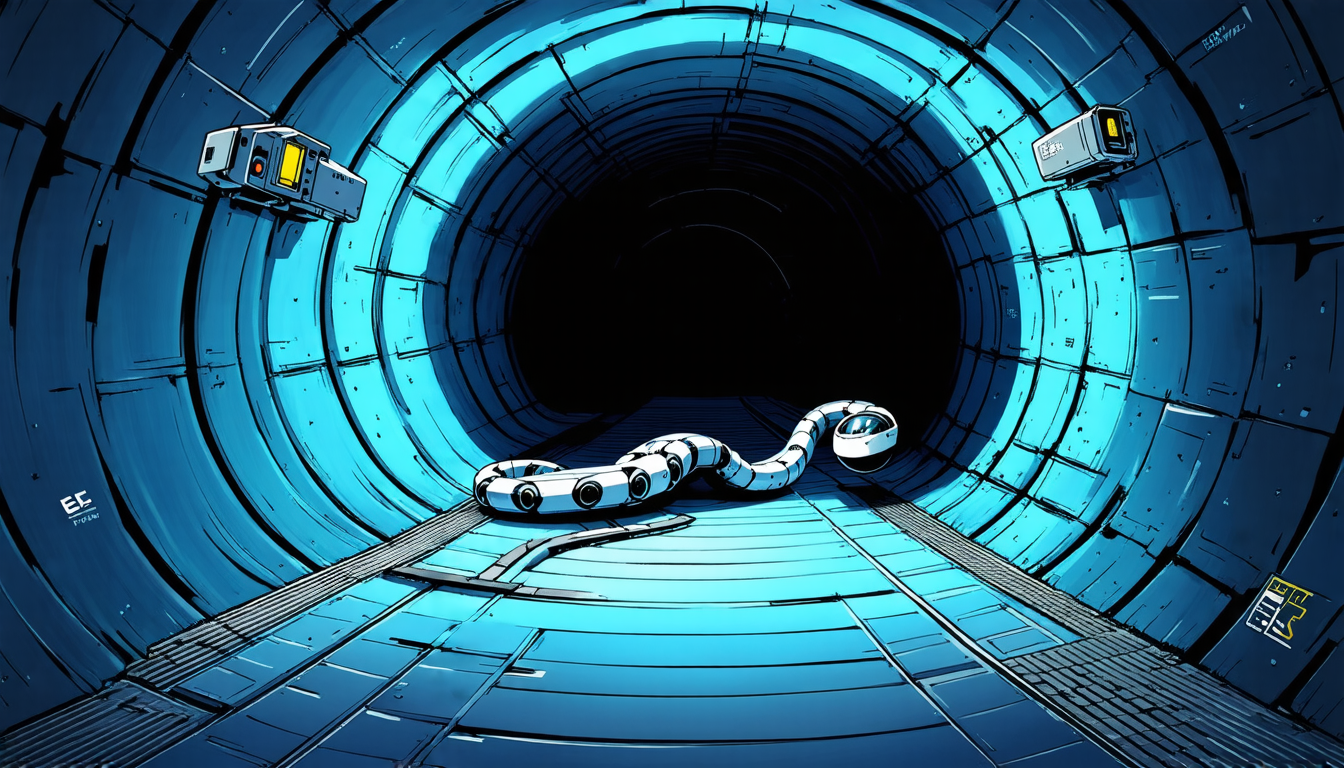
In practice, BLISS-TAMP has already been integrated into a snake-like robot called EELS, which is designed to navigate through tight spaces and explore extreme environments. The results of these experiments have been promising, with the robot successfully navigating complex terrain while avoiding obstacles and taking regular scans to gather information about its surroundings.
Cite this article: “BLISS-TAMP: A Holistic Approach to Robot Navigation in Uncertain Environments”, The Science Archive, 2025.
Here Are The Keywords: Robotics, Navigation, Uncertain Environments, Proprioceptive Movement, Exteroceptive Scans, Task Planning, Motion Planning, Chance-Constrained Milp, Robot Sensors, Risk Tolerance





