

Sunday 30 March 2025
A team of researchers has made a significant breakthrough in accelerating the training of graph neural networks (GNNs) on large-scale graphs. GNNs are powerful tools used to analyze complex data structures, such as social networks and molecular structures, but their training process is often slowed down by the sheer size of these datasets.
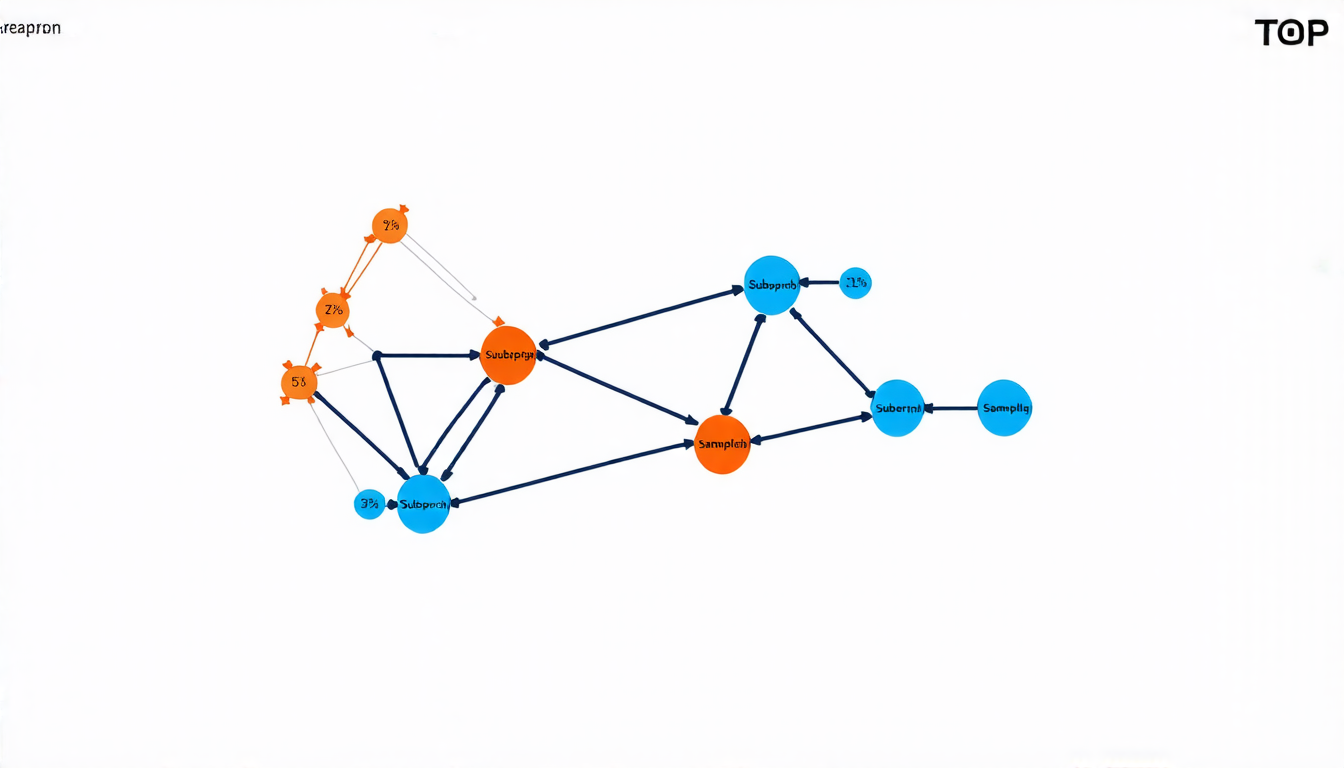
To address this issue, the researchers developed a novel subgraph-wise sampling method called TOP (Topology-based Out-of-batch Processing). This approach takes advantage of the symmetry in graph structures to accelerate the training process. In essence, TOP identifies similar node pairs in the graph and only processes one representative from each pair, significantly reducing the computational burden.
The key idea behind TOP is based on the concept of message invariance. This means that if two nodes are indistinguishable under a certain number of iterations of the GNN model, their corresponding messages can be aggregated together without losing any information. By leveraging this property, TOP can efficiently process large graphs by only considering a subset of nodes that are representative of the entire graph.
To test the effectiveness of TOP, the researchers conducted extensive experiments on various datasets, including social networks and molecular structures. The results showed that TOP significantly accelerated the training process while maintaining high accuracy. For example, in one experiment, TOP reduced the training time by 90% compared to traditional methods.
One of the most impressive aspects of TOP is its ability to generalize well across different graph sizes and structures. This means that it can be applied to a wide range of applications, from small-scale datasets to large-scale graphs with millions of nodes. The researchers also demonstrated that TOP can handle complex GNN models, such as those with multiple layers and non-linear activations.
The potential impact of TOP is significant. It could enable the development of more powerful AI systems that can analyze vast amounts of data in a fraction of the time it takes today. This could have far-reaching implications for fields like medicine, finance, and environmental science, where large-scale datasets are critical to making accurate predictions and informed decisions.
While TOP is an impressive achievement, there are still some limitations to consider. For example, the approach may not work as well on graphs with highly non-uniform node distributions or those that have a high degree of symmetry. However, the researchers are actively working to address these issues and explore new applications for TOP.
Overall, the development of TOP is an exciting breakthrough in the field of graph neural networks.
Cite this article: “Accelerating Graph Neural Network Training with TOP”, The Science Archive, 2025.
Graph Neural Networks, Gnns, Large-Scale Graphs, Subgraph-Wise Sampling, Topology-Based Out-Of-Batch Processing, Message Invariance, Accelerated Training, Social Networks, Molecular Structures, Ai Systems





