

Sunday 30 March 2025
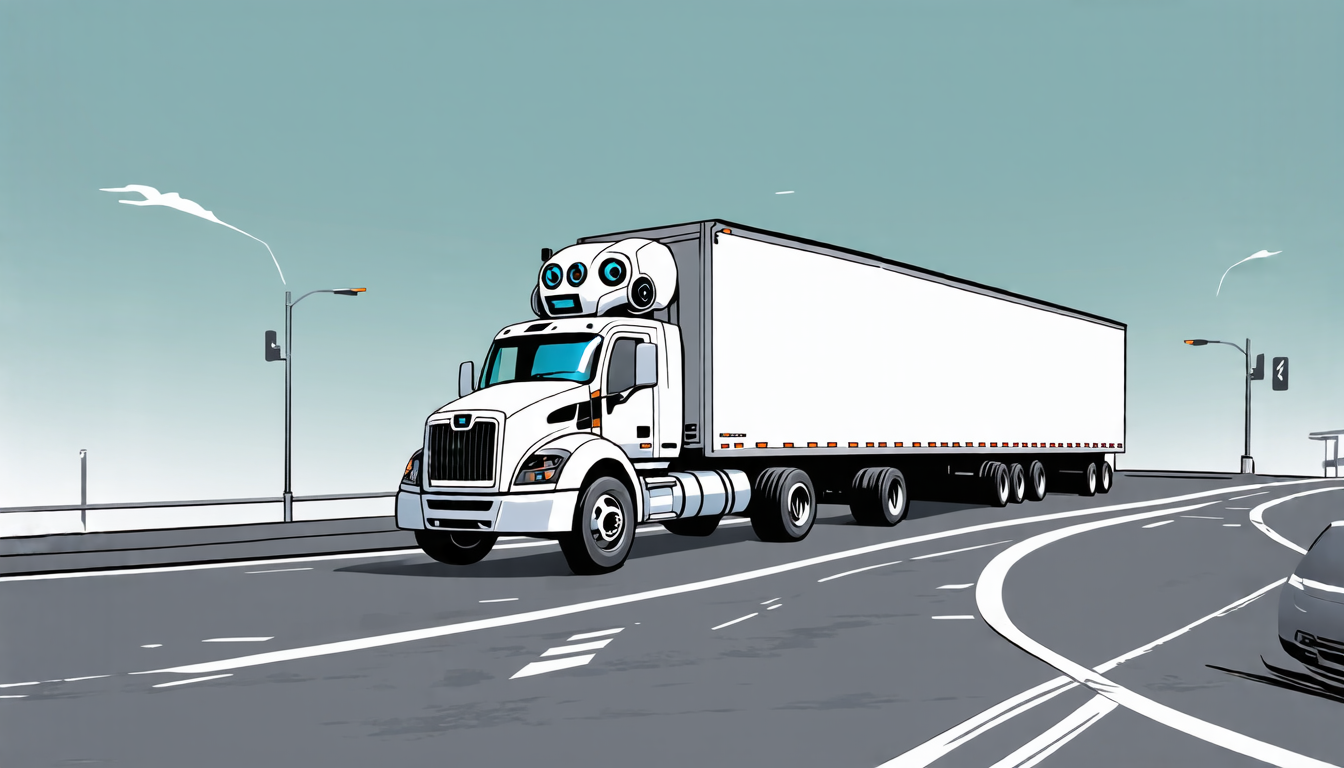
Autonomous vehicles have been making headlines in recent years, but one type of self-driving tech has flown under the radar: tractor-trailer robots. These behemoths are designed to navigate complex environments and transport heavy loads with ease, but they require sophisticated planning algorithms to ensure safe and efficient operation.
A team of researchers has developed a new trajectory planner that tackles this challenge head-on. Their approach uses a lightweight and compact representation of trajectories, which allows for faster computation times and more precise control over the robot’s movements.
The key innovation is a novel way of handling deformable structures, such as trailers or cargo containers. Traditional planning algorithms often struggle with these types of objects because they can’t accurately predict how they’ll move or interact with their surroundings. The new planner uses a combination of machine learning and physics-based modeling to simulate the behavior of these structures and generate optimal trajectories.
The benefits are twofold. First, the planner can handle complex environments with ease, such as narrow tunnels or crowded city streets. Second, it can optimize trajectory planning for tractor-trailer robots that carry heavy loads, which is critical for applications like logistics and transportation.
To test their approach, the researchers simulated various scenarios using a software framework called CasADi. They compared the results to traditional planners and found significant improvements in terms of computational efficiency and trajectory quality.
The implications are far-reaching. Autonomous tractor-trailer robots could revolutionize industries like manufacturing, construction, and emergency response, where heavy loads need to be transported quickly and safely. The technology also has potential applications in environmental monitoring, search and rescue, and even space exploration.
Of course, there’s still much work to be done before these robots hit the streets. But with advancements like this, we’re one step closer to making autonomous transportation a reality.
Cite this article: “Robot Tractors Get Smarter: Advances in Trajectory Planning Enable Autonomous Heavy-Lifting”, The Science Archive, 2025.
Autonomous Vehicles, Tractor-Trailer Robots, Trajectory Planner, Machine Learning, Physics-Based Modeling, Deformable Structures, Logistics, Transportation, Computational Efficiency, Trajectory Quality





