

Sunday 30 March 2025
The quest for efficient large model fine-tuning has reached a new milestone. Researchers have developed a novel framework that enables collaborative training of transformer-based models on edge devices, achieving significant reductions in computational costs and memory usage.
The challenge of fine-tuning large language models is well-known: they require vast amounts of computation and data to achieve good performance. However, this makes them impractical for deployment on resource-constrained devices such as smartphones or IoT devices. To address this issue, researchers have turned to federated learning, a technique that enables multiple devices to jointly train a model without sharing their local data.
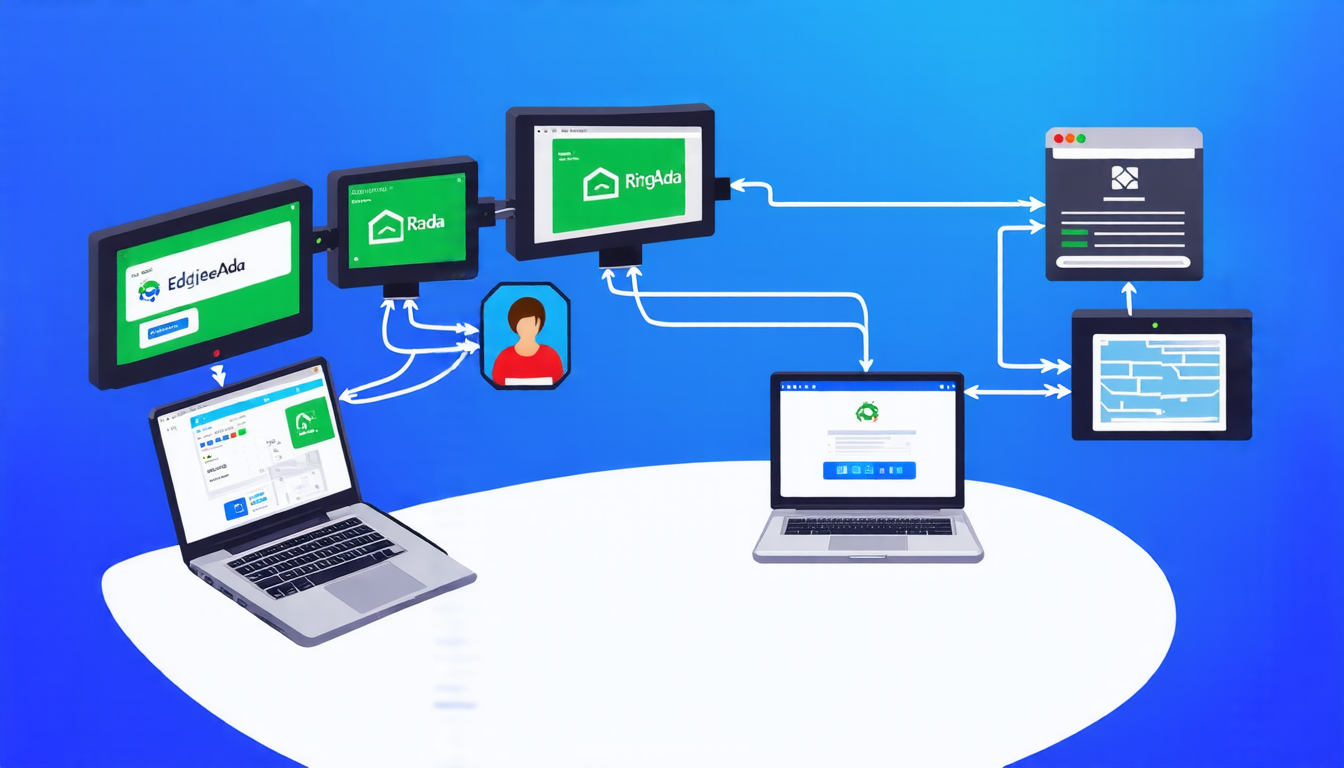
The new framework, dubbed RingAda, takes a unique approach by incorporating adapter-based fine-tuning into the pipeline parallel training process. This allows each device to focus on updating specific layers of the model, reducing the computational overhead and memory requirements. The authors achieve this by scheduling layer unfreezing, which enables early stopping of backward propagation at the lowest adapter layer.
RingAda is designed specifically for edge devices, taking into account their limited resources and processing capabilities. By leveraging the ring topology, where devices communicate with each other in a circular fashion, RingAda enables fast and efficient training. Each device performs forward and backward passes on its local data, and then sends the results to its neighbors, who repeat the process.
The authors evaluate RingAda using a pre-trained transformer model and a question-answering task on the SQuAD dataset. The results show that RingAda significantly outperforms traditional fine-tuning methods in terms of computational efficiency and memory usage. For example, RingAda reduces the number of epochs required to converge by 40% compared to single-device training.
RingAda also demonstrates improved performance on edge devices, achieving a 20% reduction in convergence time compared to PipeAdapter, another popular federated learning framework. This is likely due to the adaptive nature of RingAda, which adjusts its training strategy based on the available resources and processing capabilities of each device.
The implications of RingAda are significant. As AI models continue to grow in size and complexity, they will require increasingly powerful hardware to train efficiently. RingAda offers a solution that can be deployed on edge devices, enabling real-time AI applications on resource-constrained platforms. This could have far-reaching consequences for industries such as healthcare, finance, and transportation, where edge AI is becoming increasingly important.
In the future, researchers may explore further optimizations of the RingAda framework to achieve even greater efficiency gains.
Cite this article: “RingAda: A Novel Framework for Efficient Large Model Fine-Tuning on Edge Devices”, The Science Archive, 2025.
Transformer Models, Federated Learning, Edge Devices, Adapter-Based Fine-Tuning, Pipeline Parallel Training, Ring Topology, Squad Dataset, Question-Answering Task, Computational Efficiency, Memory Usage





