

Monday 31 March 2025
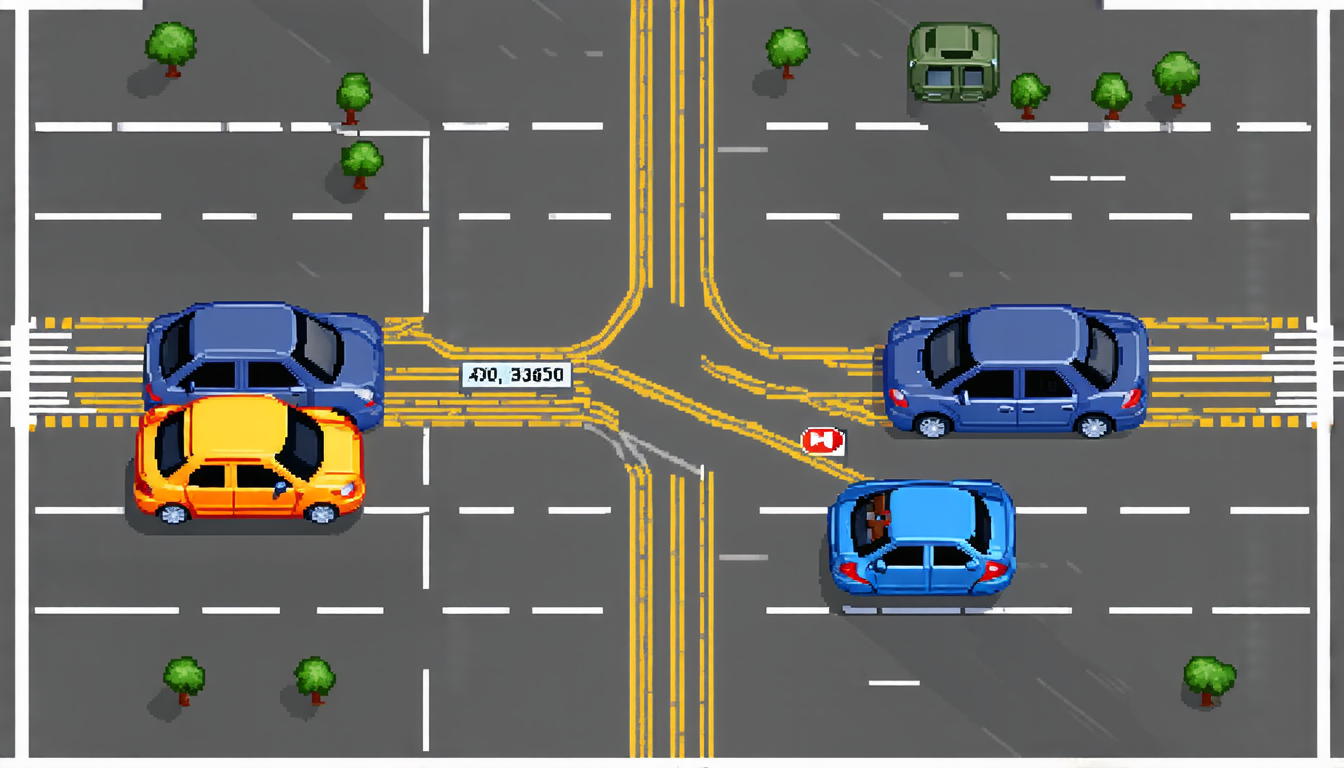
Artificial intelligence has made tremendous strides in recent years, but one of its biggest challenges is generating realistic and coherent data that meets specific constraints. For instance, when training AI models to generate traffic scenes, it’s crucial they produce accurate vehicle positions, distances between cars, and orientations without violating real-world rules like not having vehicles collide or drive off the road.
Researchers have tackled this problem by developing manual bridges, which are clever ways to condition AI models to respect specific constraints. The idea is to inject carefully designed noise into the model during training, ensuring it generates data that adheres to those constraints. This approach has shown promise in various domains, but its limitations become apparent when dealing with complex constraints like non-convex sets or irregular shapes.
Enter manually bridged diffusion models (MBM), a novel framework that leverages the power of manual bridges and diffusion-based generative models. The team behind MBM designed a system that combines the strengths of both approaches to produce AI models that can generate realistic data while respecting intricate constraints.
The key innovation lies in how MBM handles noise injection during training. Traditional methods often rely on simple scaling or linear transformations, but these can lead to suboptimal results when dealing with complex constraints. Instead, MBM introduces a novel bridge computation mechanism that takes into account the specific constraint set and data distribution. This allows the model to adapt to the constraint’s geometry and produce more realistic data.
To test the effectiveness of MBM, the researchers conducted experiments in two domains: traffic scene generation and image watermarking. In both cases, they compared MBM with traditional manual bridges and other state-of-the-art methods. The results were striking: MBM outperformed its competitors in terms of constraint satisfaction and generated more realistic data.
One of the most impressive demonstrations was in the traffic scene generation experiment. Standard diffusion models struggled to produce coherent scenes, often resulting in vehicles colliding or driving off the road. In contrast, MBM generated scenes that not only respected the constraints but also looked remarkably realistic. The team even released a set of samples showcasing the model’s capabilities, which are eerily convincing.
The implications of MBM are far-reaching. This technology has the potential to revolutionize various fields where data generation is crucial, such as computer-aided design, robotics, and autonomous vehicles. By enabling AI models to generate realistic data that meets specific constraints, researchers can accelerate progress in these areas and unlock new possibilities for innovation.
Cite this article: “Manual Bridges Meet Diffusion: A Novel Framework for Generating Realistic Data with Complex Constraints”, The Science Archive, 2025.
Artificial Intelligence, Manual Bridges, Diffusion Models, Generative Models, Noise Injection, Constraint Satisfaction, Traffic Scene Generation, Image Watermarking, Computer-Aided Design, Autonomous Vehicles





