

Monday 31 March 2025
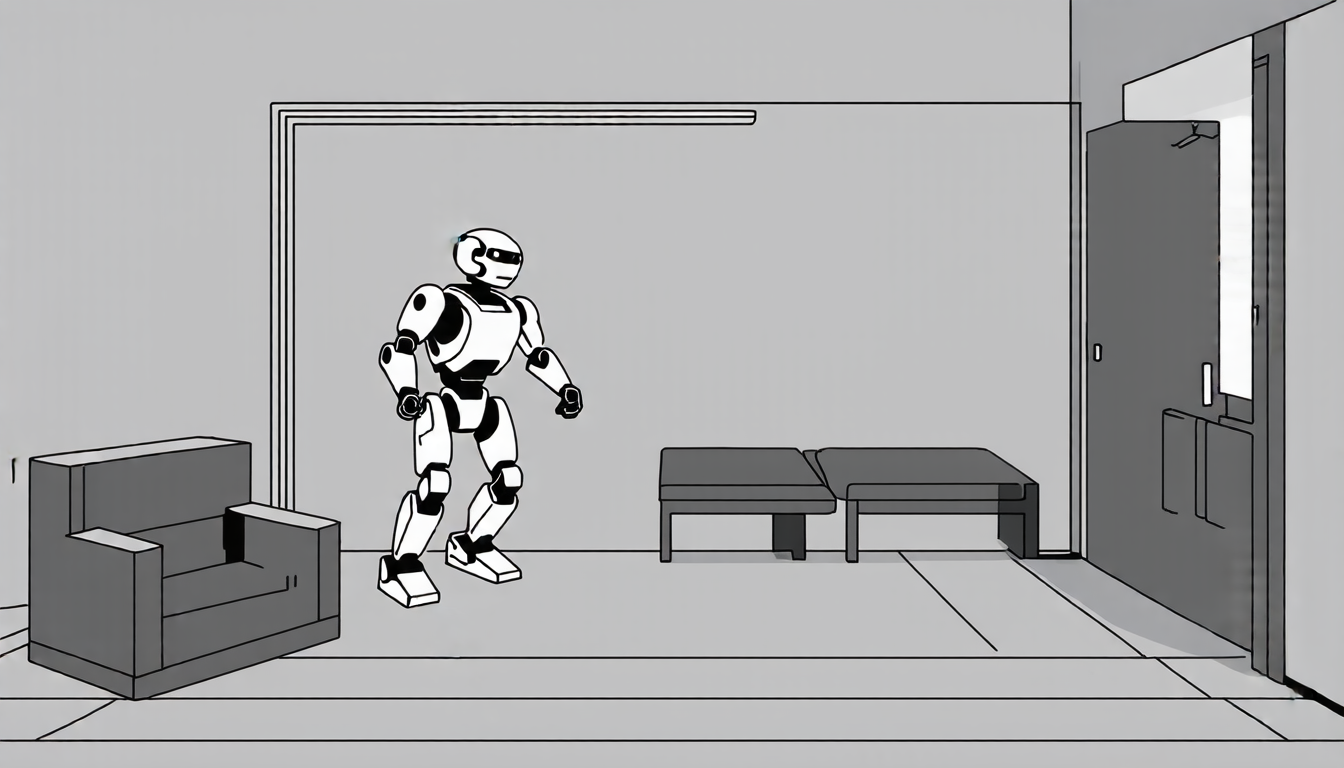
As robots and autonomous vehicles navigate increasingly complex environments, they’re relying on a crucial component: scene understanding. This involves recognizing objects, rooms, and entire spaces within the robot’s surroundings, allowing it to make informed decisions about where to move next.
But traditional approaches to scene understanding rely on labor-intensive manual labeling of datasets or limited domain-specific knowledge. A team of researchers has now proposed an innovative solution that leverages large language models to enable robots to learn from scratch in any environment.
The key innovation lies in the development of a hierarchical representation system, which allows robots to gradually build a mental map of their surroundings by combining information from various sensors and sources. This process is facilitated by a novel architecture that integrates visual and linguistic features, enabling the robot to recognize patterns and relationships between objects and spaces.
To test this approach, researchers trained a robotic platform on a dataset comprising images and natural language descriptions of indoor scenes. The results were impressive: the robot was able to accurately identify rooms, furniture, and even specific objects within those rooms, without any prior training or manual labeling.
The implications are significant. With this technology, robots could be deployed in various settings – from warehouses to homes – without requiring extensive customization or human oversight. They would be capable of adapting to new environments and tasks by learning from their own experiences, rather than relying on pre-programmed rules or limited domain expertise.
Moreover, the language-based approach allows for more intuitive and natural interaction between humans and robots. By using natural language commands and descriptions, users could instruct a robot to perform complex tasks or navigate unfamiliar spaces, without needing extensive technical knowledge or training.
While there are still challenges to overcome – such as handling ambiguities in language and visual cues – this research marks an important step towards creating more autonomous and adaptable robots. As robotics continues to evolve, the potential applications of this technology will only continue to expand, from search and rescue operations to healthcare and education.
Cite this article: “Robots Learn Scene Understanding with Language-Based Approach”, The Science Archive, 2025.
Robots, Autonomous Vehicles, Scene Understanding, Large Language Models, Hierarchical Representation System, Robotic Platform, Indoor Scenes, Natural Language Descriptions, Adaptation, Autonomy





