

Monday 31 March 2025
The quest for making massive language models, like those used in virtual assistants and chatbots, more accessible on mobile devices has taken a significant leap forward. A team of researchers has developed MobiLLM, a system that enables fine-tuning of these large language models on resource-constrained smartphones and tablets.
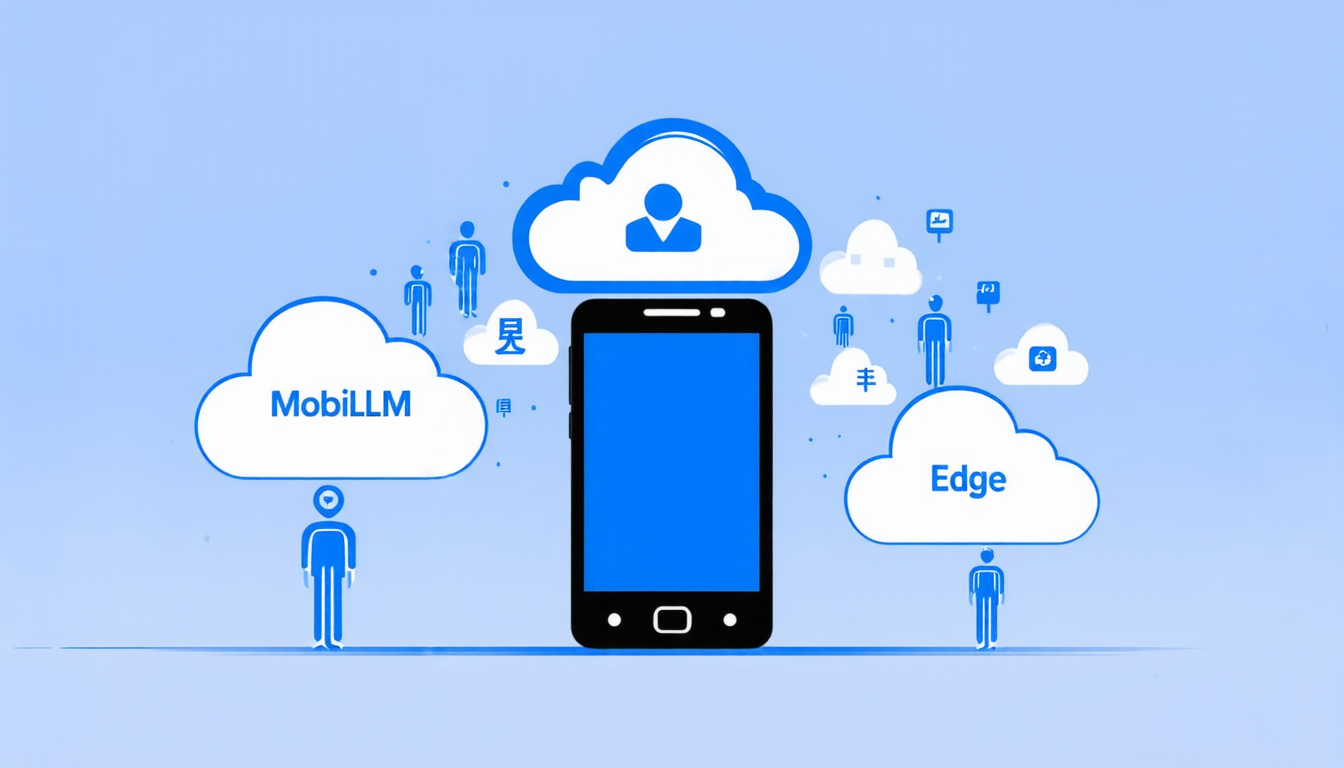
To put it simply, MobiLLM is a clever way to divide the workload between your phone and a powerful server in the cloud. The phone still does the important job of processing user input and generating responses, but the computationally intensive tasks are offloaded to the server. This approach not only saves battery life on your device but also enables you to fine-tune these massive models even when your phone’s resources are limited.
The system works by separating the large language model into two parts: a frozen backbone model that remains on the phone and a trainable side-network that is executed on the server. The phone still performs forward propagation, which means it generates responses based on the input you give it, but the server takes care of backpropagation, which is the time-consuming process of updating the model’s weights.
MobiLLM has several advantages over traditional fine-tuning methods. For one, it reduces the memory footprint of the language model, allowing it to run on devices with limited resources. It also speeds up the training process by offloading the computationally intensive tasks to a more powerful server. Additionally, MobiLLM preserves data privacy by keeping the user’s input and responses locally on their device.
The researchers tested MobiLLM on several large language models, including OPT-350M and OPT-1.3B, which are both widely used in natural language processing applications. They found that MobiLLM was able to achieve similar accuracy results as traditional fine-tuning methods while using significantly less memory and reducing the training time.
The potential impact of MobiLLM is significant. With this system, developers can create more personalized and accurate language models for mobile devices, which could lead to improved performance in virtual assistants, chatbots, and other applications that rely on natural language processing.
Furthermore, MobiLLM opens up new possibilities for edge computing, where computations are performed at the edge of the network, closer to the user. This approach can reduce latency and improve the overall user experience by minimizing the amount of data that needs to be transmitted over the internet.
Cite this article: “Mobile Language Models: A New Era in Fine-Tuning”, The Science Archive, 2025.
Language Models, Mobile Devices, Fine-Tuning, Resource-Constrained, Smartphones, Tablets, Cloud Computing, Edge Computing, Natural Language Processing, Virtual Assistants, Chatbots





