

Monday 31 March 2025
A novel approach to sampling complex distributions has been proposed by researchers, which could revolutionize the field of probability theory.
Traditionally, sampling from a complex distribution involves using algorithms that are either slow or inaccurate. Markov Chain Monte Carlo (MCMC) methods, for example, can take a long time to converge, while Variational Inference (VI) approaches often sacrifice accuracy for speed.
The new method, called Reward-ParVI, takes a different tack by incorporating reinforcement learning principles into the sampling process. By introducing a reward function that encourages particles to explore high-density regions of the target distribution, researchers have been able to achieve faster and more accurate sampling.
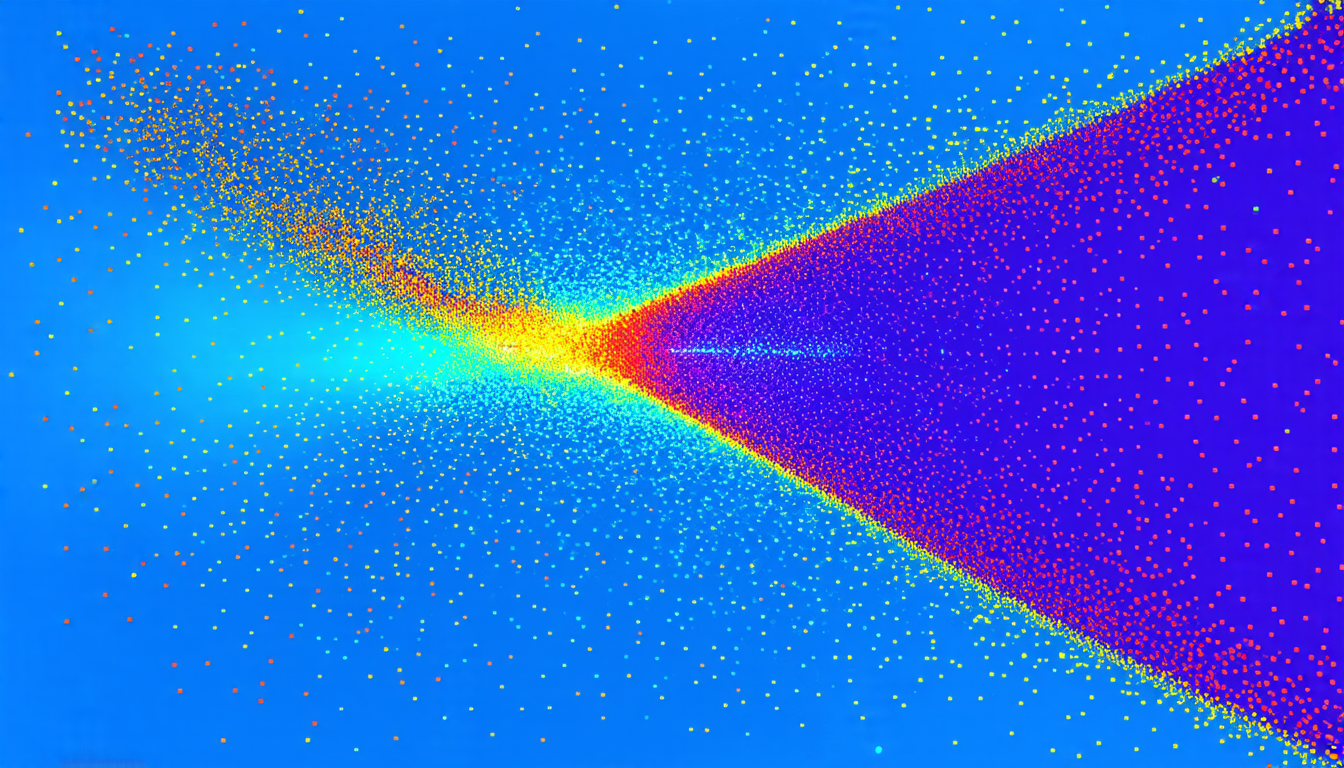
The approach relies on the concept of particle-based inference, where a set of particles is evolved over time to approximate the target distribution. The key innovation is the introduction of a reward mechanism that guides the movement of these particles towards areas of high probability density.
This reward function is designed to balance two competing goals: density-seeking, which involves moving towards regions with high probability density, and diversity-maintenance, which ensures that the particles do not collapse into clusters or get stuck in local minima. By carefully tuning the weights of these two components, researchers have been able to achieve a sweet spot where sampling is both efficient and accurate.
The method has been tested on a range of complex distributions, including those encountered in Bayesian inference and machine learning applications. The results are impressive: Reward-ParVI outperforms traditional MCMC methods in terms of speed and accuracy, while also providing a more flexible and scalable framework for sampling.
One of the key advantages of Reward-ParVI is its ability to handle high-dimensional data sets with ease. By avoiding the need for costly gradient calculations, the method can be applied to problems where other approaches would struggle to converge.
The implications of this research are far-reaching. By providing a more efficient and accurate way to sample complex distributions, researchers may be able to tackle previously intractable problems in fields such as medicine, finance, and climate science.
In addition, the development of Reward-ParVI highlights the growing importance of interdisciplinary approaches in modern science. By combining insights from probability theory, machine learning, and reinforcement learning, researchers are pushing the boundaries of what is possible in this field.
As researchers continue to refine and extend the method, it will be exciting to see how Reward-ParVI shapes the future of probability theory and its applications.
Cite this article: “Rewriting the Rules: A New Approach to Sampling Complex Distributions”, The Science Archive, 2025.
Probability Theory, Sampling Complex Distributions, Reinforcement Learning, Markov Chain Monte Carlo, Variational Inference, Particle-Based Inference, Reward Function, Bayesian Inference, Machine Learning, Interdisciplinary Research
Reference: Yongchao Huang, “R-ParVI: Particle-based variational inference through lens of rewards” (2025).





