

Monday 31 March 2025
Scientists have made a remarkable discovery about the interstellar medium, the material that fills the space between stars and planets. By studying the X-ray radiation scattered by dust grains in our galaxy, they’ve been able to create detailed maps of this medium’s structure.
The researchers focused on a particularly bright gamma-ray burst, known as GRB 221009A, which occurred near the galactic plane. This meant that the X-rays from the burst had to travel through a significant amount of dust before reaching Earth. By analyzing the scattered radiation, scientists were able to reconstruct the path it took and infer the density of the interstellar medium along the way.
One of the key findings is that the medium’s density varies significantly across different parts of the galaxy. The team discovered that there are regions with relatively low densities, where the dust grains are sparse and the X-rays can travel long distances without being scattered too much. These areas are thought to be located in the galactic halo, a vast, spherical region surrounding the central bulge of the Milky Way.
In contrast, other regions have much higher densities, where the dust grains are packed tightly together and scatter the X-rays more heavily. These areas are likely found near the galactic plane, where stars and star-forming regions are concentrated.
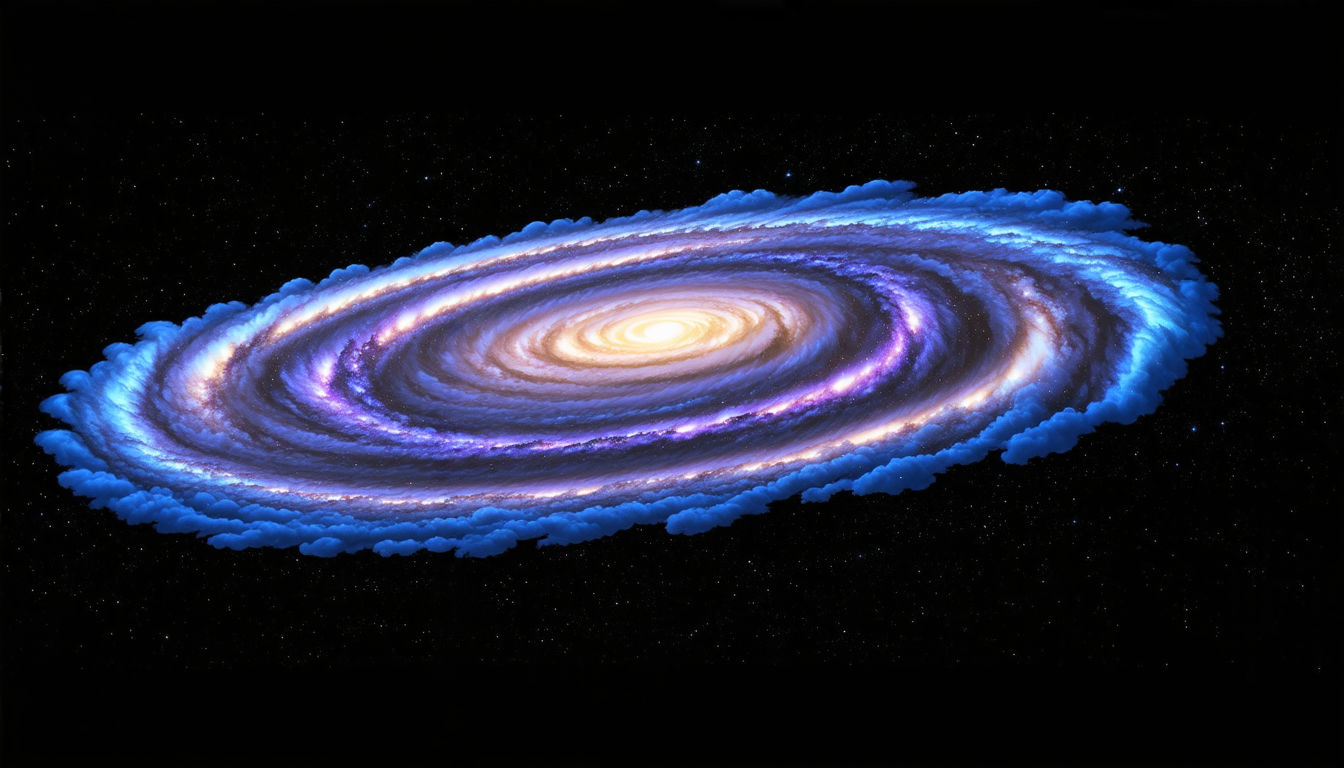
The maps created by the researchers provide a detailed picture of this density variation, with different colors representing different levels of interstellar medium density. The images show that the medium is not uniform, but rather has complex structures and patterns.
This research has important implications for our understanding of the galaxy’s evolution and structure. By studying the interstellar medium, scientists can learn more about how stars form and evolve, as well as how galaxies like ours have changed over billions of years.
The findings also highlight the potential benefits of using X-ray radiation to probe the interstellar medium. This technique allows researchers to study the dust and gas that fills the galaxy in ways that other methods cannot.
As scientists continue to explore our galaxy and others, these maps will serve as a valuable resource for understanding the complex structures and patterns of the interstellar medium. By combining observations with computer simulations, they’ll be able to refine their models and gain new insights into the workings of the universe.
Cite this article: “Unveiling the Complex Structure of the Interstellar Medium”, The Science Archive, 2025.
Interstellar Medium, Galaxy, X-Ray Radiation, Dust Grains, Gamma-Ray Burst, Galactic Plane, Galactic Halo, Star Formation, Galaxy Evolution, Density Variation





