

Monday 31 March 2025
Researchers have made a significant breakthrough in developing a new method for teaching robots how to perform complex tasks, such as moving objects or performing surgeries. The technique, called Motion ReTouch, allows robots to learn and adapt to new situations by modifying their behavior in real-time.
Traditionally, robots are programmed to follow precise instructions, but this approach can be limited when dealing with unexpected events or changing circumstances. Motion ReTouch addresses this issue by allowing the robot to modify its actions based on feedback from the environment.
The system uses a combination of three robots: a leader robot that performs the task, a follower robot that mimics the leader’s movements, and an editor robot that makes adjustments as needed. The leader robot is equipped with sensors that detect changes in the environment, and the follower robot adjusts its actions accordingly. The editor robot then reviews the follower’s performance and makes further adjustments to ensure that the task is completed successfully.
One of the key benefits of Motion ReTouch is its ability to adapt to changing circumstances. For example, if a robot is tasked with moving an object from one location to another, it can adjust its path if there are obstacles in the way or if the object’s size or shape changes unexpectedly.
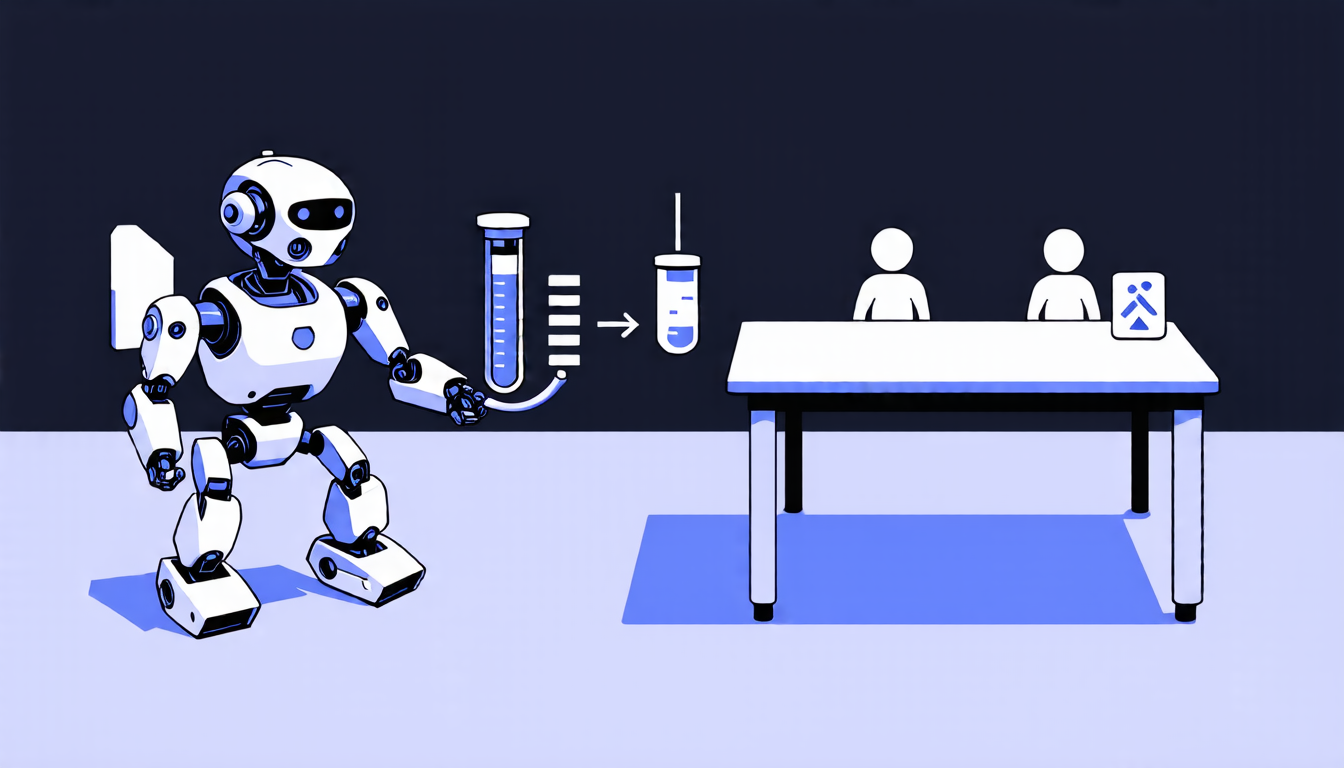
The researchers tested Motion ReTouch by having the robots perform a series of tasks, including moving test tubes and performing surgeries. The results showed that the system was able to successfully complete the tasks with high accuracy and adaptability.
This breakthrough has significant implications for the field of robotics and artificial intelligence. It could be used in a variety of applications, such as manufacturing, healthcare, and search and rescue missions. For example, robots equipped with Motion ReTouch could be used to perform complex surgeries or assemble products on an assembly line.
Overall, Motion ReTouch represents a major advancement in robot learning and adaptation. Its ability to adapt to changing circumstances makes it a powerful tool for a wide range of applications.
Cite this article: “Breakthrough in Robot Learning: Motion ReTouch Technology”, The Science Archive, 2025.
Robotics, Artificial Intelligence, Motion Retouch, Learning, Adaptation, Real-Time Feedback, Sensor Technology, Task Automation, Surgical Robotics, Industrial Automation.





