

Friday 04 April 2025
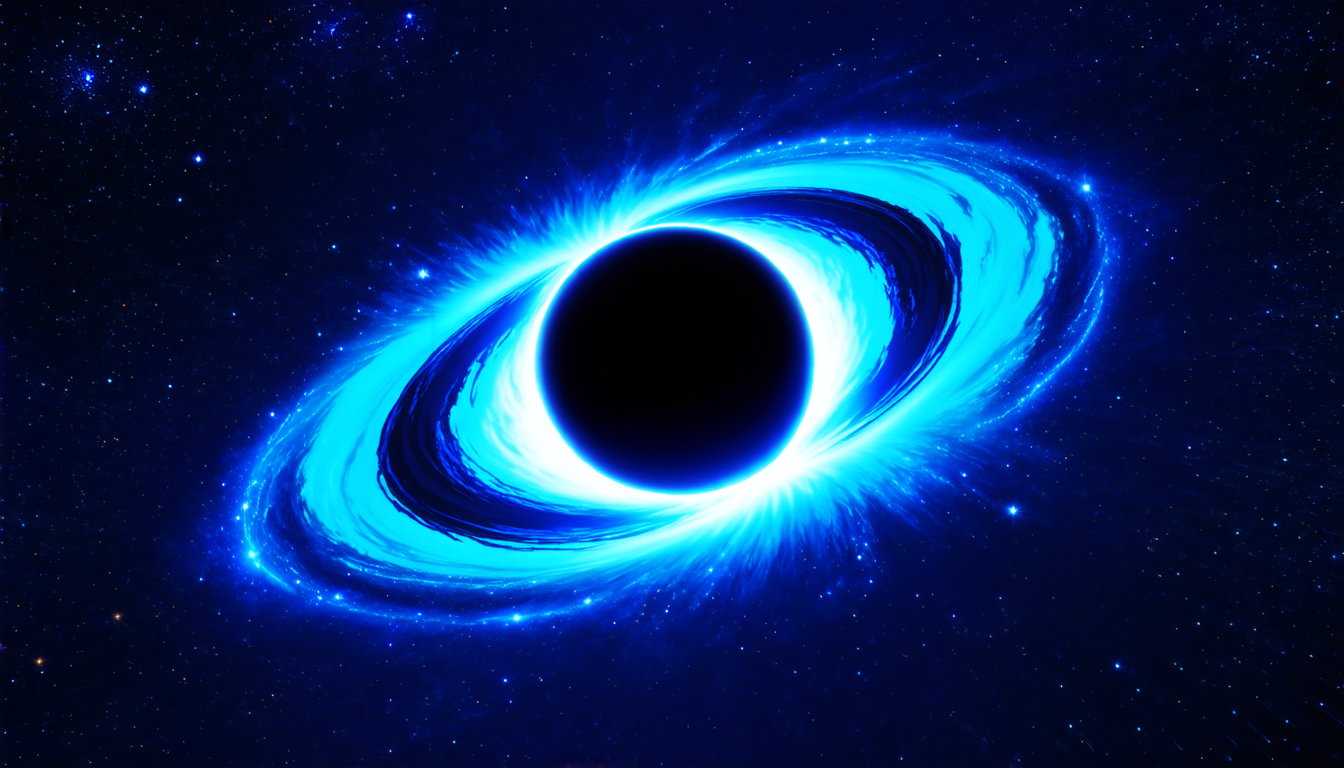
Scientists have long been fascinated by black holes, those mysterious regions of spacetime where gravity is so strong that nothing, not even light, can escape once it falls within a certain radius. For decades, researchers have studied these cosmic phenomena, trying to understand their properties and behavior. Recently, a team of scientists made a significant breakthrough in their understanding of black holes by discovering a new type of black hole that surrounds itself with a massive vector field.
In the past, scientists thought that all black holes were similar, with a simple structure consisting of a singularity at the center and an event horizon marking the point of no return. However, this new discovery challenges our previous understanding and reveals a more complex and fascinating landscape.
The researchers used advanced computer simulations to model the behavior of these new black holes. They found that the massive vector field surrounding the black hole plays a crucial role in shaping its properties and behavior. This field is responsible for the way matter and energy interact with the black hole, affecting the way it accretes material from its surroundings.
One of the most significant implications of this discovery is that it could help scientists better understand the nature of dark matter. Dark matter is a mysterious type of matter that makes up about 27% of the universe but has yet to be directly observed. Scientists believe that dark matter could be composed of particles that interact with normal matter through weak forces, such as electromagnetism or gravity.
The new black holes could provide a unique laboratory for studying these interactions, allowing scientists to test theories and models of dark matter. By observing how the massive vector field affects the behavior of the black hole and its surroundings, researchers may be able to gain insights into the nature of dark matter and its role in the universe.
Furthermore, this discovery could have significant implications for our understanding of spacetime itself. The massive vector field surrounding the black hole is thought to warp the fabric of spacetime, creating a region where gravity behaves differently than it does elsewhere in the universe. By studying these regions, scientists may be able to gain a deeper understanding of the fundamental laws of physics that govern our universe.
The discovery of these new black holes is an exciting development in the field of astrophysics, and it has the potential to revolutionize our understanding of the cosmos. As researchers continue to study these phenomena, they are likely to uncover even more surprising and fascinating properties, shedding light on some of the most fundamental mysteries of the universe.
Cite this article: “Unlocking the Secrets of Black Holes: New Insights into Kaluza-Klein Gravity”, The Science Archive, 2025.
Black Holes, Vector Field, Dark Matter, Spacetime, Gravity, Simulation, Astrophysics, Event Horizon, Singularity, Cosmology





