

Saturday 05 April 2025
Mathematicians have long been fascinated by a peculiar property of numbers: their ability to be divided into prime factors. These fundamental building blocks of arithmetic have captivated mathematicians for centuries, and yet, despite significant progress, many questions about them remain unanswered.
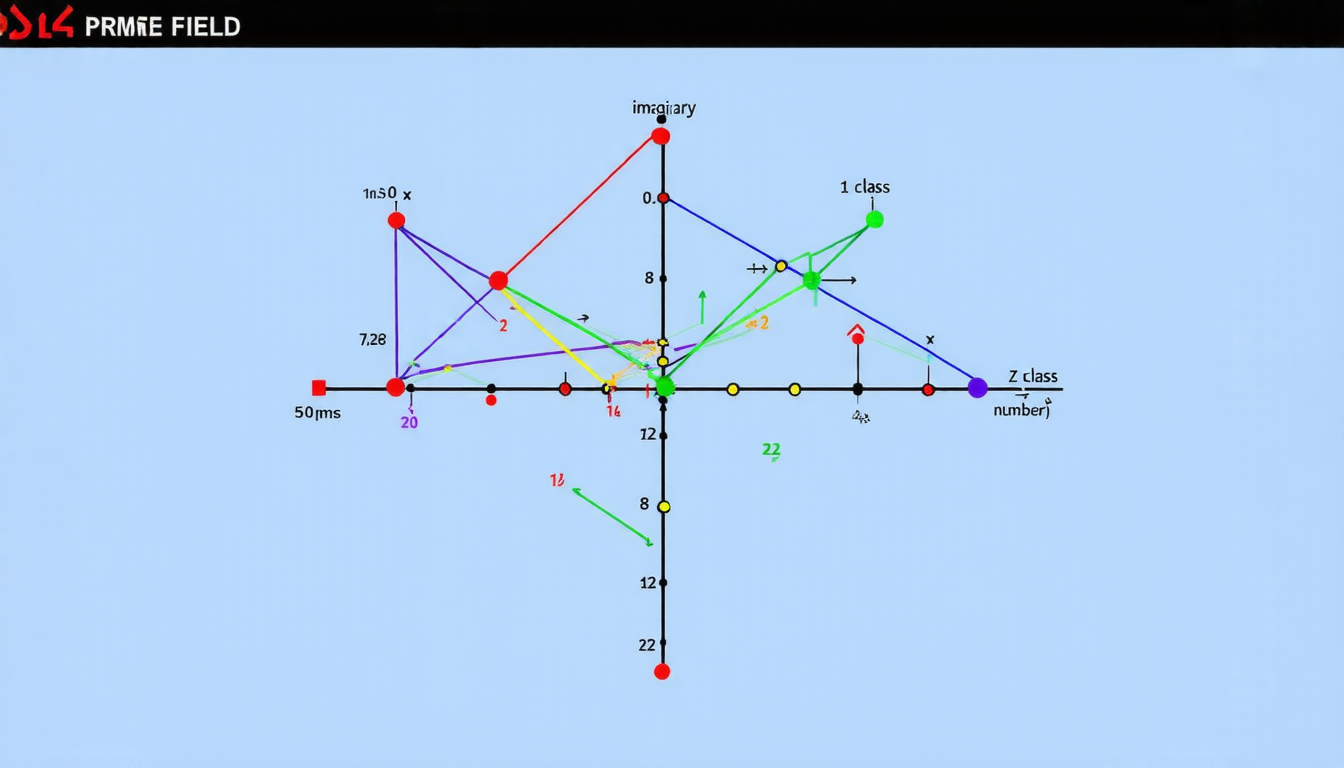
One such question is the distribution of class numbers, which measure how many ways there are to divide an imaginary quadratic number field (think complex numbers with square roots of negative integers) into prime factors. Researchers have long suspected that these class numbers follow a predictable pattern, but proving it has been a notoriously difficult task.
Recently, a team of mathematicians made significant headway in cracking this problem. By studying the behavior of certain polynomials, they were able to establish a connection between the distribution of class numbers and the density of square-free values of those polynomials. This breakthrough allowed them to prove that the class numbers of imaginary quadratic number fields follow a predictable pattern, at least for large enough fields.
To understand what this means, let’s dive into the world of imaginary quadratic number fields. These are complex number systems where every element is a combination of real and imaginary parts (think 2 + 3i). The class number of such a field measures how many ways there are to divide it into prime factors, much like how you might divide a number into smaller prime numbers.
The problem is that these class numbers can be quite large, making them difficult to study. Mathematicians have long suspected that they follow a predictable pattern, but proving it has been a challenge. The new research provides evidence that this pattern exists, and in doing so, sheds light on the fundamental properties of prime numbers themselves.
One key insight from the paper is the connection between class numbers and square-free values of polynomials. Square-free values are those where each prime factor appears only once (think 2 × 3 versus 4). By studying these values, researchers were able to establish a relationship with the distribution of class numbers.
This breakthrough has significant implications for our understanding of prime numbers and their role in arithmetic. Prime numbers have long been considered fundamental building blocks of mathematics, and yet, despite significant progress, many questions about them remain unanswered. This research provides new tools and insights that will help mathematicians tackle some of these remaining questions.
In the world of imaginary quadratic number fields, this breakthrough has opened up new avenues for exploration. By better understanding how these class numbers behave, researchers can gain a deeper appreciation for the underlying structure of prime numbers themselves.
Cite this article: “Unlocking the Secrets of Imaginary Numbers: A New Frontier in Algebraic Geometry”, The Science Archive, 2025.
Prime Numbers, Imaginary Quadratic Number Fields, Class Numbers, Distribution, Polynomials, Square-Free Values, Arithmetic, Mathematics, Prime Factors, Algebraic Geometry





