

Saturday 05 April 2025
Scientists have long been fascinated by the intricate dance of life and death in populations, where individuals interact with each other and their environment in complex ways. A recent study has shed new light on this phenomenon, revealing a hidden pattern that governs the behavior of populations over time.
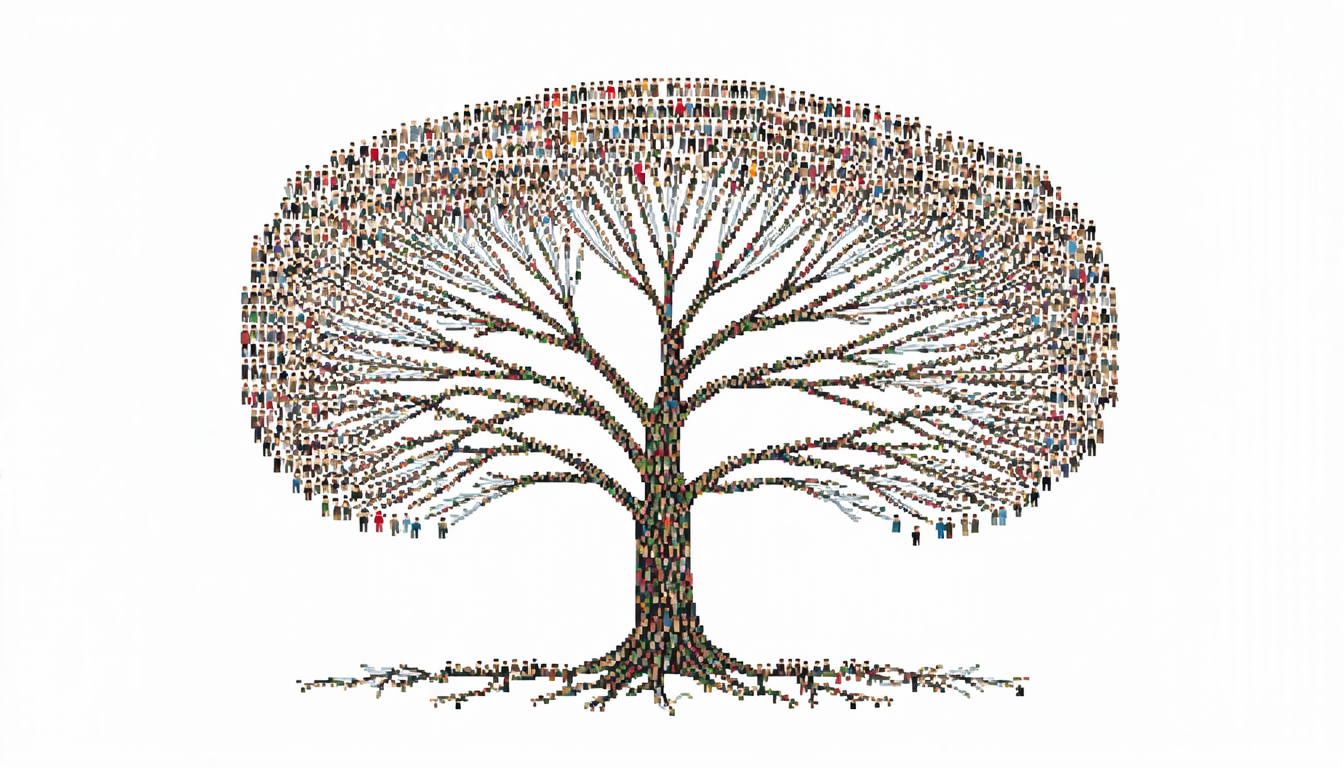
The research focuses on a type of population known as branching processes, where individuals reproduce and die off in a random manner. This can be seen in everything from bacteria colonies to human societies. The scientists used advanced mathematical techniques to analyze these processes and discovered a surprising connection between the way populations grow and the ancestry of individual members.
In essence, they found that when you look at the history of an individual’s ancestors, you can predict how the population as a whole will behave in the future. This is because the way individuals interact with each other and their environment influences the trajectory of the population over time.
The researchers used computer simulations to model different scenarios, where populations grew or shrunk depending on various factors such as environmental conditions, competition for resources, and genetic mutations. They then analyzed the ancestry of individual members in these populations, tracing back their lineage to uncover patterns and trends.
What they found was astonishing – certain patterns emerged that allowed them to predict how the population would behave in the future. For example, if a population is growing rapidly, the researchers could use this information to identify the types of individuals that are driving this growth, and therefore anticipate how the population will continue to evolve.
This discovery has significant implications for our understanding of complex systems, from ecology to economics. It suggests that by analyzing the ancestry of individual members in a population, we can gain valuable insights into the dynamics of the system as a whole.
The study also opens up new avenues for research in fields such as epidemiology and conservation biology. For instance, scientists could use this method to track the spread of diseases or predict the impact of environmental changes on populations over time.
In essence, this research has uncovered a hidden pattern that underlies the behavior of complex systems, allowing us to better understand and predict how they will evolve in the future.
Cite this article: “Unlocking the Secrets of Population Dynamics: A New Framework for Modeling and Sampling in Complex Systems”, The Science Archive, 2025.
Branching Processes, Population Dynamics, Ancestry Tracing, Computer Simulations, Environmental Conditions, Competition For Resources, Genetic Mutations, Predictive Modeling, Epidemiology, Conservation Biology.





