

Saturday 05 April 2025
FPGAs have long been a staple of high-performance computing, but their potential for scalability has been limited by their reliance on traditional host-FPGA connectivity. However, researchers have now developed an Ethernet-based framework that allows FPGAs to be hot-plugged into a network in a stand-alone fashion, enabling flexible scaling and simultaneous reconfiguration of multiple devices.
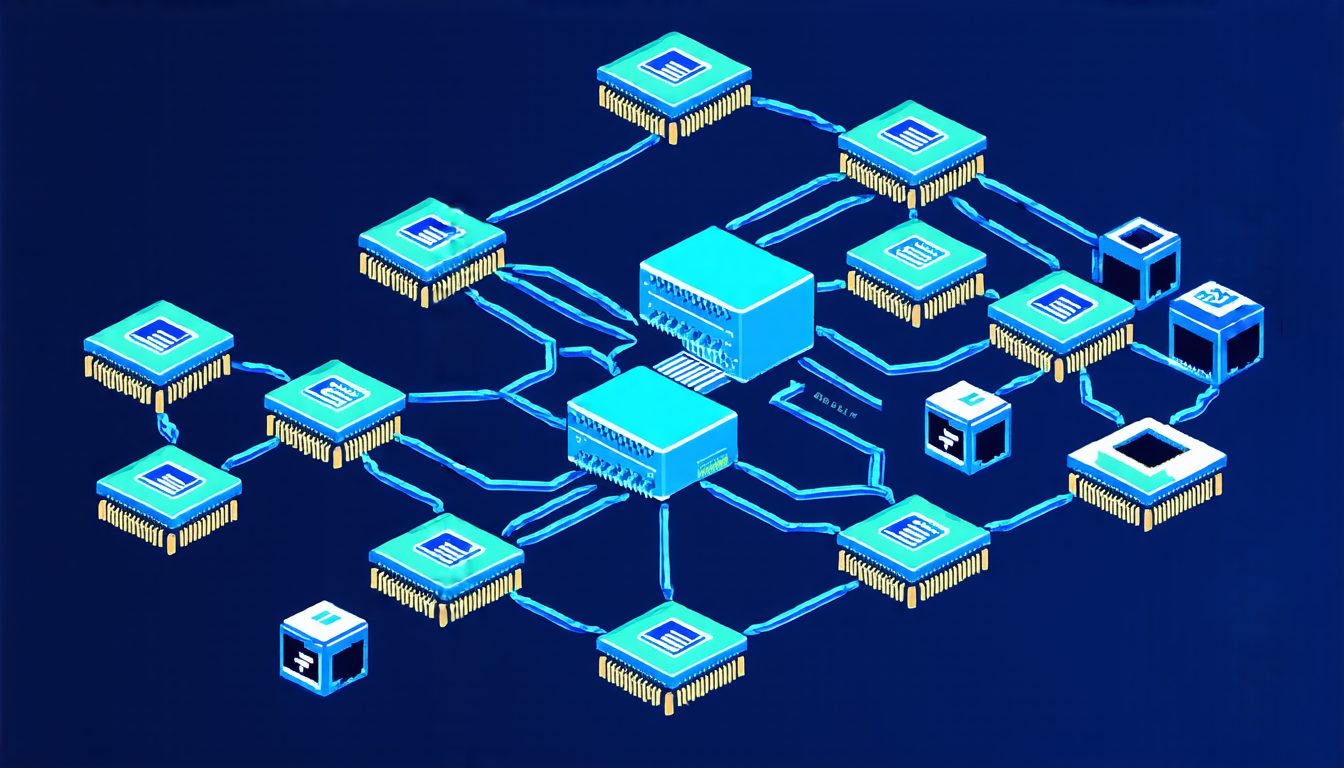
The new framework, known as SAF (Scalable Acceleration Framework), uses a custom FPGA shell and a set of Ethernet protocols to enable communication between FPGAs and remote hosts. This allows for the dynamic addition or removal of FPGAs from the network, without requiring manual intervention or downtime.
One of the key benefits of SAF is its ability to reduce reconfiguration time. Traditional host-FPGA connectivity requires each host to individually configure each FPGA, which can be a time-consuming process. With SAF, however, multiple FPGAs can be configured simultaneously, reducing reconfiguration time by up to 13 times compared to traditional methods.
SAF also offers significant advantages in terms of scalability and flexibility. By allowing FPGAs to be hot-plugged into the network, SAF enables users to add or remove devices as needed, without requiring extensive reconfiguration of the entire system. This makes it ideal for applications where resources need to be dynamically allocated or reallocated.
The framework has been tested on a range of benchmarks, including the PTRANS benchmark from the HPCC FPGA benchmark suite. Results show that SAF is able to provide almost linear performance scaling, with minimal overhead and energy consumption.
In addition to its technical benefits, SAF also offers significant cost savings. Traditional multi-FPGA clusters require multiple hosts and interconnects, which can be expensive and complex to implement. SAF, on the other hand, uses a single Ethernet network to connect FPGAs, reducing infrastructure costs and simplifying system deployment.
The implications of SAF are far-reaching, with potential applications in high-performance computing, datacentre acceleration, and edge computing. As the demand for fast and efficient processing continues to grow, SAF could play an important role in enabling the development of next-generation computing systems.
In a world where speed and efficiency are increasingly critical, SAF offers a powerful new tool for researchers and developers looking to unlock the full potential of FPGAs. By providing a scalable and flexible framework for FPGA acceleration, SAF is poised to revolutionize the way we approach high-performance computing.
Cite this article: “FPGA-Based Scalable Acceleration Framework for Edge Computing”, The Science Archive, 2025.
Fpgas, Scalability, Ethernet, High-Performance Computing, Datacentre Acceleration, Edge Computing, Reconfiguration Time, Hot-Plugging, Framework, Acceleration





