

Saturday 05 April 2025
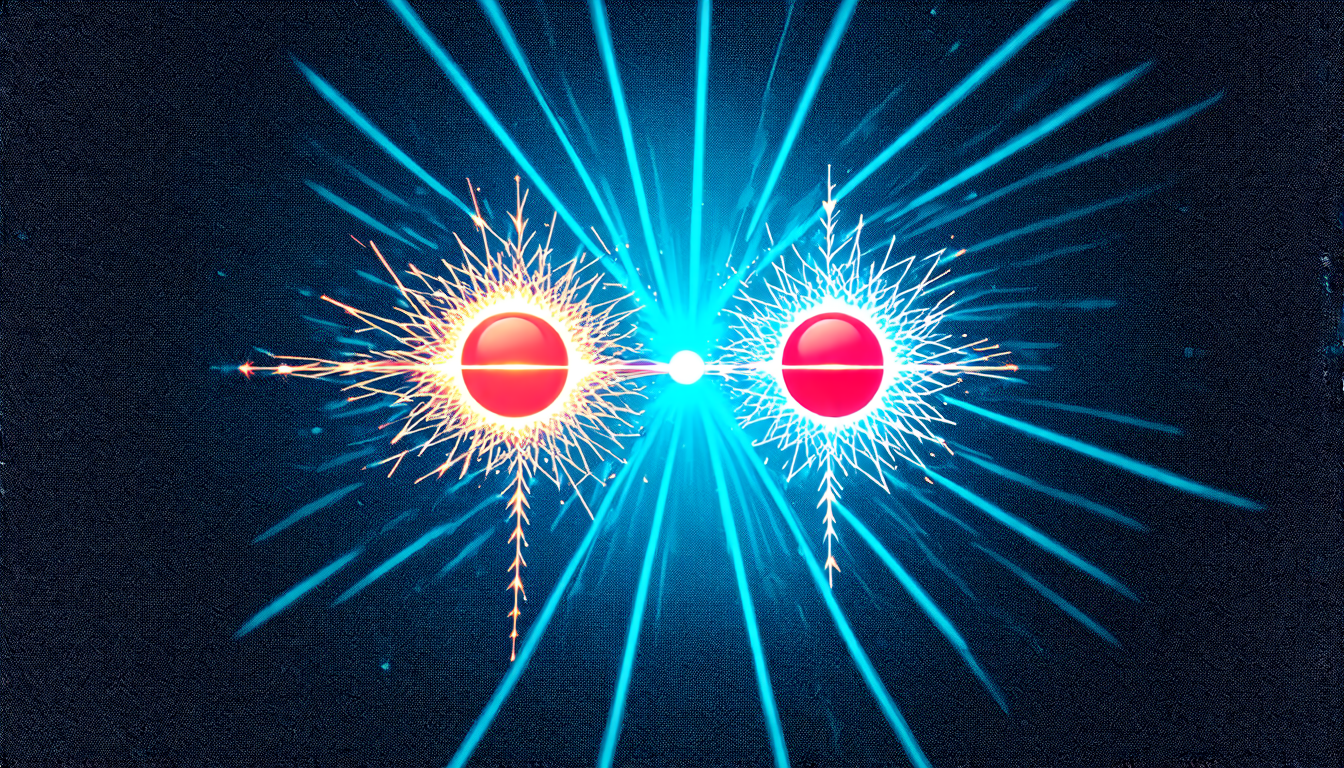
Scientists have long been fascinated by the mysterious world of quantum mechanics, where the rules of classical physics no longer apply. In a recent breakthrough, researchers have made significant strides in understanding the behavior of entangled photons – particles that are connected in such a way that their properties are linked, regardless of the distance between them.
Entanglement is a mind-boggling phenomenon that has puzzled physicists for decades. When two photons become entangled, they form a single entity that cannot be separated without affecting both particles simultaneously. This connection allows for some truly remarkable abilities, such as teleporting information from one photon to another instantaneously – regardless of the distance between them.
The research team used a technique called spontaneous parametric down-conversion (SPDC) to generate entangled photons. SPDC involves shining a laser beam through a crystal, which causes the light to split into two separate beams. These beams then interact with each other in a way that creates the entangled state.
One of the most fascinating aspects of this research is the ability to control the properties of the entangled photons. By manipulating the pump beam used in SPDC, scientists can adjust the degree of spatial coherence – essentially the amount of information shared between the two photons. This allows for some remarkable capabilities, such as creating partially coherent qubits.
Qubits are the basic units of quantum computing, and they rely on the principles of superposition and entanglement to function. By generating partially coherent qubits, scientists can potentially create more robust and reliable quantum computers.
The research has significant implications for a range of fields, from quantum communication and cryptography to advanced imaging techniques. For example, partially coherent qubits could be used to create highly sensitive sensors that can detect even the smallest changes in their environment.
Perhaps most excitingly, this breakthrough opens up new possibilities for studying the behavior of entangled particles in real-world environments. By understanding how these particles interact with each other and their surroundings, scientists may be able to develop more effective methods for harnessing the power of quantum mechanics.
As researchers continue to explore the mysteries of entanglement, it’s clear that we’re on the cusp of a new era in quantum science – one that promises to revolutionize our understanding of the world around us.
Cite this article: “Unlocking Quantum Secrets: New Study Reveals Power of Partially Coherent Qubits”, The Science Archive, 2025.
Quantum Mechanics, Entangled Photons, Quantum Computing, Qubits, Superposition, Entanglement, Spontaneous Parametric Down-Conversion, Spatial Coherence, Partially Coherent Qubits, Quantum Communication





