

Saturday 05 April 2025
A team of mathematicians has made a significant breakthrough in understanding how certain patterns appear in complex systems, specifically in graphs that represent relationships between objects.
Graph theory is a branch of mathematics that studies the properties and structures of graphs, which are collections of nodes connected by edges. Understanding these patterns is crucial in many real-world applications, such as network analysis, computer science, and social sciences.
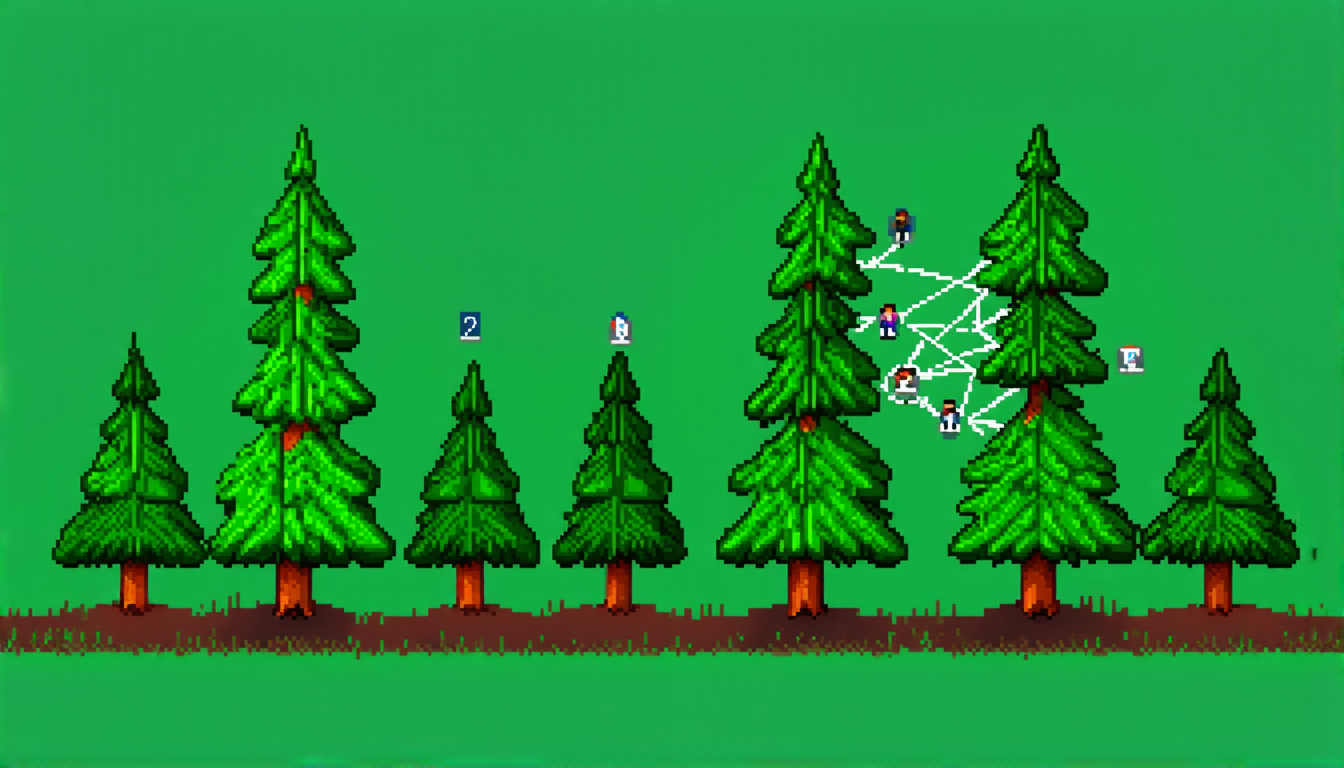
The researchers focused on a specific type of graph known as forests, which consist of trees (connected components without cycles) that share vertices but not edges. They explored the zero-sum Ramsey problem, where they sought to find the smallest number of nodes required for a forest to guarantee the presence of a certain pattern.
To put it simply, if you have a group of people and each person is connected to others through relationships (edges), how many people do you need before you can be sure that there will be at least one specific type of connection or grouping? This problem has been around for decades, but the researchers made significant progress in solving it.
The team discovered that the zero-sum Ramsey number for forests depends on the number of vertices and edges in each tree. They found that if a forest has only three trees, the Ramsey number is relatively small, whereas if there are more trees, it increases rapidly.
This breakthrough has implications for various fields, such as computer networks, social network analysis, and cryptography. For instance, understanding how patterns emerge in complex systems can help improve the design of secure communication networks or predict the spread of diseases through social networks.
The researchers used a combination of mathematical techniques, including combinatorics and graph theory, to solve this problem. They also leveraged computational tools to verify their findings and explore the properties of these graphs.
This study demonstrates how mathematicians can use theoretical frameworks to understand complex systems and make predictions about their behavior. The results have far-reaching implications for various fields and highlight the importance of interdisciplinary research in tackling real-world problems.
The team’s work has opened up new avenues for research, and it is expected that future studies will build upon these findings to explore even more complex systems and relationships.
Cite this article: “Unlocking the Secrets of Zero-Sum Ramsey Numbers: A Breakthrough in Combinatorial Mathematics”, The Science Archive, 2025.
Graph Theory, Mathematics, Complex Systems, Patterns, Forests, Zero-Sum Ramsey Problem, Computer Networks, Social Network Analysis, Cryptography, Combinatorics





