

Saturday 05 April 2025
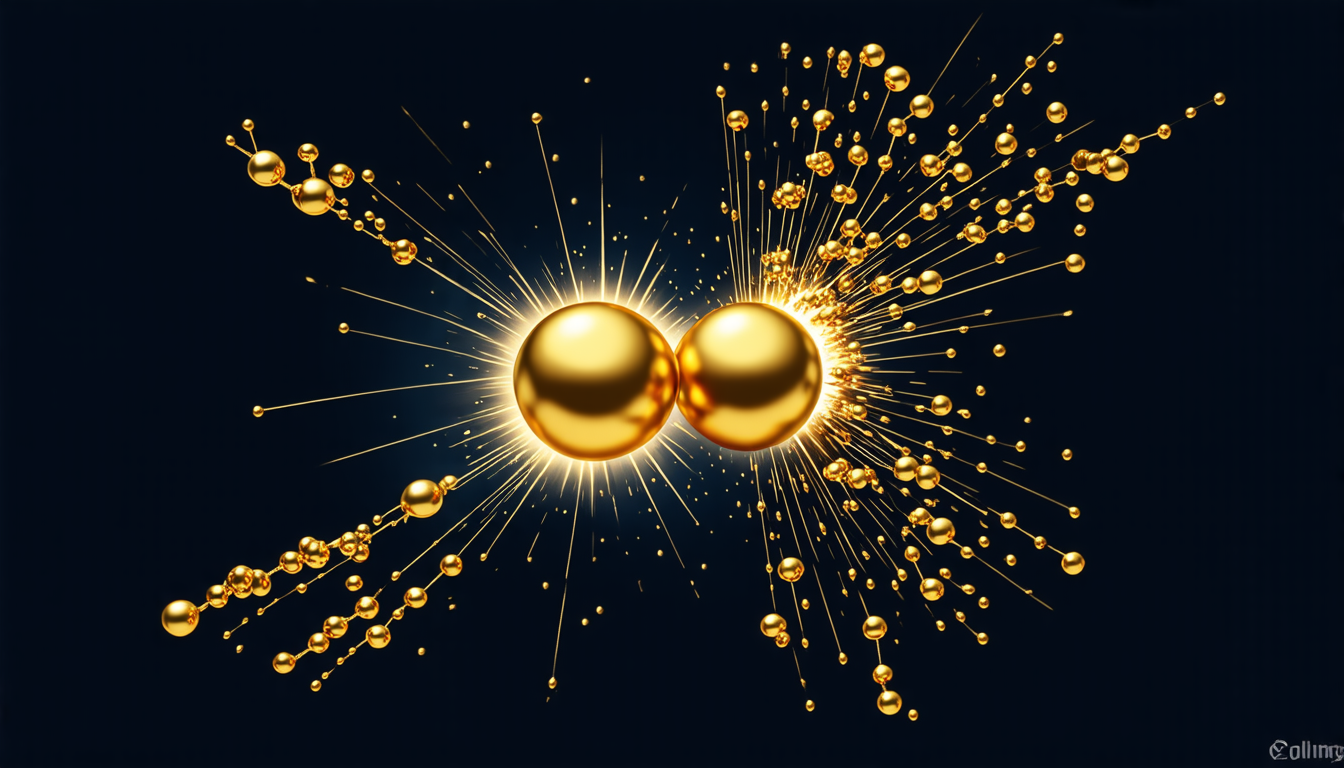
Researchers have made a significant breakthrough in understanding the formation of light nuclei, such as protons and deuterons, in high-energy collisions between heavy ions like gold and lead. These particles are formed when nucleons – the building blocks of atomic nuclei – come together to create new, lighter nuclei.
In recent years, scientists have been studying these collisions using powerful particle accelerators, trying to understand how the properties of matter change under extreme conditions. One key question has been what role nucleon-nucleon correlations play in the formation of light nuclei.
Correlations refer to the way nucleons interact with each other before and after they collide. For example, if two protons are close together, their interactions may affect the likelihood of them coming together to form a nucleus.
To answer this question, researchers used a computer simulation called SMASH (Simulating Multi-Particle Productions in Heavy-Ion Collisions) to model high-energy collisions between gold nuclei at an energy of 3 billion electronvolts. This is a significant challenge because it requires simulating the interactions of thousands of particles over billions of timescales.
The team found that including nucleon-nucleon correlations significantly improved their predictions for light nucleus production, particularly in central collisions where the density of particles is highest. They also found that the formation of deuterons, which are a type of light nucleus made up of one proton and one neutron, was enhanced by these correlations.
These results have important implications for our understanding of high-energy collisions and the properties of matter at extreme densities. For example, they may help scientists better understand how heavy ions interact with each other in the early universe, or how dark matter particles might be produced in particle colliders.
The study also highlights the power of computer simulations like SMASH in helping us understand complex phenomena that are difficult to study directly. By using these simulations, researchers can test different scenarios and hypotheses, which can ultimately lead to new insights and discoveries.
In addition, the results may have practical applications in fields such as nuclear medicine, where light nuclei play a crucial role in the production of medical isotopes. A better understanding of how they are formed could potentially lead to more efficient and effective methods for producing these isotopes.
Overall, this study demonstrates the importance of considering nucleon-nucleon correlations in high-energy collisions and highlights the potential for computer simulations to drive new discoveries in particle physics.
Cite this article: “Unlocking the Secrets of Quantum Chromodynamics in Heavy Ion Collisions”, The Science Archive, 2025.
Heavy Ions, Nucleon-Nucleon Correlations, Light Nuclei, Particle Accelerators, High-Energy Collisions, Nuclear Physics, Computer Simulation, Smash, Deuterons, Protons





