

Saturday 05 April 2025
The math behind turbulence is finally starting to make sense. For decades, physicists have struggled to understand how fluids flow through pipes and around objects, but a new study has shed light on the mysterious forces at play.
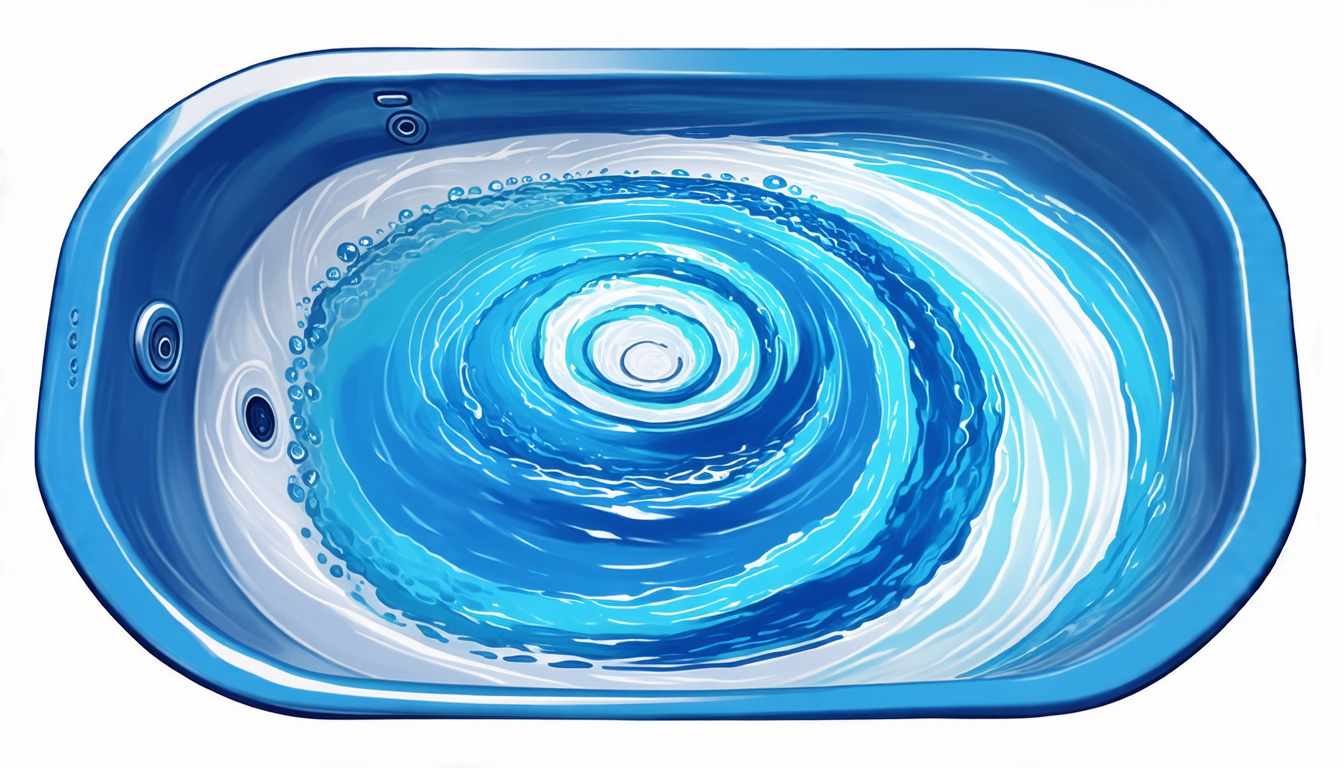
Turbulence is all around us – from the whirlpools in our bathwater to the chaotic winds that shape our weather. But despite its ubiquity, it’s surprisingly hard to predict or control. The problem lies in the sheer complexity of the math involved. Turbulence is a jumbled mess of swirling fluid and air, making it difficult to model or simulate.
Enter the Euler-voigt equations, a set of mathematical rules that aim to simplify this chaos. Developed by physicist Hermann von Helmholtz over 150 years ago, these equations describe how fluids behave when they’re moving at high speeds. But until recently, researchers couldn’t quite get them to work for turbulent flows.
The breakthrough came from a team of mathematicians who discovered a way to tweak the Euler-voigt equations to make them more accurate and stable. By adding a small adjustment to the math, they were able to create a model that accurately predicted how fluids behave in turbulent situations.
This might not seem like a huge deal, but it has significant implications for fields ranging from engineering to meteorology. For instance, being able to predict how fluids flow through pipes could improve everything from oil refineries to medical devices. And more accurate weather forecasting would be a major boon for disaster prevention and planning.
The math itself is complex, involving things like vorticity (twisted fluid motion) and enstrophy (a measure of turbulence). But in simple terms, the researchers have cracked the code on how to make the Euler-voigt equations work for turbulent flows. This means that scientists can now use these equations to model and simulate real-world scenarios with greater accuracy.
One of the key advantages of this new approach is its ability to capture the small-scale details that are often lost in traditional turbulence models. By accurately modeling these tiny fluctuations, researchers can better understand how fluids interact with their surroundings – a crucial piece of information for predicting everything from ocean currents to storm patterns.
Of course, there’s still much work to be done. The Euler-voigt equations are just one tool in the toolbox of turbulence research, and scientists will need to continue refining them before they become widely used.
Cite this article: “Turbulent Fluid Dynamics: Unveiling the Secrets of Eulers Equations”, The Science Archive, 2025.
Turbulence, Euler-Von Helmholtz Equations, Fluid Dynamics, Pipe Flow, Weather Forecasting, Disaster Prevention, Oil Refineries, Medical Devices, Vorticity, Enstrophy





