

Saturday 05 April 2025
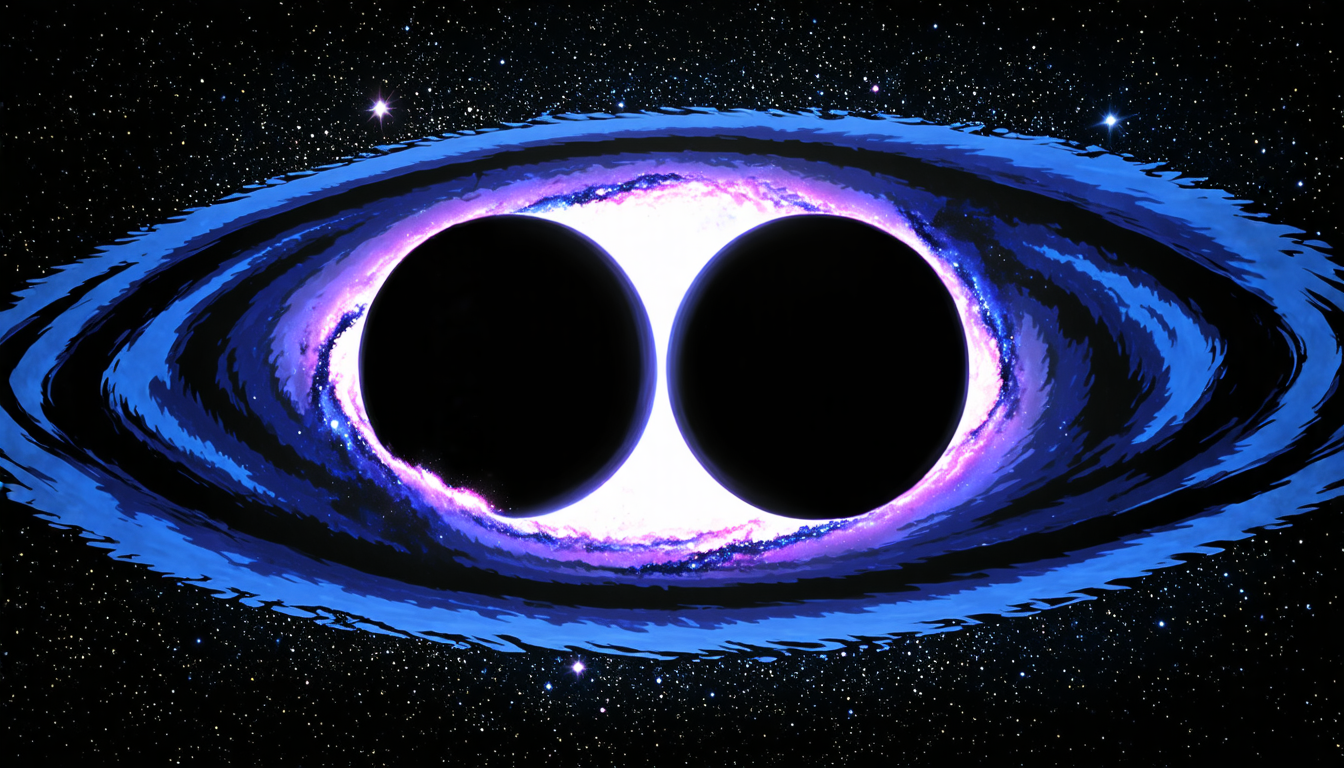
The gravitational waves emitted by merging black holes have long been a topic of fascination for scientists and astronomers alike. These cosmic events, which occur when two massive black holes collide in space, produce ripples that travel through the fabric of spacetime, carrying information about their mass, spin, and orientation.
Recently, researchers have made significant progress in understanding the electromagnetic signatures accompanying these gravitational wave events. By analyzing simulations of merging black hole binaries, scientists have discovered a previously unknown thermal X-ray signature that could be used to identify the location of the host galaxy and distinguish between equal-mass and unequal-mass systems.
The study, published in the journal Monthly Notices of the Royal Astronomical Society, focused on the late stages of inspiral, where the two black holes are close enough to affect each other’s motion. In these situations, the surrounding circumbinary disk (CBD) plays a crucial role in shaping the electromagnetic signatures.
Researchers found that unequal-mass black hole binaries exhibit a distinct thermal X-ray signature, characterized by a sharp spike in luminosity just before merger. This feature is absent in equal-mass systems and could serve as a diagnostic tool to identify the host galaxy of the merging black holes.
The team also discovered that the primary out-accretes the secondary during late inspiral, which can lead to a role-reversal in the accretion rates. This phenomenon has implications for our understanding of the electromagnetic signatures produced by unequal-mass black hole binaries.
Simulations without burn-in periods or grid refinement were also tested to gauge the sensitivity of these findings. Results showed that the characteristic flaring and drop in accretion rates remain robust, even when varying sink rates and using acceleration-free and torque-free sink models.
In addition, researchers explored the brightness of the minidisks, which are thought to be responsible for producing X-ray radiation. They found that the primary outshines the secondary during late inspiral, but this conclusion is dependent on allowing the gas to relax before initiating inspiral.
These findings have significant implications for future multi-messenger observations, where scientists aim to combine gravitational wave detections with electromagnetic counterparts to study cosmic phenomena in unprecedented detail. By identifying the host galaxy of merging black holes and distinguishing between equal-mass and unequal-mass systems, researchers can gain valuable insights into the physics of these events.
As scientists continue to refine their understanding of these complex astrophysical processes, we can expect even more exciting discoveries on the horizon.
Cite this article: “Unlocking the Secrets of Gravitational Waves: Unveiling the Hidden Patterns in Merging Black Hole Binaries”, The Science Archive, 2025.
Gravitational Waves, Black Holes, Merging, X-Rays, Thermal Signature, Galaxy, Unequal-Mass Systems, Electromagnetic Signatures, Circumbinary Disk, Inspiral





