

Saturday 05 April 2025
The universe has long been shrouded in mystery, and one of its most enigmatic phenomena is the black hole. These cosmic voids have fascinated scientists for decades, and recent advances in technology have allowed us to gain a deeper understanding of their behavior.
Black holes are regions of spacetime where gravity is so strong that nothing, not even light, can escape once it gets too close. They’re formed when massive stars collapse under their own weight, causing an intense gravitational pull that warps the fabric of space around them.
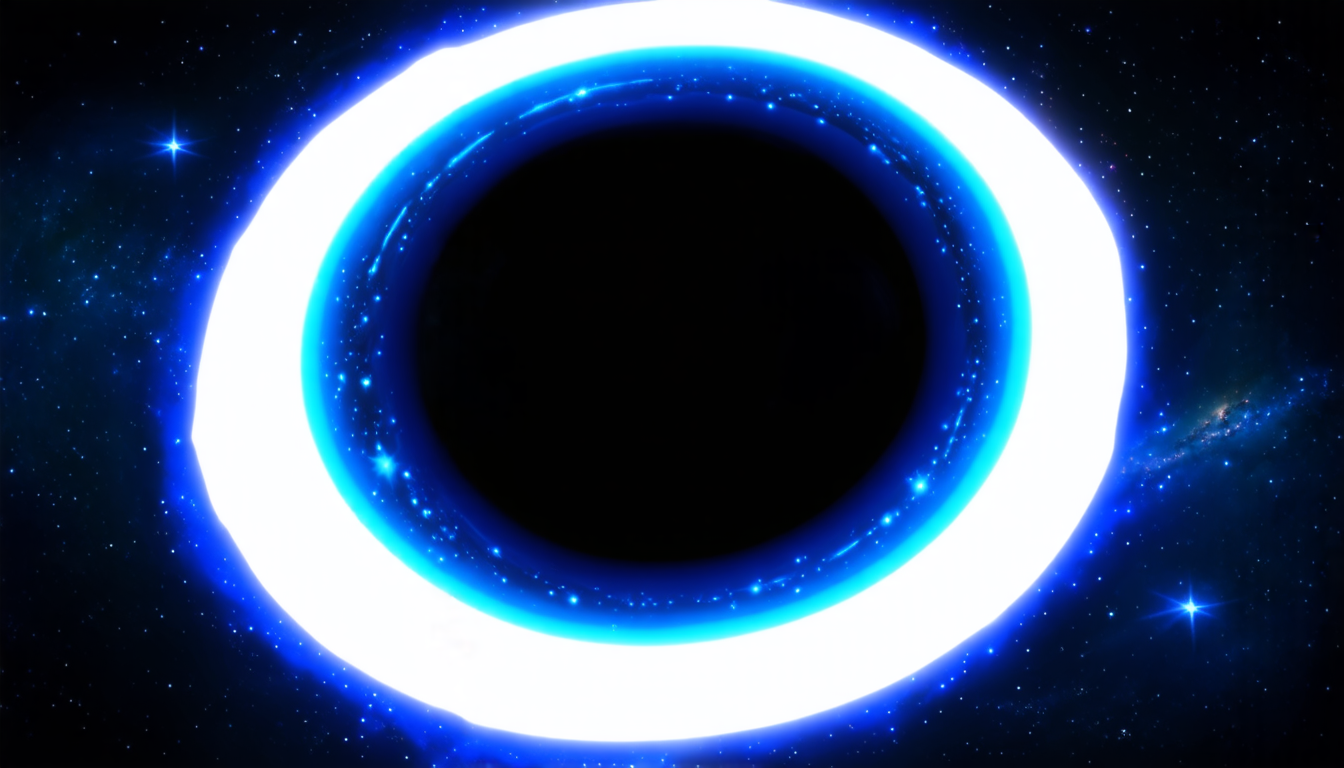
One of the most intriguing aspects of black holes is their shadow – a dark disk-like region that appears to surround these cosmic monsters. This shadow is caused by the bending and focusing of light as it approaches the event horizon, the point of no return around a black hole. The shape and size of this shadow can provide valuable insights into the properties of the black hole itself, such as its mass, spin, and charge.
In recent years, scientists have been able to observe the shadows of supermassive black holes at the centers of galaxies using powerful telescopes like the Event Horizon Telescope (EHT). This has allowed them to study these cosmic behemoths in unprecedented detail, including their spin, size, and even their environment.
However, not all black holes are created equal. There are many types of black holes, each with its own unique properties and behavior. For example, there are rotating black holes, which have a distinct spinning motion that affects the way they bend light around them. There are also charged black holes, which possess an electric charge that influences their gravitational pull.
Recently, scientists have been able to study these different types of black holes using advanced mathematical techniques and computer simulations. By analyzing the behavior of light around these cosmic monsters, researchers can gain a deeper understanding of their properties and how they interact with their environment.
One of the most exciting areas of research is in the field of gravitational physics, which seeks to understand the fundamental laws that govern gravity itself. Black holes play a crucial role in this area, as their intense gravitational pull allows scientists to test these laws under extreme conditions.
In addition to their role in gravitational physics, black holes are also important for understanding the behavior of matter and energy in extreme environments. By studying the properties of black holes, scientists can gain valuable insights into the fundamental nature of spacetime itself.
Overall, the study of black holes is a rapidly advancing field that has far-reaching implications for our understanding of the universe.
Cite this article: “Unveiling the Mysteries of Black Hole Shadows: A New Perspective on Kerr-AdS Spacetime”, The Science Archive, 2025.
Black Holes, Spacetime, Gravity, Event Horizon, Telescopes, Eht, Supermassive Black Holes, Rotating Black Holes, Charged Black Holes, Gravitational Physics





