

Sunday 06 April 2025
The quest for smarter AI has led researchers down many a winding path, from neural networks to generative adversarial networks and beyond. But a new paper takes an innovative approach by combining elements of both to create a system that can tackle complex reasoning tasks.
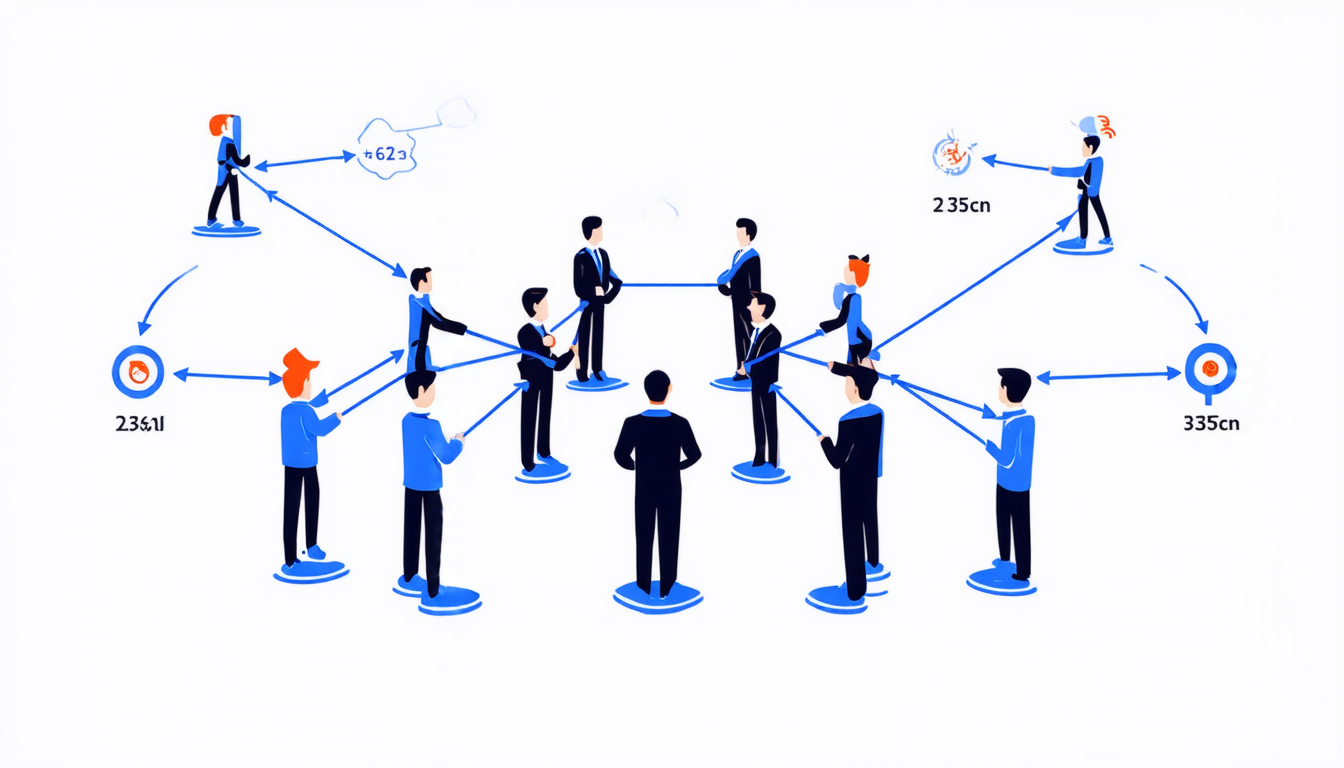
At its core, the system is based on a multi-agent architecture, where multiple AI models work together to solve problems. Each agent is a large language model, trained on vast amounts of data to become an expert in a particular domain – say, physics or chemistry. When presented with a complex task, these agents are deployed to tackle it from different angles.
Here’s the clever part: each agent’s output isn’t just a simple answer, but rather a structured prompt that describes its reasoning process. This prompt is then used as input for another agent, which can refine or build upon the previous response. The result is a cascading effect of expertise and insight, as each agent leverages the strengths of those before it.
The researchers tested this system on a range of tasks, from simple algebra problems to complex science questions that require deep domain knowledge. And the results are impressive: not only did the multi-agent system outperform individual agents in many cases, but it also showed remarkable flexibility and adaptability.
For instance, when asked to solve a physics problem involving both mechanics and thermodynamics, the system was able to break down the task into smaller sub-problems, assigning each agent to tackle a specific aspect of the question. The result was a comprehensive answer that not only arrived at the correct solution but also provided detailed explanations for each step.
The implications of this work are significant. In an era where AI is increasingly being called upon to make decisions in fields like medicine and finance, it’s crucial that these systems can demonstrate not just technical proficiency but also a deep understanding of the underlying principles. The multi-agent system presented here offers a promising approach to achieving just that.
Of course, there are still many challenges to overcome before this technology becomes widely adopted. For one, scaling up the number of agents and domains will require significant computational resources. And developing more sophisticated methods for integrating the outputs of multiple agents is essential.
But the potential payoff is well worth the effort. By combining the strengths of individual AI models into a cohesive whole, researchers may be able to create systems that are not only smarter but also more transparent and explainable – crucial qualities in an age where trust in technology is increasingly important.
Cite this article: “Multimodal Expertise Network for Solving Complex Reasoning Tasks in Scientific Benchmarks”, The Science Archive, 2025.
Ai, Machine Learning, Multi-Agent Architecture, Language Models, Complex Reasoning Tasks, Domain Knowledge, Physics, Chemistry, Algebra Problems, Scientific Questions, Explainable Ai.





