

Sunday 06 April 2025
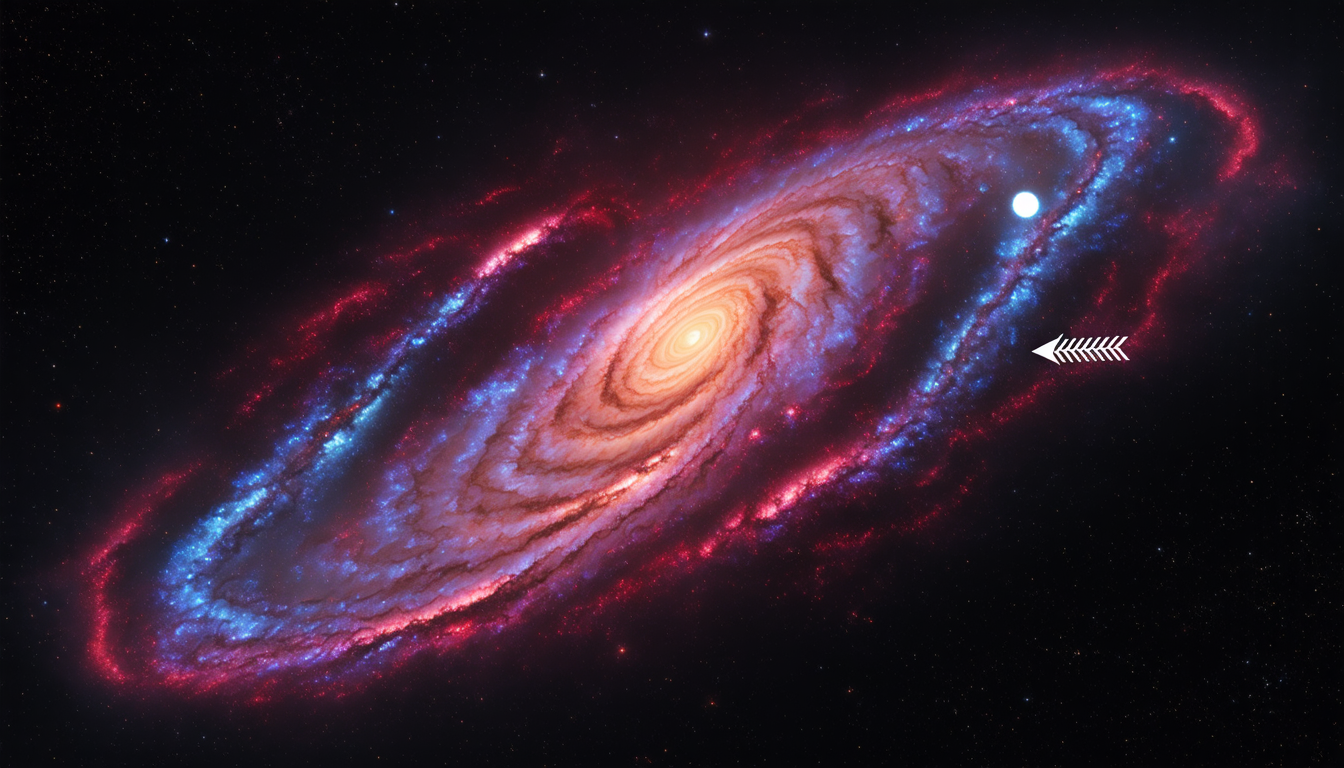
The universe is full of mysteries, and one of its most enduring puzzles has been the cosmic dipole anomaly. For decades, astronomers have struggled to understand why the number count of galaxies in the universe seems to be biased towards a particular direction. This phenomenon has been observed across different wavelengths of light, from radio waves to infrared radiation.
Now, a team of researchers has made significant progress in solving this enigma by studying the kinematic contribution to the cosmic dipole. The idea is that the dipole could be due not just to the motion of galaxies themselves but also to the way they move within the universe.
To tackle this problem, the scientists combined data from three large galaxy surveys: the NVSS (NRAO VLA Sky Survey), RACS- low (Rapid ASKAP Continuum Survey-low frequency), and CatWISE (Catalogue Wise). These surveys have mapped the distribution of galaxies across vast regions of the sky, providing a treasure trove of information for astronomers to analyze.
By carefully examining the data, the team found that the observed dipole could be explained by a combination of kinematic and non-kinematic contributions. The kinematic part is thought to arise from the motion of galaxies within the universe, while the non-kinematic part might be due to unknown physical processes or even dark matter.
One striking finding was that the residual dipole, which cannot be explained by kinematics alone, has a direction offset from the cosmic microwave background (CMB) dipole. This suggests that there may be an additional component at play, possibly related to large-scale structure in the universe.
The research also highlighted the importance of considering different wavelengths and frequencies when studying the cosmic dipole. The team found that by combining data from radio, infrared, and optical surveys, they could better understand the underlying physics driving this phenomenon.
While more work is needed to fully unravel the mystery of the cosmic dipole anomaly, these findings represent a significant step forward in our understanding of the universe’s large-scale structure. As astronomers continue to refine their models and gather more data, we may eventually uncover the secrets behind this enigmatic phenomenon.
Cite this article: “Unlocking the Secrets of the Cosmic Dipole: A New Perspective on the Universes Large-Scale Structure”, The Science Archive, 2025.
Cosmic Dipole Anomaly, Galaxy Surveys, Kinematic Contribution, Non-Kinematic Contributions, Dark Matter, Cosmic Microwave Background, Cmb Dipole, Large-Scale Structure, Universe’S Large-Scale Structure, Astronomical Research.





