

Sunday 06 April 2025
The world of mathematics is often shrouded in mystery, but a recent discovery has shed new light on an important area: functional differential equations. These complex mathematical structures are used to model real-world phenomena, such as population growth and electrical circuits.
Functional differential equations differ from traditional differential equations in that they involve not only the rate of change of a function, but also its value at different points in time. This added layer of complexity allows for more accurate modeling of systems with delayed responses, such as communication networks and financial markets.
Researchers have long struggled to find a solution to these equations, which often feature multiple variables and non-linear relationships. However, a recent breakthrough has provided new insights into the nature of these equations and their applications.
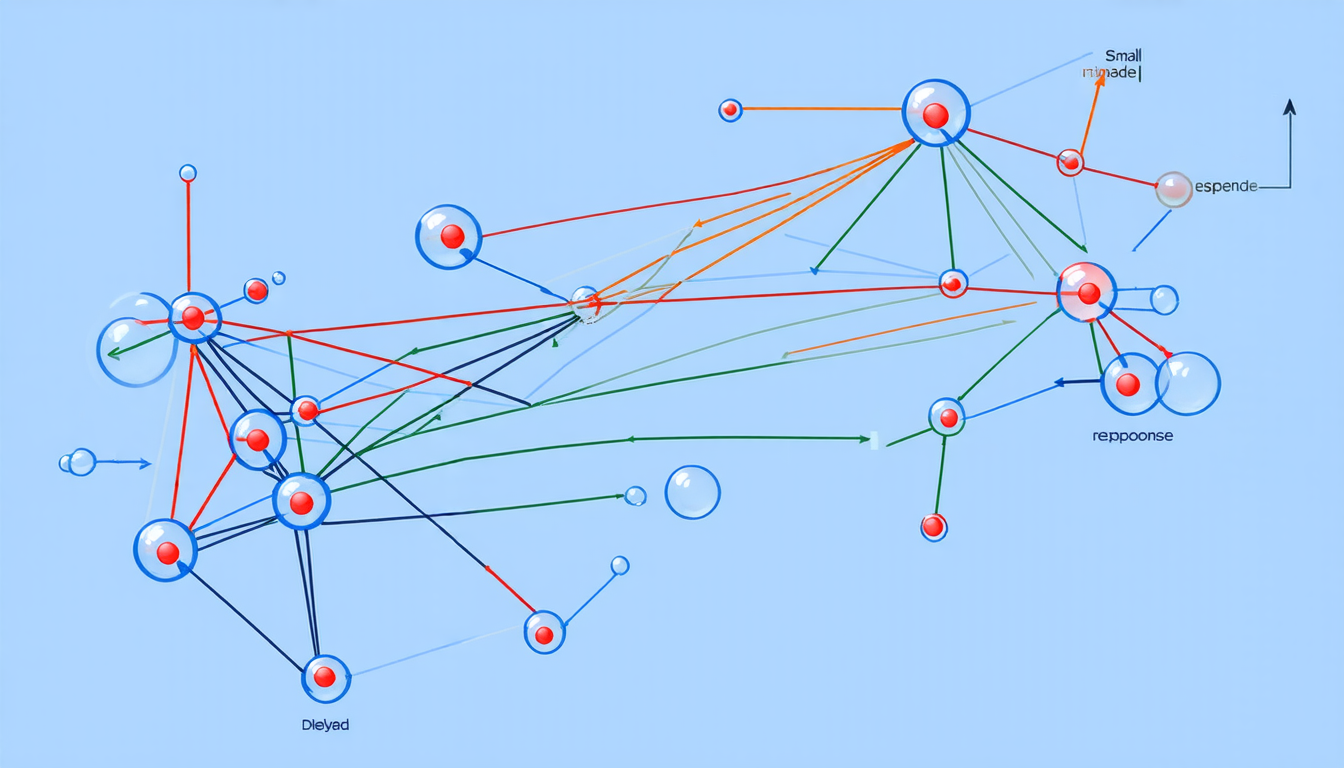
The key to this discovery lies in the concept of quantum graphs, which are mathematical models used to describe networks of interconnected systems. By applying the principles of quantum mechanics to functional differential equations, researchers have been able to develop new methods for solving these complex equations.
One of the most significant implications of this research is its potential application to real-world problems. For example, it could be used to improve the efficiency of communication networks by optimizing signal transmission and reception times. It could also be applied to financial modeling, allowing for more accurate predictions of market fluctuations.
The study of functional differential equations has far-reaching implications for many fields, from biology to engineering. By better understanding these complex mathematical structures, researchers can develop new methods for solving problems that were previously thought unsolvable.
In the past, researchers have relied on numerical methods and approximations to solve functional differential equations. However, these approaches often lack accuracy and are limited in their ability to capture the underlying dynamics of the system.
The new methods developed through this research offer a more precise and powerful approach to solving these equations. They can be used to analyze complex systems, identify patterns and trends, and make more accurate predictions.
This breakthrough has opened up new avenues for research in mathematics and its applications. It has also sparked interest from scientists and engineers across various disciplines, who are eager to explore the potential of functional differential equations in their own work.
The study of functional differential equations is an ongoing effort, with researchers continuing to push the boundaries of what is possible. As new discoveries are made, we can expect to see even more innovative applications of this powerful mathematical tool.
Cite this article: “Unlocking Quantum Graphs: A Novel Approach to Understanding Functional-Differential Equations on Geometric Graphs”, The Science Archive, 2025.
Mathematics, Functional Differential Equations, Population Growth, Electrical Circuits, Communication Networks, Financial Markets, Quantum Graphs, Numerical Methods, Approximation, Mathematical Modeling.





