
Sunday 06 April 2025
Mathematicians have long been fascinated by the intricate patterns that emerge when complex systems interact. From the swirling shapes of galaxies to the branching networks of trees, these patterns can reveal hidden structures and relationships that underlie our universe.
Recently, researchers have made a significant breakthrough in understanding one such pattern – the likelihood correspondence. This concept arises in statistical models, where it describes how data is distributed across different variables. By analyzing the likelihood correspondence, mathematicians hope to uncover new insights into complex phenomena, from predicting stock market trends to understanding the behavior of subatomic particles.
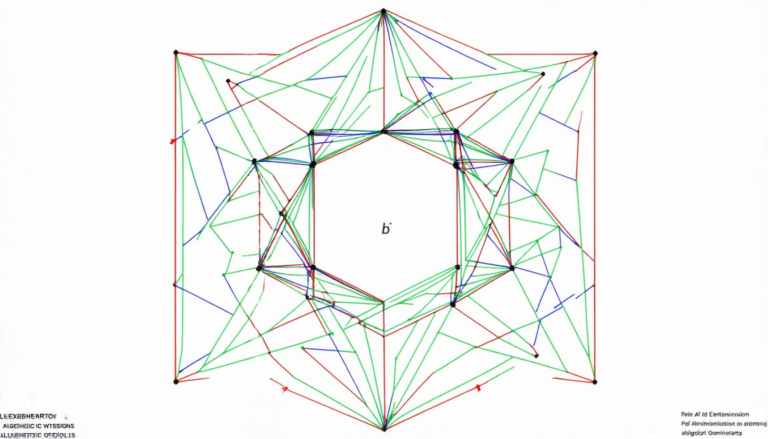
The key to this breakthrough lies in a mathematical structure called an arrangement, which represents the intersection of multiple hyperplanes (or higher-dimensional analogs of lines). In the past, researchers have studied these arrangements in isolation, but the new work takes a bold step by combining them with statistical models. This fusion allows mathematicians to explore the likelihood correspondence as it emerges from the intricate dance of these intersecting hyperplanes.
The team behind this research used advanced mathematical techniques to construct a new framework for understanding the likelihood correspondence. By mapping the arrangement of hyperplanes onto a higher-dimensional space, they were able to visualize and analyze the complex patterns that emerge. This allowed them to identify key features and relationships within the data, shedding light on long-standing puzzles in statistical theory.
One of the most exciting implications of this work is its potential application to machine learning. By better understanding how data is distributed across different variables, researchers can develop more accurate models for predicting outcomes and identifying patterns. This could have significant implications for fields such as medicine, finance, and climate modeling.
The authors’ approach also offers a fresh perspective on the nature of complexity itself. By exploring the intricate patterns that arise from the intersection of multiple systems, they are helping to reveal the hidden structures that underlie our world. This work has far-reaching implications for fields ranging from physics to biology, as it challenges us to rethink our understanding of how complex phenomena emerge and interact.
As researchers continue to build upon this breakthrough, we can expect a new wave of innovations in data analysis and machine learning. The likelihood correspondence is just one example of the many fascinating patterns that await discovery at the intersection of mathematics and statistics.
Cite this article: “Cracking the Code of Complex Data: Researchers Unravel Mystery of Likelihood Geometry”, The Science Archive, 2025.
Mathematics, Statistics, Patterns, Complexity, Arrangements, Hyperplanes, Machine Learning, Data Analysis, Likelihood Correspondence, Mathematical Structure