

Sunday 06 April 2025
A new era in particle physics is upon us, as researchers have made significant strides in understanding the fundamental forces that govern our universe. The Electron-Ion Collider (EIC), a cutting-edge facility currently under construction at Brookhaven National Laboratory, promises to revolutionize our comprehension of these forces by allowing scientists to study the building blocks of matter with unprecedented precision.
At its core, the EIC is an upgrade to the existing Relativistic Heavy Ion Collider (RHIC), which has been instrumental in shedding light on the properties of quarks and gluons, the fundamental particles that make up protons and neutrons. The RHIC’s successor will enable researchers to collide electrons with heavy ions, such as gold or lead, at incredibly high energies. This collision will create an environment where scientists can study the interactions between these particles in exquisite detail.
One of the primary goals of the EIC is to investigate the properties of quarks and gluons in a regime known as Quantum Chromodynamics (QCD). QCD is the theory that describes the strong nuclear force, which holds quarks together within protons and neutrons. By studying the behavior of these particles at high energies, scientists hope to gain a deeper understanding of how matter is composed and how it behaves.
The EIC will also provide a unique opportunity to search for new physics beyond the Standard Model, the current framework that describes all known fundamental forces and particles. Theorists have predicted the existence of new particles, such as axions or dark photons, which could shed light on the nature of dark matter and dark energy, two mysterious components that make up approximately 95% of our universe.
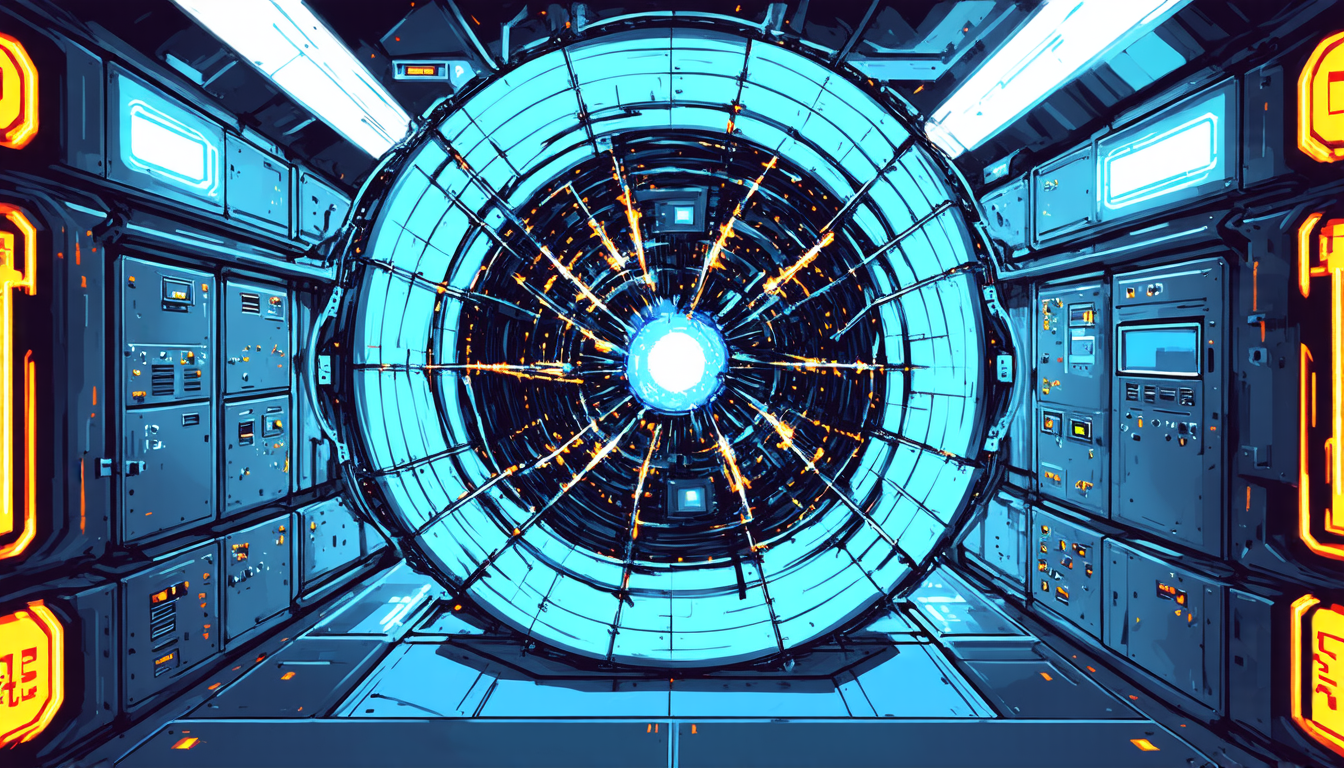
In addition to its scientific potential, the EIC is also an engineering marvel. The facility will feature a sophisticated detector system capable of tracking particles with unprecedented precision. This detector will be designed to operate in extreme conditions, such as high magnetic fields and intense radiation, making it one of the most complex and challenging detectors ever built.
The construction of the EIC is a testament to human ingenuity and our unwavering curiosity about the universe. As scientists continue to push the boundaries of what we know, they are driven by an insatiable desire to uncover the secrets that lie beneath the surface. The EIC represents a significant step forward in this pursuit, offering a glimpse into the fundamental forces that shape our reality.
Cite this article: “Unlocking the Secrets of Lepton Flavor Universality at the Electron-Ion Collider”, The Science Archive, 2025.
Particle Physics, Electron-Ion Collider, Brookhaven National Laboratory, Relativistic Heavy Ion Collider, Quarks, Gluons, Quantum Chromodynamics, Standard Model, Dark Matter, Dark Energy





