

Sunday 06 April 2025
Recently, a team of scientists has made significant progress in the field of quantum cryptography. For those unfamiliar, quantum cryptography is a method of encrypting information using the principles of quantum mechanics to ensure its secure transmission over long distances.
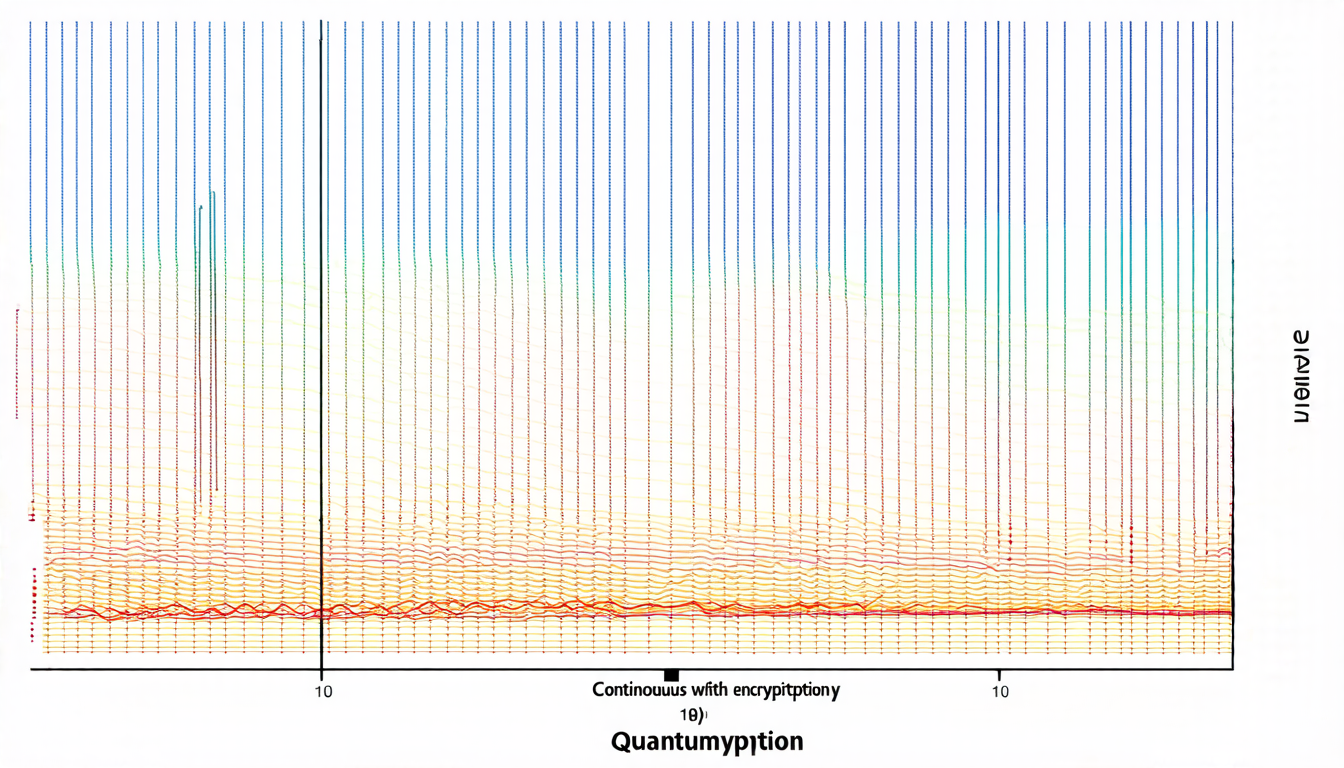
The new development involves creating an unclonable encryption scheme that uses continuous variables, as opposed to the traditional discrete-variable approach. In this scheme, the encryption key is not just a series of 0s and 1s, but rather a set of continuous values that can be represented on a graph.
To understand how it works, let’s take a step back. Traditional quantum cryptography relies on the no-cloning theorem, which states that an arbitrary quantum state cannot be copied exactly. This property is used to create encryption keys that are unique and secure.
However, in the discrete-variable approach, this uniqueness is limited by the number of possible values. For example, if you have a binary key with 8 bits, there are only 256 possible combinations. This limitation makes it easier for hackers to guess or brute-force the encryption key.
The new scheme addresses this issue by using continuous variables, which can be thought of as a never-ending string of numbers. These values can be represented on a graph, allowing for an infinite number of possible combinations.
To create the encryption key, the scientists use a process called squeezing. This involves taking a quantum state and reducing its uncertainty in one direction while increasing it in another. The resulting state is known as a squeezed state.
The beauty of this approach lies in its ability to create an unclonable encryption key that can be used for secure communication over long distances. Because the key is based on continuous variables, it’s virtually impossible to guess or reproduce.
This breakthrough has significant implications for the field of quantum cryptography. It opens up new possibilities for secure communication and could potentially revolutionize the way we transmit sensitive information.
One potential application of this technology is in financial transactions. Imagine being able to send sensitive financial data over the internet with absolute confidence that it will remain confidential.
Another area where this technology could have a significant impact is in healthcare. Medical records, patient information, and other sensitive data could be transmitted securely using this method.
While there are still many challenges to overcome before this technology can be implemented on a large scale, the potential benefits are undeniable. This breakthrough has the potential to change the way we think about secure communication and could have far-reaching implications for many industries.
Cite this article: “Unbreakable Encryption: Scientists Develop Unclonable Cipher Using Quantum States”, The Science Archive, 2025.
Quantum Cryptography, Encryption, Continuous Variables, No-Cloning Theorem, Quantum State, Squeezing, Unclonable, Secure Communication, Financial Transactions, Healthcare.
Reference: Arpan Akash Ray, Boris Škorić, “Unclonable Encryption with Continuous Variables” (2025).





