

Sunday 06 April 2025
The intricate dance of numbers and patterns, hidden beneath the surface of our digital lives, has long fascinated scientists and enthusiasts alike. In a remarkable new paper, researchers have delved into the mysteries of deep learning, uncovering surprising connections between seemingly disparate fields.
At the heart of this exploration lies the concept of optimal transport, a mathematical framework used to describe the movement of objects or probability distributions from one state to another. This idea, born in the realm of physics and economics, has been applied with great success in various domains, including computer vision and machine learning.
The authors of this paper have taken this concept to new heights by demonstrating its relevance to deep learning, specifically in the context of Boltzmann machines and energy-based models. These neural networks are designed to learn complex patterns in data by minimizing an energy function, much like our brains process sensory information.
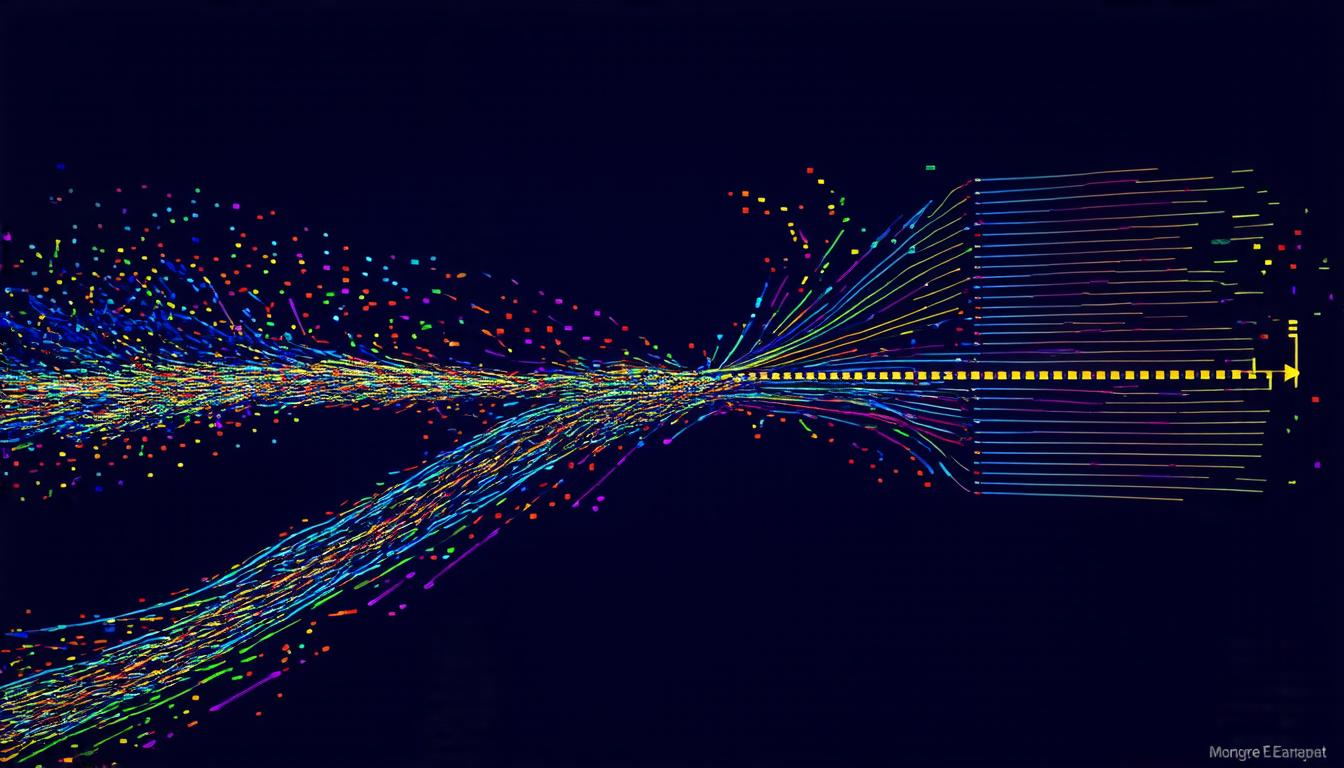
Through a series of clever mathematical manipulations, the researchers have shown that the optimization process in these networks can be viewed as an optimal transport problem. In other words, the network’s learning dynamics can be understood as a continuous flow of probability mass from one state to another, governed by a set of equations known as the Monge-Ampère equation.
This perspective offers a profound insight into the workings of deep learning. By recognizing that learning is, in essence, an optimal transport process, we gain a deeper understanding of how these networks are able to extract meaningful features from complex data sets. We also find ourselves at the intersection of two seemingly distinct disciplines: statistical mechanics and machine learning.
The implications of this work are far-reaching. For instance, the authors suggest that incorporating Monge-Ampère-based regularization terms into deep learning models could lead to more robust and interpretable results. This idea has significant potential for applications in fields such as computer vision, natural language processing, and even medicine.
Furthermore, this research paves the way for further exploration of the connections between optimal transport, renormalization group theory, and machine learning. The authors propose an alternative approach to understanding deep learning, one that draws upon the principles of Wilson’s renormalization group.
As we continue to push the boundaries of artificial intelligence, it is essential that we develop a deeper understanding of the underlying mathematical structures that govern its behavior. This paper is a testament to the power of interdisciplinary collaboration and the boundless potential of human curiosity.
Cite this article: “Unlocking the Geometry of Deep Learning: A Quantum Perspective”, The Science Archive, 2025.
Deep Learning, Optimal Transport, Machine Learning, Boltzmann Machines, Energy-Based Models, Monge-Ampère Equation, Statistical Mechanics, Renormalization Group Theory, Computer Vision, Natural Language Processing
Reference: Noémie C. Combe, “Quantum Geometry insights in Deep Learning” (2025).





