

Sunday 06 April 2025
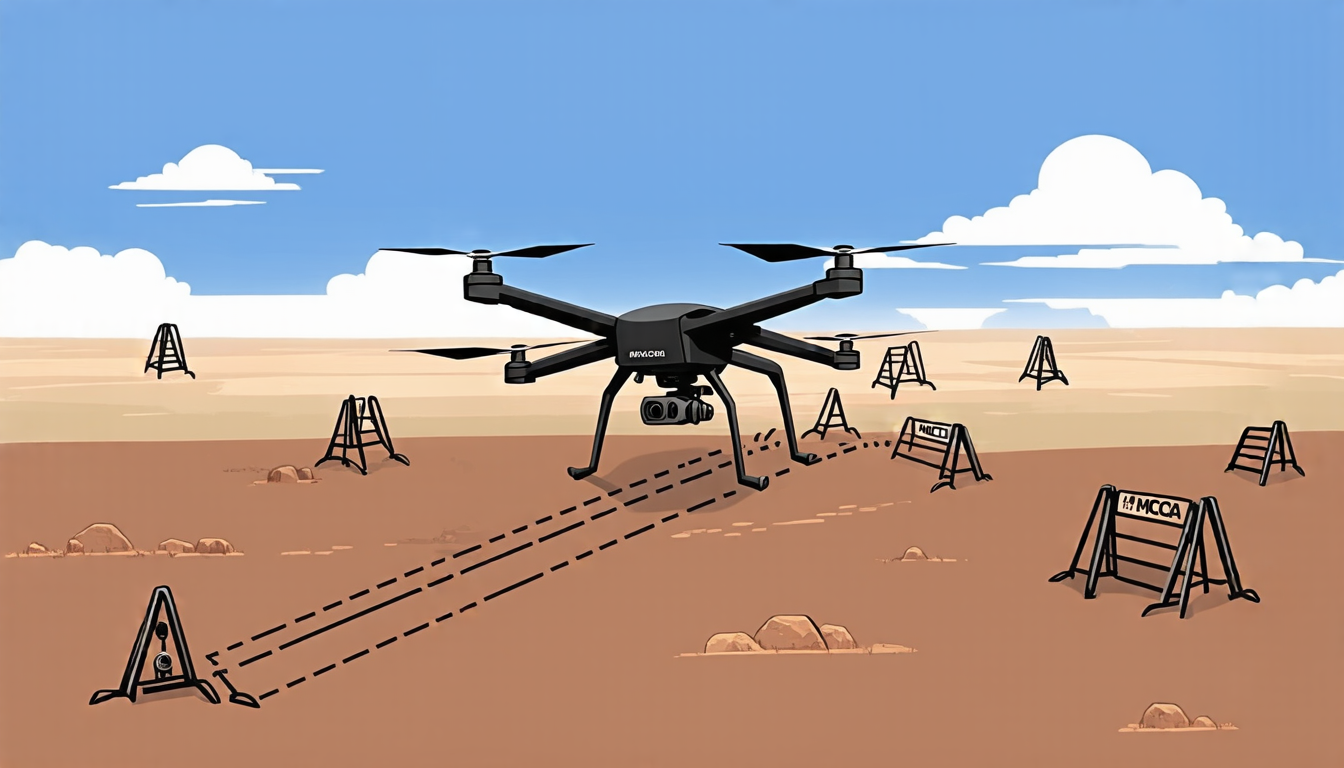
Recently, a team of researchers has made significant progress in developing an algorithm that can optimize path planning for autonomous navigation systems. The new algorithm, called Multi-Strategy Enhanced Crayfish Optimization Algorithm (MCOA), is designed to improve the efficiency and effectiveness of path planning for various applications, including unmanned aerial vehicles (UAVs) and mobile robots.
Path planning is a crucial aspect of autonomous navigation, as it determines how an autonomous system moves through its environment. The goal of path planning is to find the shortest or near-optimal path that avoids obstacles and satisfies specific constraints. However, traditional path planning algorithms often struggle with complex environments, where multiple constraints and obstacles need to be considered.
MCOA addresses this challenge by integrating three key strategies: refractive opposition learning, stochastic centroid-guided exploration, and adaptive competition-based selection. These strategies work together to refine population diversity, balance global and local search, and accelerate convergence.
The first strategy, refractive opposition learning, is inspired by the behavior of crayfish, which use their claws to detect and respond to stimuli in their environment. In MCOA, this strategy is used to generate a diverse set of solutions that can adapt to changing environments.
The second strategy, stochastic centroid-guided exploration, uses a probabilistic approach to guide the search process towards promising regions of the solution space. This helps to balance global and local search, ensuring that the algorithm does not get stuck in local optima.
The third strategy, adaptive competition-based selection, is used to select the best solutions based on their fitness values. This ensures that the algorithm adapts to changing environments and selects the most suitable solutions.
MCOA was tested on two different scenarios: 3D UAV path planning and 2D mobile robot path planning. In both cases, the algorithm outperformed traditional algorithms in terms of computational efficiency and solution quality.
In the 3D UAV scenario, MCOA reduced the total flight cost by 16.7% compared to traditional algorithms. This is significant, as it means that MCOA can help reduce fuel consumption and extend the flight duration of UAVs.
In the 2D mobile robot scenario, MCOA achieved an average reduction in path length of 44%. This is important, as it means that MCOA can help robots navigate through complex environments more efficiently.
The success of MCOA highlights its potential for real-world applications.
Cite this article: “Revolutionizing Autonomous Navigation: A Multi-Strategy Enhanced COA Algorithm for Efficient and Robust Path Planning”, The Science Archive, 2025.
Autonomous Navigation, Path Planning, Algorithm, Uavs, Mobile Robots, Optimization, Crayfish Optimization Algorithm, Multi-Strategy, Refractive Opposition Learning, Stochastic Centroid-Guided Exploration





