

Sunday 06 April 2025
The intricate dance of materials and forces that govern the behavior of composite structures, such as hybrid laminates, has long been a subject of fascination for scientists. These complex systems, which combine different materials to achieve specific properties, are ubiquitous in modern engineering applications, from aircraft wings to smartphone screens.
However, understanding how they behave under various loads and conditions is a daunting task. Researchers have long sought a unified framework that could accurately predict the behavior of these structures, taking into account the intricate interactions between their constituent parts.
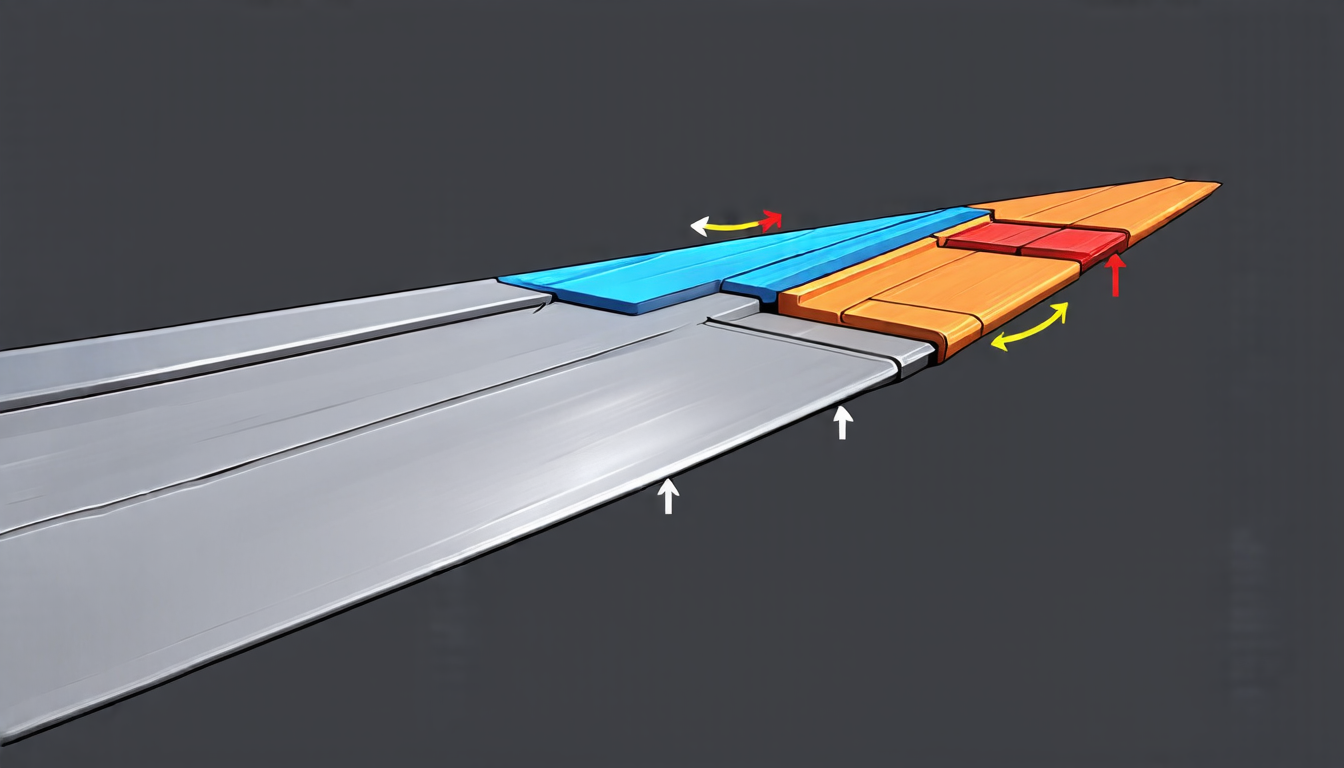
A recent paper published in Mathematical Methods in the Applied Sciences has made significant strides towards achieving this goal. By developing a novel mathematical model that accounts for the cohesive interface between different materials, researchers have created a powerful tool for predicting the behavior of composite structures under various loads and conditions.
The key innovation lies in the introduction of a new type of potential-based cohesive zone model, which simulates the interaction between the materials at the microscopic level. This approach allows researchers to capture the complex dynamics of material failure and damage propagation, providing a more accurate picture of how these structures behave under stress.
One of the most significant advantages of this new model is its ability to simulate the behavior of hybrid laminates under mixed-mode separation and over-closure conditions. In other words, it can accurately predict how these structures respond when subjected to different types of loads, such as tension, compression, or shear forces.
The implications of this research are far-reaching, with potential applications in fields ranging from aerospace engineering to materials science. By providing a more accurate and comprehensive understanding of the behavior of composite structures, researchers hope to improve the design and performance of these critical systems.
In practical terms, the new model could be used to optimize the design of hybrid laminates for specific applications, such as aircraft wings or wind turbine blades. It could also help materials scientists develop new composites with improved properties, such as strength, toughness, or durability.
The development of this novel mathematical model represents a significant milestone in the field of composite materials research, and its potential impact on our understanding of these complex systems is vast. As researchers continue to refine and apply this approach, we can expect to see major advances in the design and performance of composite structures, with far-reaching implications for a wide range of industries.
Cite this article: “Unlocking the Secrets of Cohesive Fracture: A Mathematical Framework for Hybrid Laminates”, The Science Archive, 2025.
Composite Materials, Hybrid Laminates, Mathematical Model, Cohesive Zone Model, Potential-Based Cohesive Zone Model, Material Failure, Damage Propagation, Mixed-Mode Separation, Over-Closure Conditions, Aerospace Engineering.





