

Sunday 06 April 2025
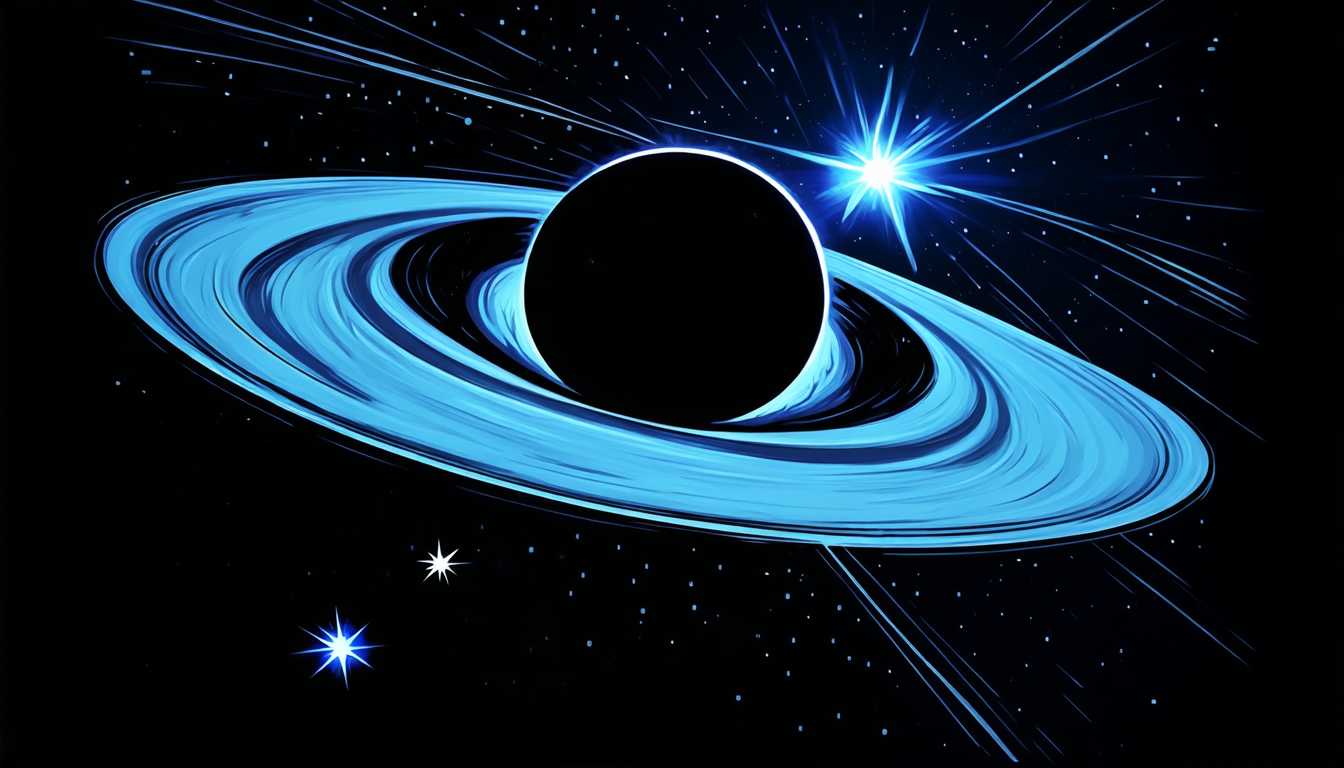
Deep in the heart of our galaxy, a peculiar star has been captivating astronomers for decades. Known as SS433, this enigmatic celestial body is a microquasar, a rare type of binary system that consists of a massive black hole and a companion star.
Recent observations by NASA’s Transiting Exoplanet Survey Satellite (TESS) have shed new light on the mysterious behavior of SS433. For about 10 days, the satellite tracked the star’s brightness fluctuations with unprecedented precision, revealing a remarkable pattern. The data showed that the star’s luminosity increased by as much as three times its normal level, only to fade back down again within a few hours.
But what’s truly fascinating is that this fluctuation was not a one-time event. It repeated every 13.3 hours, like clockwork. This periodicity is unlike anything seen in other binary systems of similar nature, leading scientists to speculate about the underlying causes.
One possibility is that the companion star itself is responsible for these oscillations. Perhaps its own internal dynamics are driving changes in the amount of material it pumps into the accretion disk surrounding the black hole. This could result in variations in X-ray and optical radiation, which TESS can detect.
Another theory suggests that the fluctuations might be linked to the precession of the binary system’s orbit. Precession is a complex phenomenon where the plane of the orbit wobbles over time, causing the star’s brightness to change as it moves relative to our line of sight. This could also produce the observed 13.3-hour period.
But here’s the twist: these fluctuations are not just a simple oscillation or precession pattern. The data suggests that there might be an additional, shorter-period component at play. This could indicate the presence of even more complex dynamics within the binary system.
The TESS observations also revealed another intriguing feature: SS433 was relatively quiet during its Sector 80 observation, with only minor fluctuations in brightness over several days. However, these fluctuations did show a periodic pattern matching the orbital period of the binary system.
These findings have sparked a new wave of research into the mysterious behavior of microquasars like SS433. By continuing to study this enigmatic star, scientists hope to unravel the secrets behind its peculiar luminosity variations and shed light on the complex interplay between black holes and their companion stars.
Cite this article: “Unlocking the Secrets of the Eruptive Black Hole System SS433”, The Science Archive, 2025.
Black Hole, Binary System, Microquasar, Ss433, Tess, Nasa, Star, Luminosity, Periodicity, Precession





