

Sunday 06 April 2025
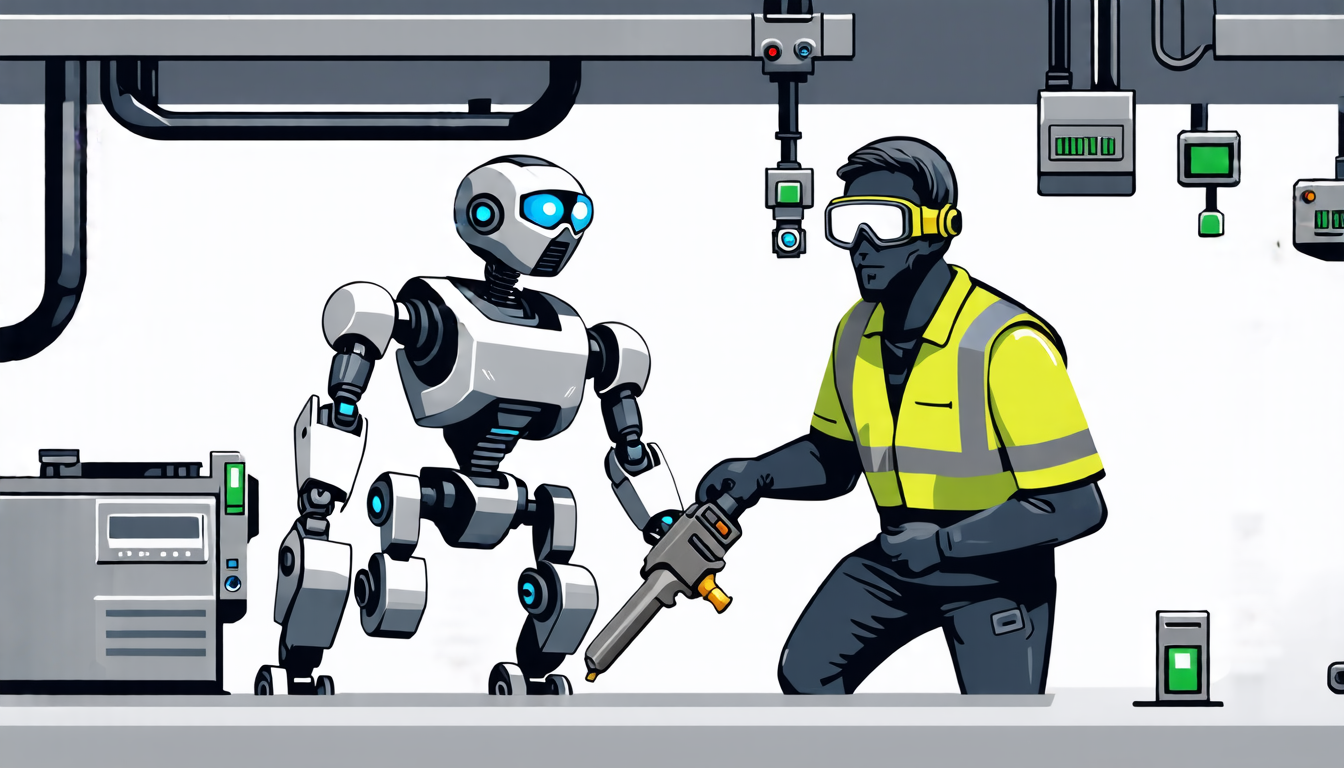
As humans and robots collaborate in the workplace, a new challenge arises: optimizing their interactions to maximize efficiency and safety. Researchers have been tackling this problem by developing digital models that can simulate and predict human-robot collaboration, allowing for better design and deployment of these workcells.
One such approach is the genetic algorithm-based method described in a recent paper. This technique uses a simulator to run multiple scenarios, evaluating various layouts and task allocations to find the optimal configuration. The algorithm takes into account several key performance indicators (KPIs), including cycle time, ergonomics, inverse manipulability, and minimum surface area.
The researchers tested their method using a case study involving an emergency stop button assembly operation. They found that by optimizing the layout and task allocation, they could reduce the overall cycle time while maintaining or even improving safety metrics. The algorithm also suggested more ergonomic positions for the human operator and robot, which could lead to reduced fatigue and increased productivity.
One of the key benefits of this approach is its ability to account for complex interactions between humans and robots. By simulating multiple scenarios, the algorithm can identify potential conflicts and optimize the layout to minimize them. This is particularly important in environments where humans and robots must work together in close proximity, such as in manufacturing or healthcare settings.
The researchers also highlight the flexibility of their method, which allows for easy adaptation to different scenarios and KPIs. This could be particularly useful in industries where workflows are constantly evolving, such as in logistics or assembly lines.
While this research is promising, there are still some limitations to consider. For example, the algorithm may not always find the global optimal solution, especially in complex scenarios. Additionally, the simulator used in this study was based on a specific robot and human operator model, which may not be representative of all possible workcell configurations.
Despite these limitations, this research has significant implications for the design and deployment of human-robot collaborative systems. By optimizing layouts and task allocations using digital models, manufacturers can create safer, more efficient, and more productive workcells that benefit both humans and robots alike. As the demand for automation continues to grow, researchers will need to continue exploring innovative solutions like this genetic algorithm-based method to meet the challenges of human-robot collaboration.
Cite this article: “Optimizing Human-Robot Collaboration: A Genetic Algorithm Approach to Enhance Productivity and Ergonomics in Manufacturing Cells”, The Science Archive, 2025.
Human-Robot Collaboration, Digital Models, Optimization, Efficiency, Safety, Genetic Algorithm, Simulator, Layout Design, Task Allocation, Robotics Engineering





