

Sunday 06 April 2025
Researchers have made a significant breakthrough in understanding the fundamental nature of gravity and its relationship to the fabric of spacetime. By studying the properties of black holes, scientists have uncovered a new way to describe how gravity behaves under extreme conditions.
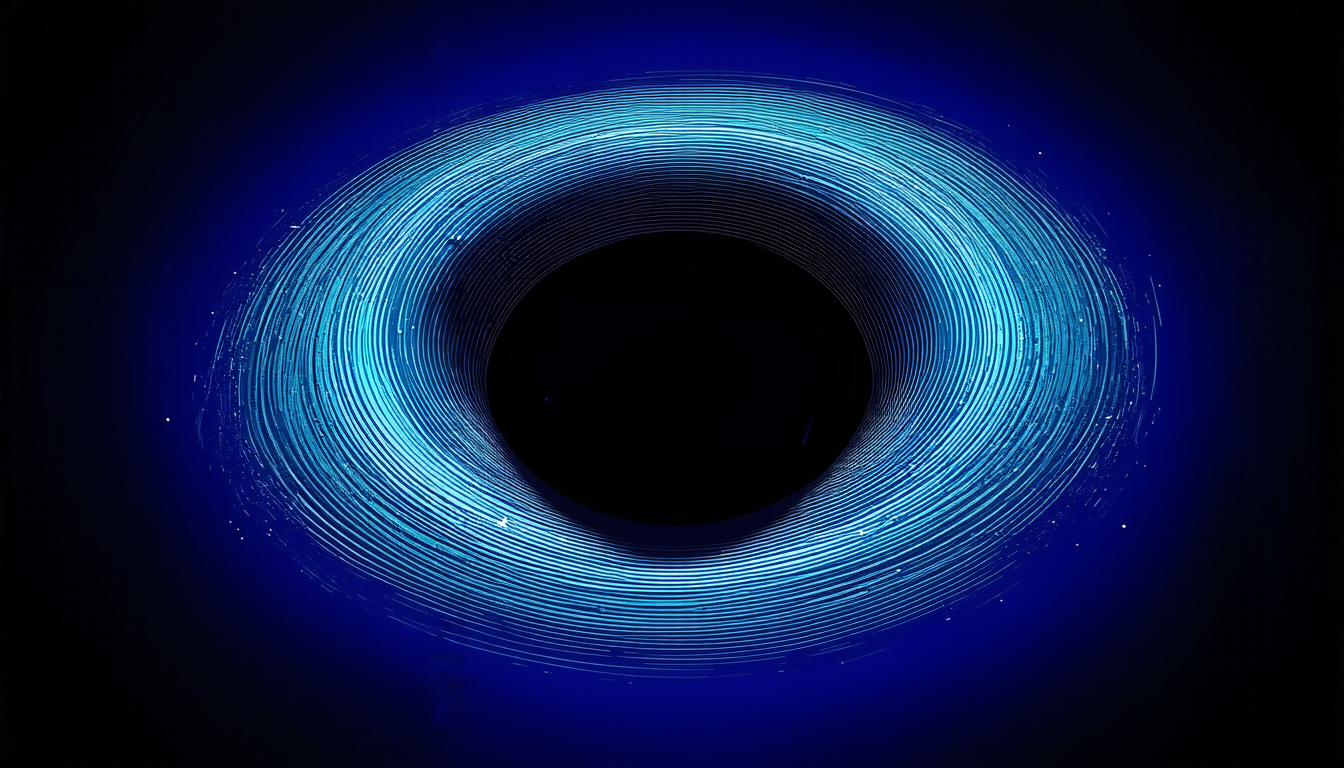
Black holes are regions of spacetime where the gravitational pull is so strong that not even light can escape once it gets too close. They’re formed when massive stars collapse in on themselves and their gravity becomes so intense that it warps the surrounding spacetime. But what’s fascinating about black holes is that they don’t just warp spacetime, they actually bend it and curve it into a shape known as a curvature.
The researchers used a mathematical framework called f(Q) theory to describe this curvature. This theory posits that gravity isn’t just caused by mass and energy, but also by the way that spacetime is curved. It’s a bit like trying to describe a rubber sheet that’s been stretched and bent into different shapes – the curvature of the sheet changes depending on how much force you apply.
By using this framework, scientists were able to create a new model for black holes that takes into account the way that spacetime is curved around them. This model shows that the gravity of a black hole isn’t just a simple attraction towards its center, but actually has a complex pattern of curvature that changes depending on the distance from the black hole.
What’s remarkable about this research is that it challenges our current understanding of gravity and spacetime. For decades, scientists have been working with Einstein’s theory of general relativity, which describes gravity as the curvature of spacetime caused by massive objects. But f(Q) theory suggests that there may be more to gravity than just mass and energy – maybe spacetime itself has a fundamental role in shaping our understanding of gravity.
The implications of this research are far-reaching and could have significant impacts on our understanding of the universe. By better understanding how gravity works, scientists can gain insights into some of the biggest mysteries of the cosmos, from dark matter to black holes.
One of the most exciting aspects of this research is that it opens up new avenues for exploring the fundamental nature of spacetime itself. By studying the curvature of spacetime around black holes, scientists may be able to uncover new secrets about the universe and its mysterious forces.
As researchers continue to explore the mysteries of gravity and spacetime, they’re pushing the boundaries of our understanding of the cosmos.
Cite this article: “Unlocking the Secrets of F(Q) Gravity: A New Perspective on Black Hole Thermodynamics”, The Science Archive, 2025.
Gravity, Spacetime, Black Holes, F(Q) Theory, Curvature, Einstein, General Relativity, Dark Matter, Cosmology, Quantum Mechanics





