

Sunday 06 April 2025
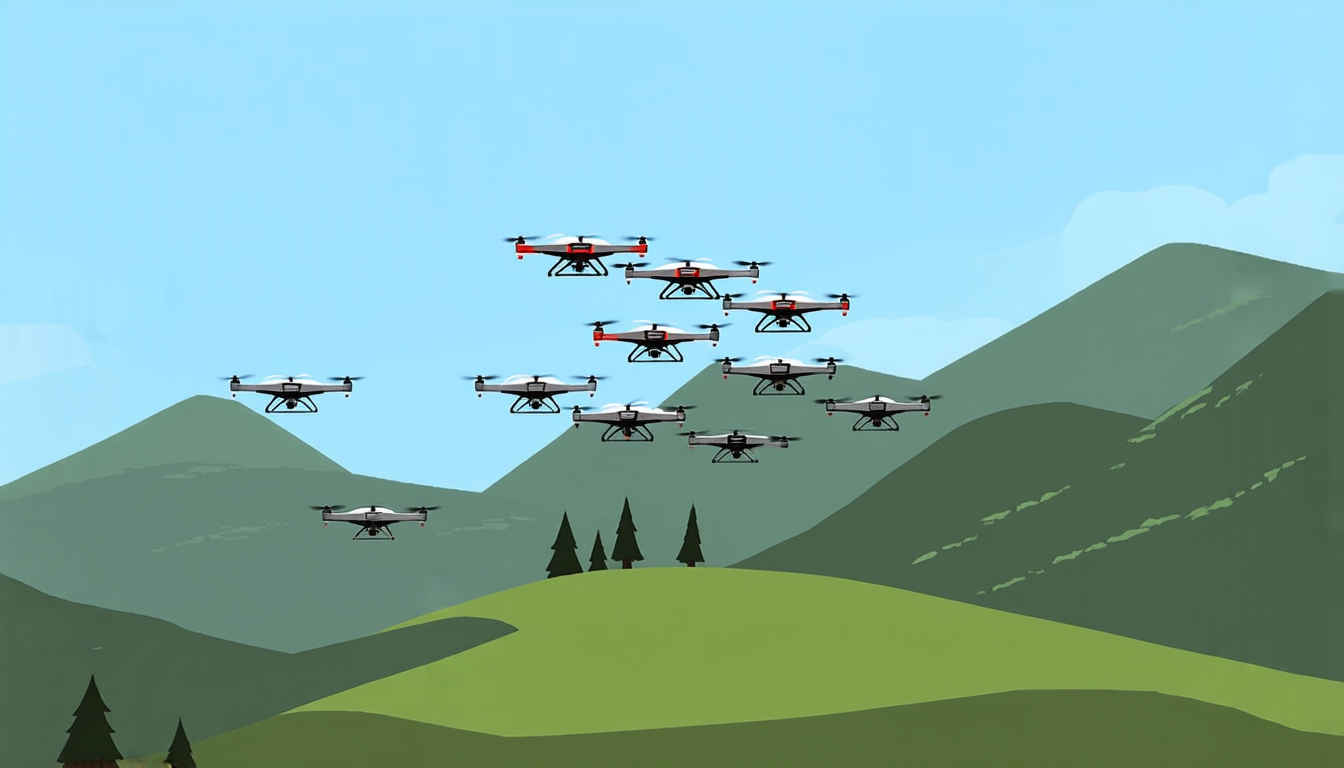
Researchers have made significant strides in developing a novel framework for multi-robot systems, which could revolutionize our ability to collect and analyze data from complex environments. The team’s innovative approach combines reinforcement learning, attention mechanisms, and sensor fusion to enable multiple unmanned aerial vehicles (UAVs) to work together seamlessly.
In traditional robotic systems, each robot operates independently, often leading to inefficiencies and reduced overall performance. The new framework, however, allows the UAVs to communicate and adapt to changing environmental conditions in real-time, significantly improving their ability to collect data and make informed decisions.
The system uses a counterfactual multi-agent policy gradient algorithm, which enables the robots to learn from each other’s experiences and adjust their behavior accordingly. This collaborative approach allows the UAVs to focus on the most valuable information-gathering tasks, reducing redundant efforts and increasing overall efficiency.
One of the key innovations is the incorporation of attention mechanisms, which enable the robots to prioritize specific areas or objects within their field of view. This selective focus ensures that the robots are collecting data on the most relevant targets, rather than wasting resources on unnecessary observations.
The system also employs a novel sensor fusion technique, which combines data from multiple sensors and sources to create a more comprehensive understanding of the environment. This allows the robots to make more accurate predictions about the best course of action, even in complex or dynamic situations.
In a series of experiments, the researchers demonstrated the effectiveness of their framework by deploying multiple UAVs in various environmental scenarios. The results showed significant improvements in data collection efficiency and accuracy compared to traditional approaches.
The implications of this technology are far-reaching, with potential applications in fields such as search and rescue, environmental monitoring, and surveillance. By enabling multiple robots to work together seamlessly, the new framework could revolutionize our ability to collect and analyze data from complex environments, leading to breakthroughs in a wide range of scientific and practical applications.
The researchers’ innovative approach has opened up new possibilities for multi-robot systems, demonstrating the potential for significant advancements in areas such as artificial intelligence, robotics, and sensor technology. As the field continues to evolve, it will be exciting to see how this technology is developed further and applied in real-world scenarios.
Cite this article: “Multi-UAV Cooperative Information Collection in Noisy Environments: A Deep Reinforcement Learning Approach”, The Science Archive, 2025.
Multi-Robot Systems, Reinforcement Learning, Attention Mechanisms, Sensor Fusion, Unmanned Aerial Vehicles, Counterfactual Multi-Agent Policy Gradient Algorithm, Data Collection Efficiency, Artificial Intelligence, Robotics, Environmental Monitoring





