

Sunday 06 April 2025
A team of scientists has made a significant breakthrough in our understanding of black holes and their role in the universe. By studying the way these cosmic monsters interact with light, researchers have gained new insights into the fundamental laws of physics that govern the behavior of matter and energy.
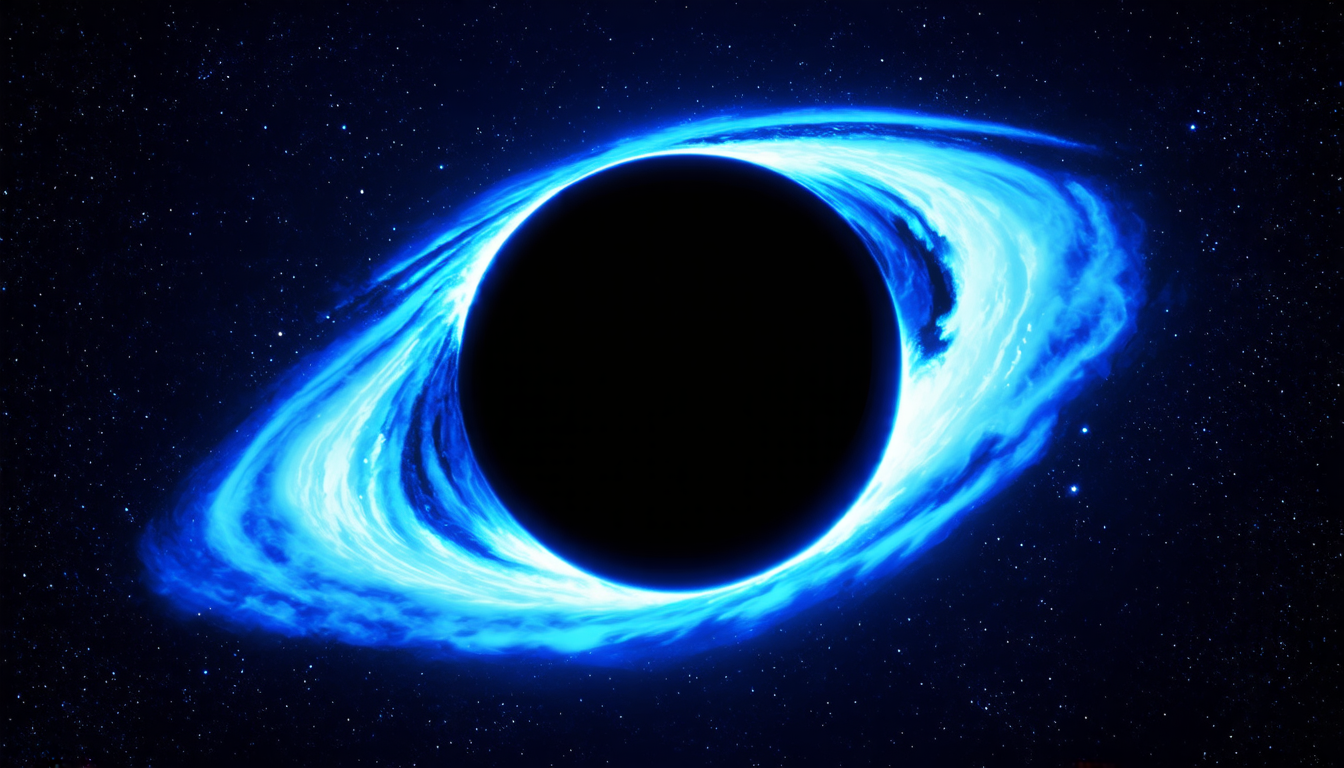
Black holes are regions of spacetime where gravity is so strong that not even light can escape once it gets too close. But what happens to photons – particles of light – as they approach the event horizon, the point of no return around a black hole? Do they get trapped in an eternal orbit, or do they somehow manage to escape?
To find out, scientists have been using some clever techniques to observe the way light behaves near black holes. One method involves watching how stars move near a black hole, and measuring the subtle effects that the black hole’s gravity has on their motion. Another approach is to study the way X-rays are emitted by hot gas swirling around a black hole.
By combining these different methods, researchers have been able to create detailed maps of the environment around black holes. These maps reveal complex patterns of light and matter that are influenced by the black hole’s intense gravity.
One of the most surprising discoveries is that photons can indeed escape from black holes – but only if they’re traveling in a very specific way. It turns out that certain wavelengths of light, such as X-rays, are more likely to be emitted than others, because they’re able to take advantage of the black hole’s strong gravity.
This finding has significant implications for our understanding of the universe. For one thing, it suggests that black holes may play a much more important role in shaping the universe than we previously thought. They may also provide a way for scientists to study cosmic phenomena that are otherwise invisible to us.
The research also raises intriguing questions about the nature of spacetime itself. How does gravity warp and curve around a black hole, causing photons to behave in such strange ways? And what happens to matter and energy as they approach the event horizon?
These questions will likely be the subject of ongoing research, as scientists continue to study the mysteries of black holes. By exploring these cosmic wonders, we may gain new insights into the fundamental laws of physics that govern our universe – and perhaps even uncover some surprises along the way.
In recent years, scientists have made significant progress in understanding black holes, including their role in the formation of stars and galaxies. But despite this progress, there’s still much to be learned about these enigmatic objects.
Cite this article: “Unlocking the Secrets of Black Hole Superradiance with Cosmic Neutrino Backgrounds”, The Science Archive, 2025.
Black Holes, Light, Gravity, Spacetime, Photons, Event Horizon, X-Rays, Matter, Energy, Physics





