

Sunday 06 April 2025
A team of astronomers has made a significant discovery in their quest to understand the mysteries of supermassive black holes at the centers of galaxies. Using data gathered by the NTT/SOFI telescope, they’ve pinpointed 29 high-redshift type 1 active galactic nuclei (AGNs) that will be observable with the GRAVITY+ upgrade to the Very Large Telescope Interferometer.
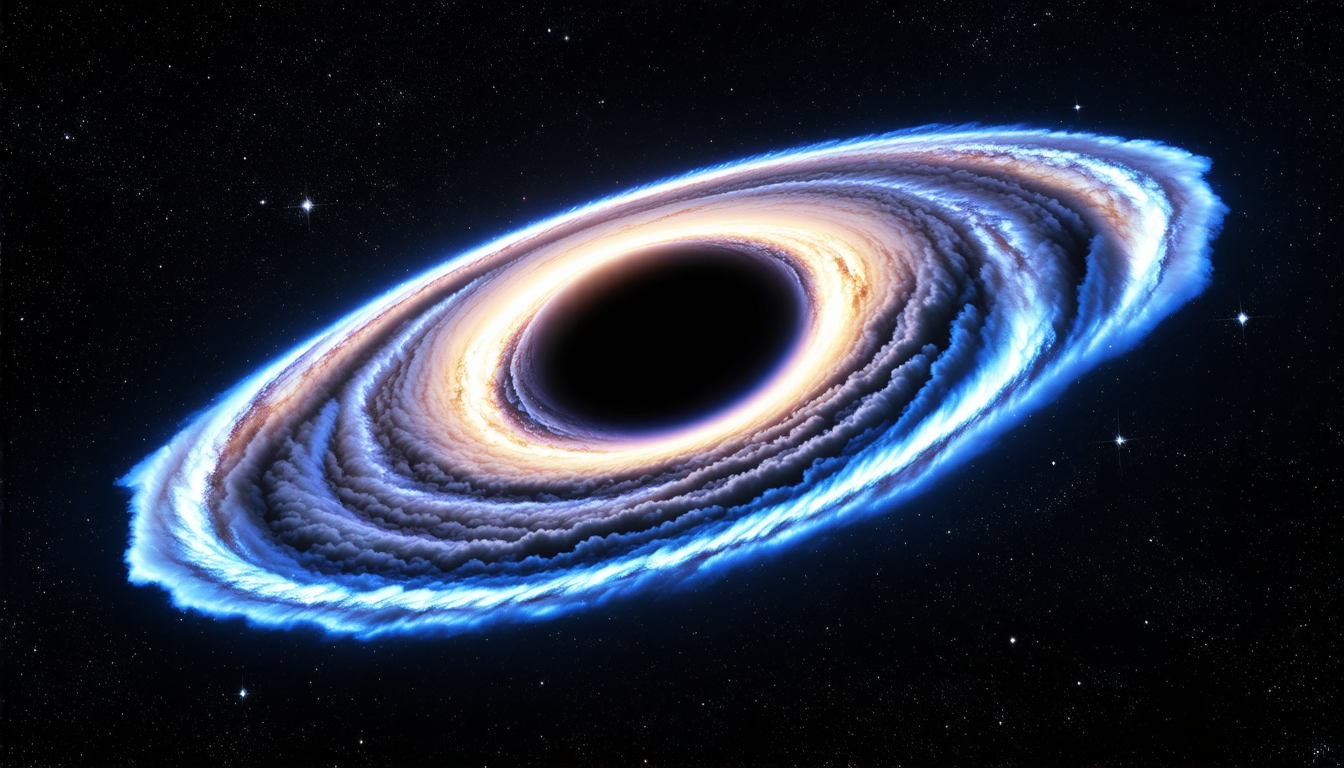
For those not familiar, supermassive black holes are behemoths of cosmic proportions, with masses millions or even billions of times that of our sun. They play a crucial role in shaping the evolution of galaxies and the formation of stars within them. Type 1 AGNs are particularly interesting because they’re powered by supermassive black holes actively feeding on surrounding material.
To study these distant AGNs, the team used the NTT/SOFI telescope to gather spectroscopic data from the Hα emission line, which is a key indicator of the presence and activity of supermassive black holes. They then analyzed the data using a sophisticated model that takes into account various factors such as the geometry of the emitting gas, the velocity of the gas, and the presence of dust.
The results are nothing short of remarkable. The team found that the 29 high-redshift type 1 AGNs they studied have broad line region (BLR) fluxes, which are indicative of the intense radiation emitted by supermassive black holes. They also discovered that the BLRs in these distant galaxies are smaller than those in nearby galaxies, which suggests that the growth of supermassive black holes is a complex process that’s still not fully understood.
One of the most interesting findings is the presence of radial motions within the BLRs. This could be evidence of inflowing or outflowing material, which would have significant implications for our understanding of how supermassive black holes interact with their surroundings. The team also found that some of the BLRs are dominated by circular motion, while others show signs of anisotropy, which is a departure from perfect circular symmetry.
The GRAVITY+ upgrade to the Very Large Telescope Interferometer will be able to observe these distant AGNs in unprecedented detail, allowing scientists to study their properties and behaviors with greater precision. This will provide valuable insights into the growth and evolution of supermassive black holes, which is essential for understanding the formation and development of galaxies.
Cite this article: “Unveiling the Secrets of Supermassive Black Holes at Cosmic Dawn”, The Science Archive, 2025.
Supermassive Black Holes, Active Galactic Nuclei, Gravity+, Very Large Telescope Interferometer, Ntt/Sofi Telescope, Spectroscopic Data, Hα Emission Line, Broad Line Region, Radial Motions, Galaxy Evolution





