

Sunday 06 April 2025
A team of researchers has developed a new approach to generating questions and answers for technical domains, such as law enforcement or healthcare, that rivals human expertise in accuracy and relevance.
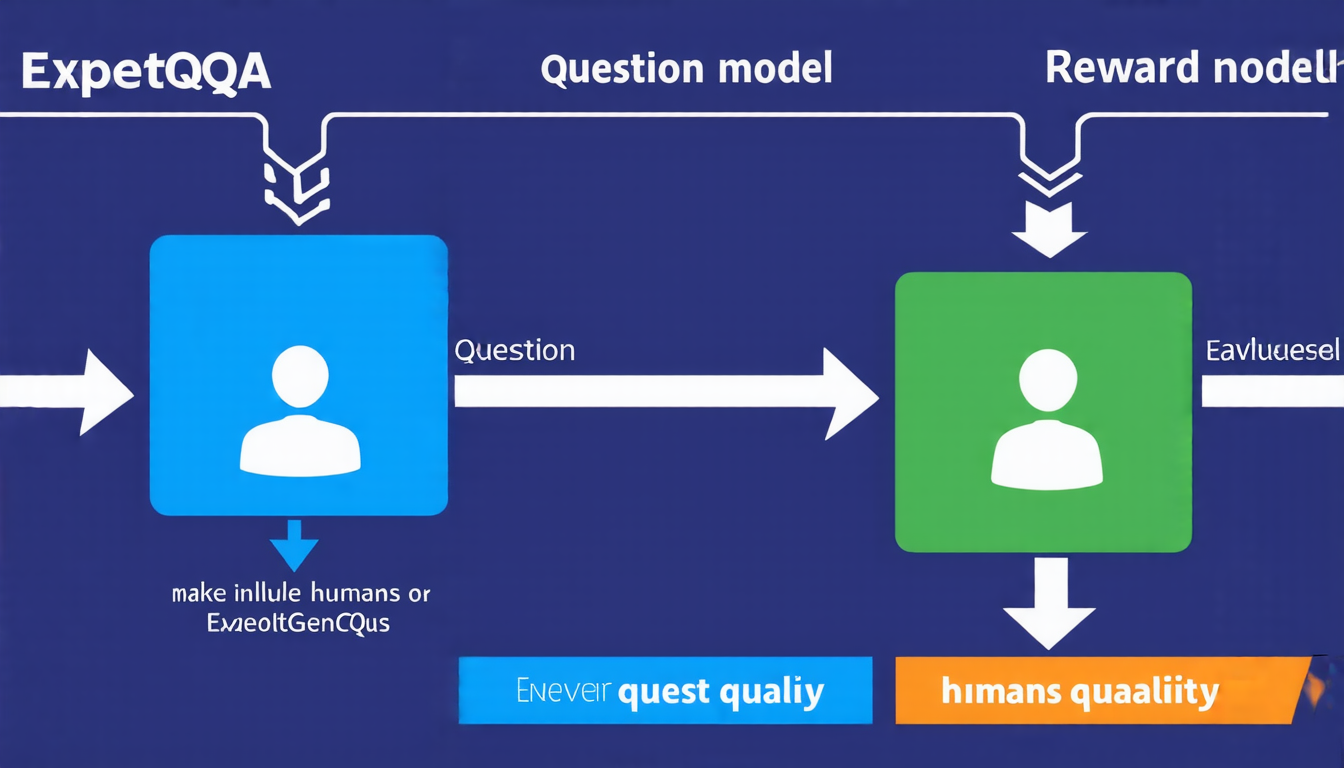
The system, dubbed ExpertGenQA, uses a combination of natural language processing (NLP) and machine learning algorithms to generate high-quality question-answer pairs. Unlike traditional approaches, which rely on simple keyword extraction or template-based prompting, ExpertGenQA employs a more sophisticated strategy.
First, the team trained a large language model on a massive corpus of text data from various technical domains. This allowed the model to learn the nuances of language and the relationships between concepts in each field.
Next, they used this trained model to generate questions based on specific passages of text. The system analyzed the passage’s content, identifying key topics and entities, before crafting questions that targeted those areas.
But here’s where ExpertGenQA gets particularly clever: it doesn’t just stop at generating questions. It also uses a sophisticated reward model to evaluate the quality of its own output. This ensures that the generated questions are not only accurate but also relevant, informative, and even creative – just like human experts would ask.
To test the system’s mettle, the researchers pitted ExpertGenQA against two other approaches: MDCure, which relies on manual crafting of prompts, and FewShot, a simpler NLP-based method. The results were striking: ExpertGenQA outperformed both rivals in terms of accuracy, relevance, and overall quality.
The implications are significant. With ExpertGenQA, technical experts could potentially generate high-quality questions and answers at scale, streamlining workflows and improving decision-making processes across various industries. The system’s potential applications extend beyond law enforcement and healthcare to fields like finance, education, and even customer support.
One of the key benefits of ExpertGenQA lies in its ability to adapt to new domains and topics with ease. By simply providing the system with a corpus of relevant text data, it can quickly learn the intricacies of a particular field and generate questions that are both accurate and relevant.
Of course, there are limitations to consider. As with any AI-powered system, ExpertGenQA’s performance is only as good as its training data. If the model is trained on biased or inaccurate information, its output will likely reflect those flaws.
Nonetheless, the potential benefits of ExpertGenQA are undeniable.
Cite this article: “Evaluating the Efficacy of Large Language Models in Generating High-Quality Question-Answer Pairs for Railroad Safety Regulations”, The Science Archive, 2025.
Expertgenqa, Natural Language Processing, Machine Learning Algorithms, Technical Domains, Law Enforcement, Healthcare, Question-Answer Pairs, Language Model, Text Data, Reward Model, Accuracy, Relevance, Quality, Decision-Making Processes, Finance, Education, Customer Support





