

Sunday 06 April 2025
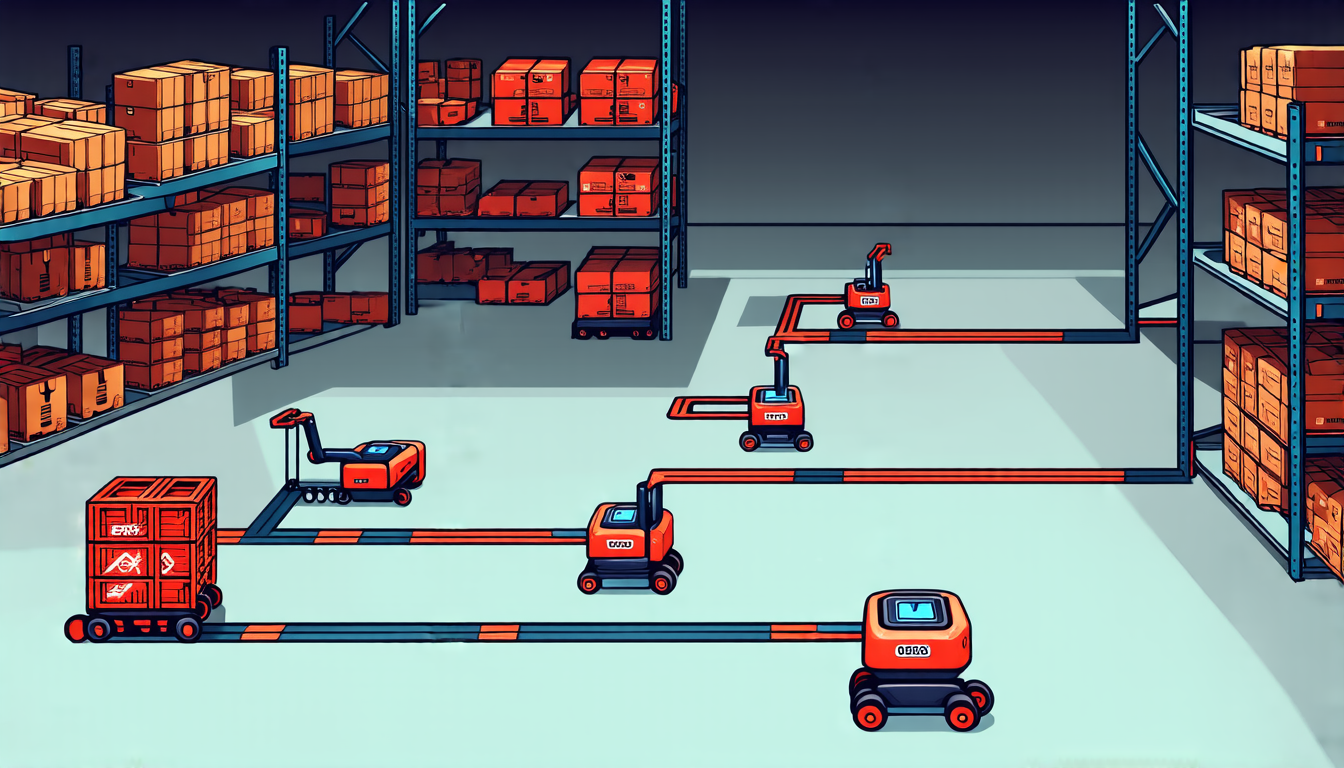
A team of researchers has made a significant breakthrough in developing a new algorithm that can efficiently and effectively plan paths for multiple robots working together in complex environments. The algorithm, called RAILGUN, uses a unique approach to tackle the challenges of multi-agent pathfinding, which is crucial for applications such as warehouse automation and search and rescue operations.
Traditionally, algorithms for path planning have focused on individual agents, treating each one separately and ignoring the interactions between them. However, this approach can lead to inefficient and even impossible solutions when multiple agents are involved. RAILGUN takes a different tack by predicting edge directions for each map grid cell, allowing it to handle maps of any size and any number of agents.
The algorithm’s key innovation is its use of a convolutional neural network (CNN) architecture, which enables it to learn patterns in the data and make predictions about the best paths. This approach allows RAILGUN to outperform existing algorithms in terms of speed and effectiveness, making it an attractive solution for real-world applications.
One of the most impressive aspects of RAILGUN is its ability to generalize across different tasks and environments. In tests, the algorithm was able to adapt to new maps and agent numbers without requiring additional training data, demonstrating its potential for use in a wide range of scenarios.
RAILGUN’s performance was evaluated using the POGEMA benchmark, which provides a comprehensive set of metrics for testing multi-agent pathfinding algorithms. The results showed that RAILGUN achieved high scores across all six metrics, including performance, coordination, scalability, cooperation, out-of-distribution and pathfinding. This suggests that the algorithm is well-suited to handle complex tasks in realistic scenarios.
The development of RAILGUN has significant implications for a range of fields, from robotics and automation to logistics and search and rescue operations. By providing a more efficient and effective way to plan paths for multiple agents, this algorithm could revolutionize the way we approach multi-agent pathfinding and open up new possibilities for applications that require coordination between multiple robots or agents.
Overall, RAILGUN represents a major advance in the field of multi-agent pathfinding and has the potential to make a significant impact on a wide range of industries. Its ability to generalize across different tasks and environments, combined with its high performance in complex scenarios, make it an attractive solution for developers looking to tackle challenging path planning problems.
Cite this article: “Reinforcing Pathfinding: A Deep Learning Approach to Multi-Agent Navigation”, The Science Archive, 2025.
Robotics, Multi-Agent Pathfinding, Railgun, Algorithm, Path Planning, Convolutional Neural Network, Cnn, Edge Directions, Map Grid Cell, Pathfinding Problem





