

Sunday 06 April 2025
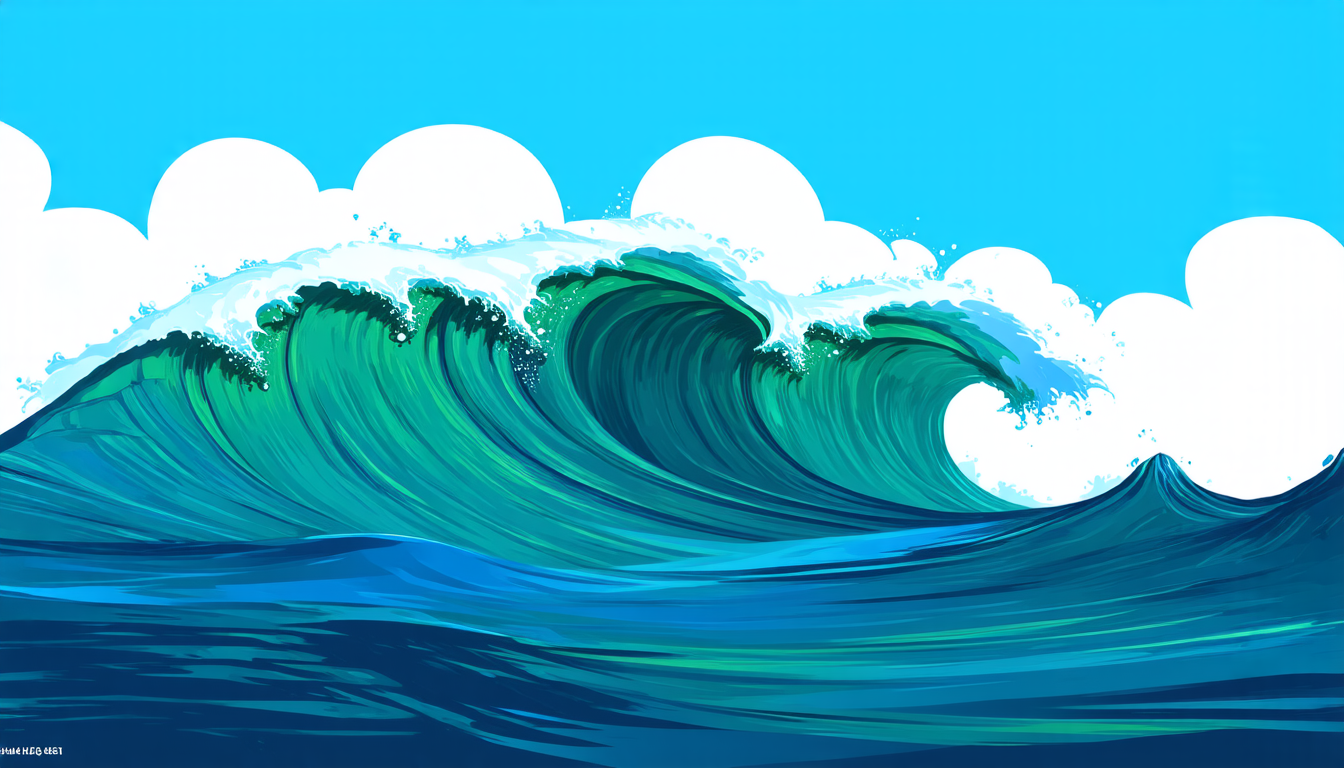
The turbulent dance of ocean waves and currents has long fascinated scientists, but a new study sheds light on how these two forces interact in the uppermost layer of the sea.
Researchers have long known that wind-driven waves play a crucial role in shaping our planet’s climate. The way these waves break and dissipate energy is particularly important, as it can influence everything from ocean currents to atmospheric circulation patterns. However, understanding this process has been hampered by the lack of direct observations at the surface of the sea.
Enter the latest research, which uses advanced numerical simulations to study the interplay between wave breaking and turbulence in the ocean’s mixed layer. This is the topmost layer, where sunlight penetrates and photosynthesis occurs, supporting a vast array of marine life.
The scientists developed a sophisticated model that can resolve scales from about 50 centimeters up to one kilometer – an unprecedented level of detail for such simulations. They then used this tool to study the dynamics of wave breaking and turbulence in various scenarios, ranging from calm seas to extreme weather conditions.
Their findings reveal a rich tapestry of interactions between waves, currents, and turbulence. For instance, they discovered that the breaking of waves creates vortices – swirling motions of water – which in turn inject energy into the turbulent flow. This process is crucial for transporting heat and momentum across the ocean’s surface layer.
The researchers also found that the vertical structure of the mixed layer plays a significant role in shaping these interactions. In regions where the layer is thin, wave breaking dominates the turbulence generation, while in thicker layers, other processes like wind shear and Langmuir circulation come into play.
These insights have important implications for our understanding of ocean-atmosphere interactions and their impact on climate. For example, they suggest that changes in wave breaking patterns could influence the distribution of heat across the planet’s surface, with potential effects on global weather patterns.
The study also highlights the need for more observations at the sea surface to better understand these complex processes. This could involve deploying advanced sensors or using aircraft and satellite data to monitor ocean dynamics from above.
As our understanding of these interactions grows, scientists are poised to make significant advances in fields ranging from climate modeling to coastal engineering. The intricate dance between waves and currents may hold the key to unlocking some of the planet’s most pressing environmental challenges – and it’s a discovery that will continue to captivate researchers for years to come.
Cite this article: “Unraveling the Mysterious Forces Behind Ocean Turbulence”, The Science Archive, 2025.
Ocean Waves, Currents, Turbulence, Wave Breaking, Mixed Layer, Climate Modeling, Coastal Engineering, Langmuir Circulation, Wind Shear, Ocean-Atmosphere Interactions





