

Sunday 06 April 2025
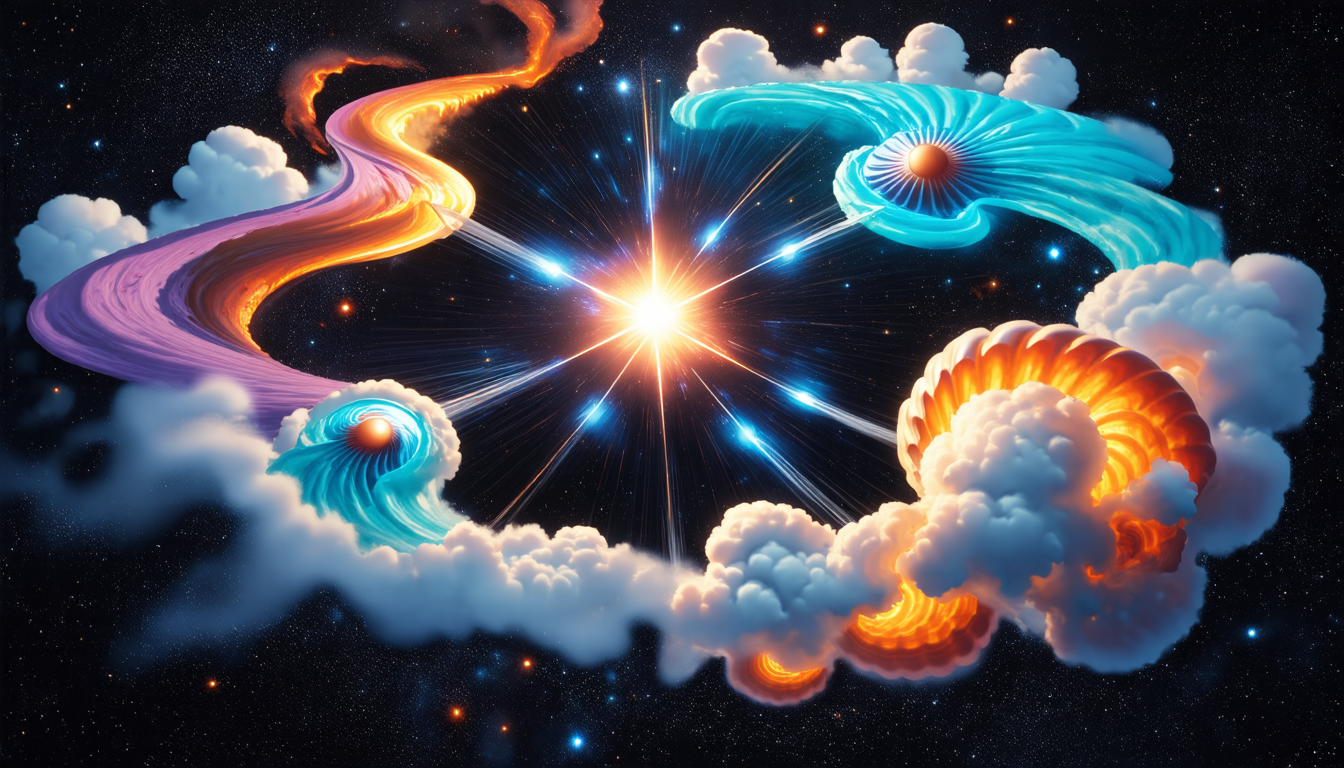
Deep in the heart of a distant galaxy, a star was born. But this wasn’t just any star – it’s one that would go on to create some of the most complex and fascinating structures in our universe: protostellar outflows.
These outflows are massive plumes of gas and dust that shoot out from young stars as they form and grow. They’re like giant cosmic jets, powered by the star’s intense energy output. And scientists have long been fascinated by them because they hold secrets to understanding how stars like our own Sun came to be.
Recently, a team of astronomers used two of the world’s most powerful telescopes – the James Webb Space Telescope and the Atacama Large Millimeter/submillimeter Array (ALMA) – to study one such protostellar outflow in unprecedented detail. Their findings offer a glimpse into the tumultuous early days of star formation, and shed light on the complex interplay between gas, dust, and radiation that shapes these cosmic phenomena.
The target of their study was a young star called IRAS 15398-3359, which is nestled in a nearby galaxy known as the Carina Nebula. Using ALMA’s incredible resolution, they were able to map the outflow’s structure with unprecedented precision – revealing four distinct shell-like structures that are thought to be the result of turbulent gas and dust being swept up by the star’s powerful radiation.
But that was just the beginning. By combining ALMA’s data with observations from JWST, the team was able to probe the temperature and composition of the outflow in unprecedented detail. They discovered hot H2 gas within the outflow cavity, which is thought to be heated by the intense radiation emitted by the star. This hot gas is likely playing a key role in shaping the outflow’s structure, and could even help explain why certain regions are more active than others.
The team also used ALMA to study the chemical makeup of the outflow, analyzing the spectra of molecules like H2CO (formaldehyde) and CS (carbon monosulfide). These molecules are thought to be created when gas and dust within the outflow react with each other – offering a window into the complex chemistry that’s occurring at play.
By combining all these different lines of evidence, the team was able to build a detailed picture of this protostellar outflow – one that suggests a complex interplay between radiation, gas, and dust.
Cite this article: “Unlocking the Secrets of a Young Stars Outflow: A Multi-Wavelength Study”, The Science Archive, 2025.
Star Formation, Protostellar Outflows, Galaxy, James Webb Space Telescope, Atacama Large Millimeter/ Submillimeter Array, Alma, Radiation, Gas, Dust, Chemistry, Carina Nebula





