

Sunday 06 April 2025
Researchers have made a significant breakthrough in understanding the intricacies of magnetic materials, specifically in the realm of antiferromagnetic bilayers. By combining advanced computational methods and symmetry analysis, scientists have uncovered a novel way to control the anomalous Hall effect (AHE) in these materials.
The AHE is a phenomenon where an electric current flows perpendicular to both the direction of the applied electric field and the magnetic field. This effect has been extensively studied in ferromagnetic materials, but its behavior in antiferromagnets remains poorly understood. Antiferromagnets are unique in that they lack a net magnetic moment, yet still exhibit complex magnetic properties.
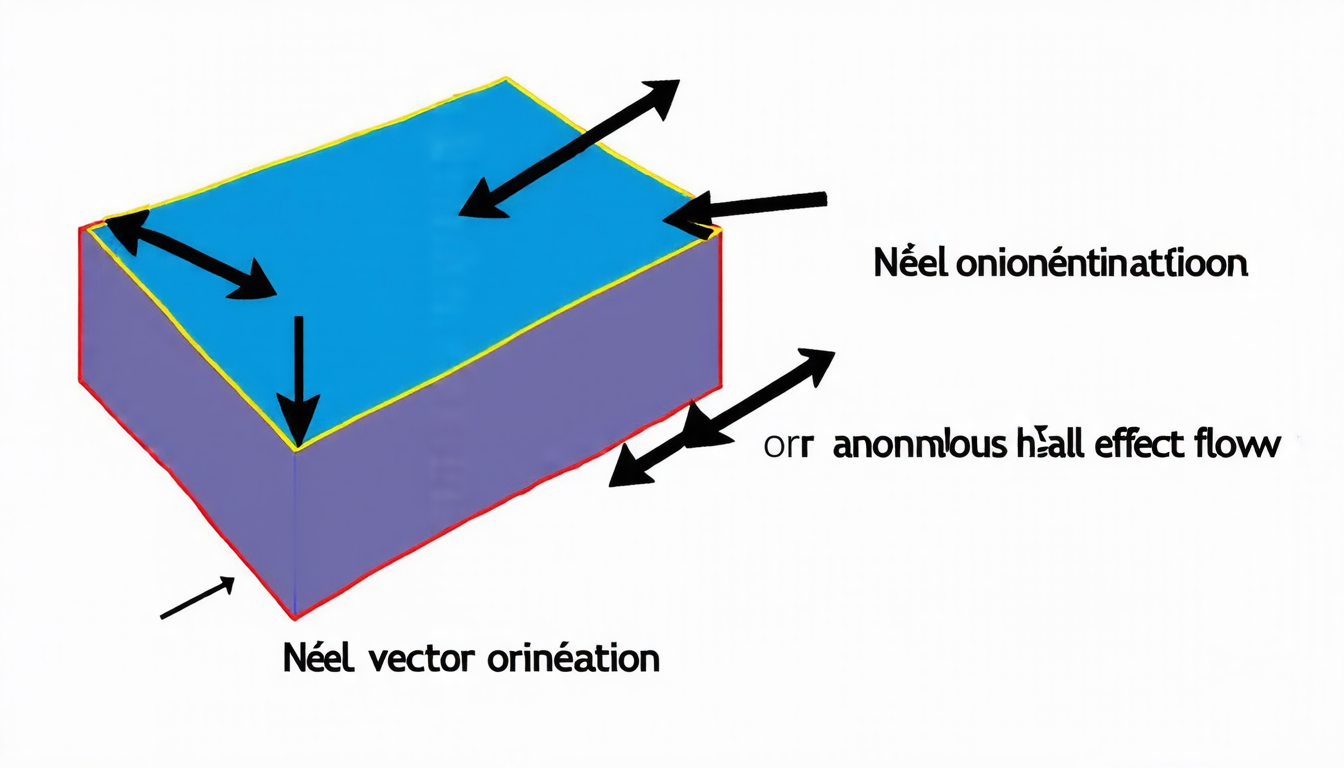
The study focused on a specific type of antiferromagnetic bilayer, composed of cobalt phosphorus selenide (CoPSe3). By analyzing the material’s crystal structure and magnetic configuration, researchers discovered that the AHE is sensitive to the orientation of the Néel vector – a fundamental concept in magnetism.
The team found that when the Néel vector is aligned in specific directions, the AHE is suppressed or enhanced depending on the symmetry properties of the material. This behavior is attributed to the interplay between the magnetic moments and the crystal lattice structure.
One of the key findings is that the AHE can be controlled by manipulating the stacking mode of the bilayer. By altering the arrangement of the layers, researchers can tune the AHE’s magnitude and even change its sign. This level of control has significant implications for the development of spin-based electronics and magnetic sensors.
The study also explored the behavior of a trilayer system composed of CoPSe3. Researchers discovered that non-relativistic spin splitting occurs in certain magnetic configurations, which could lead to new opportunities for manipulating the material’s electronic properties.
This work highlights the importance of understanding the intricate relationships between crystal structure, magnetic configuration, and electronic properties in antiferromagnetic materials. The ability to control the AHE in these materials opens up new avenues for research into spin-based technologies and could potentially lead to breakthroughs in fields such as data storage and processing.
The discovery also underscores the significance of symmetry analysis in understanding complex magnetic phenomena. By leveraging advanced computational methods and theoretical frameworks, researchers can gain valuable insights into the behavior of these materials and develop novel strategies for harnessing their properties.
As research continues to uncover the intricacies of antiferromagnetic bilayers, scientists are poised to unlock new opportunities for spin-based technologies.
Cite this article: “Unlocking Quantum Properties in Hexagonal Magnets: A Novel Route to Anomalous Hall Effects”, The Science Archive, 2025.
Magnetic Materials, Antiferromagnetic Bilayers, Anomalous Hall Effect, Ahe, Cobalt Phosphorus Selenide, Copse3, Néel Vector, Spin Splitting, Symmetry Analysis, Computational Methods





