

Sunday 06 April 2025
In a recent study, researchers have made significant progress in understanding the delay performance of a complex network system that uses random coding and broadcasting to distribute messages among nodes. This system is particularly useful for applications where messages need to be transmitted quickly and efficiently, such as emergency response systems or vehicle-to-everything communication.
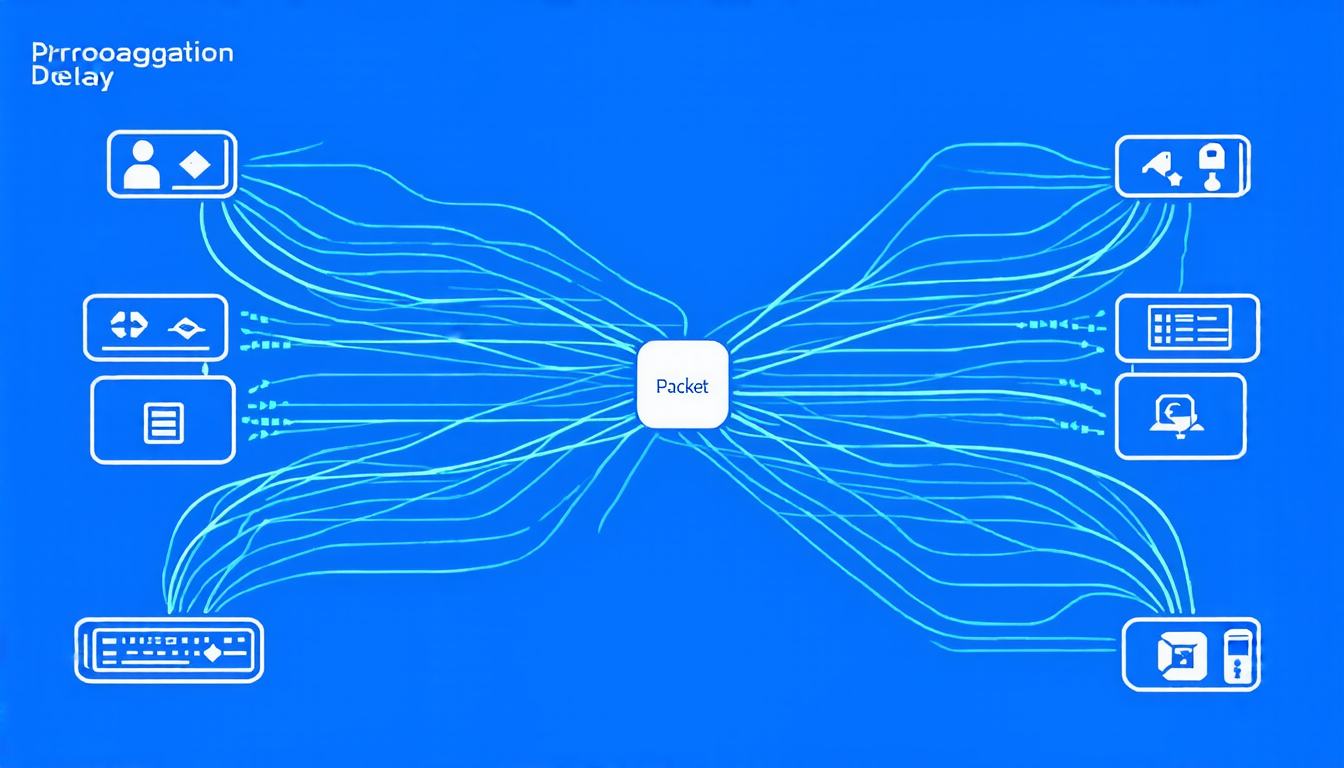
The researchers’ approach was to analyze the network’s delay performance by dividing it into two parts: propagation delay and queuing delay. The propagation delay refers to the time it takes for a packet of information to travel from its source node to its destination node, while the queuing delay occurs when packets are delayed due to congestion in the network.
To simplify their analysis, the researchers used an equivalent route concept, which allows them to assume that all packets follow the same path through the network. This assumption is reasonable because the network coding method ensures that each packet can be decoded independently of its transmission path.
The researchers also developed a detour method to improve the accuracy of their delay estimation. This method takes into account the possibility that packets may take alternative routes through the network due to congestion, which can significantly affect the overall delay performance.
To test their approach, the researchers simulated several different network topologies and packet generation rates. They found that their model provided a good estimate of the average packet delay in most cases, although it sometimes underestimated the delay in networks with high congestion.
The study’s findings have important implications for the design and optimization of complex network systems. By understanding how delays occur and propagate through the system, engineers can develop more efficient routing protocols and scheduling algorithms to reduce congestion and improve overall performance.
One potential application of this research is in emergency response systems, where timely communication between responders and dispatch centers is critical. By optimizing the delay performance of these networks, researchers may be able to improve response times and save lives.
The study’s results also have broader implications for understanding complex network behavior. By developing more accurate models of delay propagation, researchers can gain insights into the dynamics of other complex systems, such as traffic flow or social networks.
Overall, this research demonstrates the importance of considering both propagation and queuing delays when analyzing complex network systems. By taking a holistic approach to delay performance analysis, engineers and researchers can develop more effective solutions for optimizing network behavior and improving overall system performance.
Cite this article: “Unlocking the Secrets of Delay-Optimal Broadcasting in Dynamic Networks”, The Science Archive, 2025.
Complex Networks, Delay Performance, Random Coding, Broadcasting, Emergency Response Systems, Vehicle-To-Everything Communication, Propagation Delay, Queuing Delay, Network Optimization, System Performance.





