

Sunday 06 April 2025
Scientists have made a significant breakthrough in developing heuristics for complex optimization problems, using large language models to generate efficient solutions. Heuristics are rules of thumb that help solve difficult problems by providing a good, but not necessarily optimal, solution. In this case, researchers used large language models, which are trained on vast amounts of text data, to automatically design and optimize heuristics for the unit-load pre-marshalling problem.
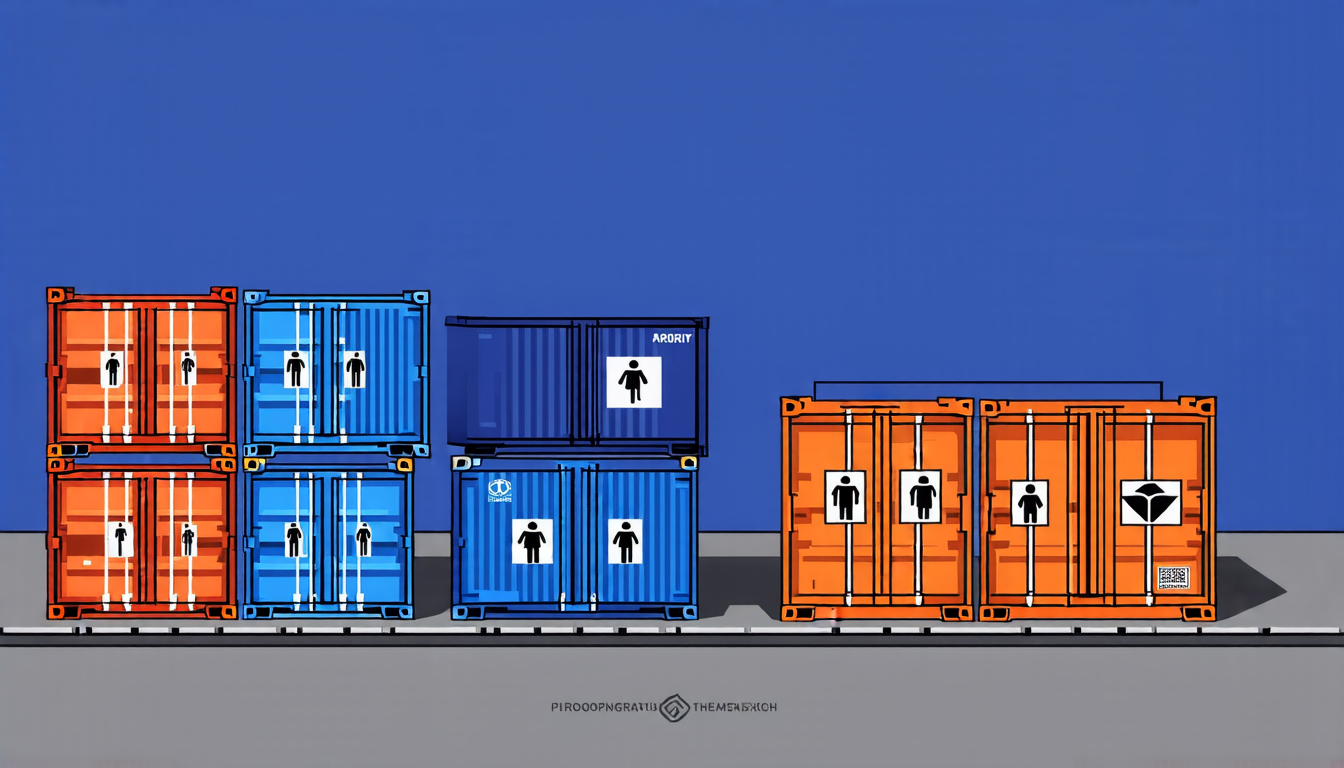
The unit-load pre-marshalling problem is a real-world challenge faced by logistics companies, where containers need to be stacked efficiently in warehouses. The goal is to minimize the number of moves required to stack all containers, while ensuring that high-priority items are accessible quickly. This problem is notoriously difficult, and existing solutions often rely on manual design or require extensive computational resources.
The researchers employed a novel approach by using large language models to generate heuristics for this problem. They created a framework called Contextual Evolution of Heuristics (CEoH), which incorporates additional problem-specific information to enhance the heuristic design process. This allowed the language models to learn from the context and adapt their suggestions accordingly.
The team tested CEoH on various instances of the unit-load pre-marshalling problem, using different large language models trained on diverse datasets. The results showed that CEoH consistently outperformed traditional optimization methods, providing high-quality heuristics that solved complex problems efficiently.
One of the most impressive aspects of this breakthrough is its potential to revolutionize the way we approach optimization problems. By leveraging the power of large language models, scientists can automate the design and optimization process, making it more efficient and effective. This has significant implications for industries that rely heavily on logistics and supply chain management.
The success of CEoH also highlights the importance of interdisciplinary collaboration between computer science, artificial intelligence, and operations research. By combining these fields, researchers can develop innovative solutions to complex problems that might have otherwise seemed intractable.
As we continue to push the boundaries of AI and optimization, it’s exciting to think about the potential applications of CEoH in other domains. From optimizing production lines to scheduling healthcare resources, the possibilities are vast. With this breakthrough, scientists have taken a significant step towards harnessing the power of large language models for real-world problems.
In future studies, researchers will likely explore ways to further improve CEoH and adapt it to tackle even more complex challenges.
Cite this article: “AI-Powered Optimization: Unleashing the Potential of Large Language Models in Solving Complex Combinatorial Problems”, The Science Archive, 2025.
Heuristics, Optimization, Language Models, Logistics, Supply Chain Management, Unit-Load Pre-Marshalling Problem, Contextual Evolution Of Heuristics, Ceoh, Artificial Intelligence, Operations Research





