

Sunday 06 April 2025
A team of scientists has made a fascinating discovery about a distant quasar, shedding light on the mysterious magnetic fields that surround it. Quasars are incredibly luminous objects that are thought to be powered by supermassive black holes at the centers of galaxies.
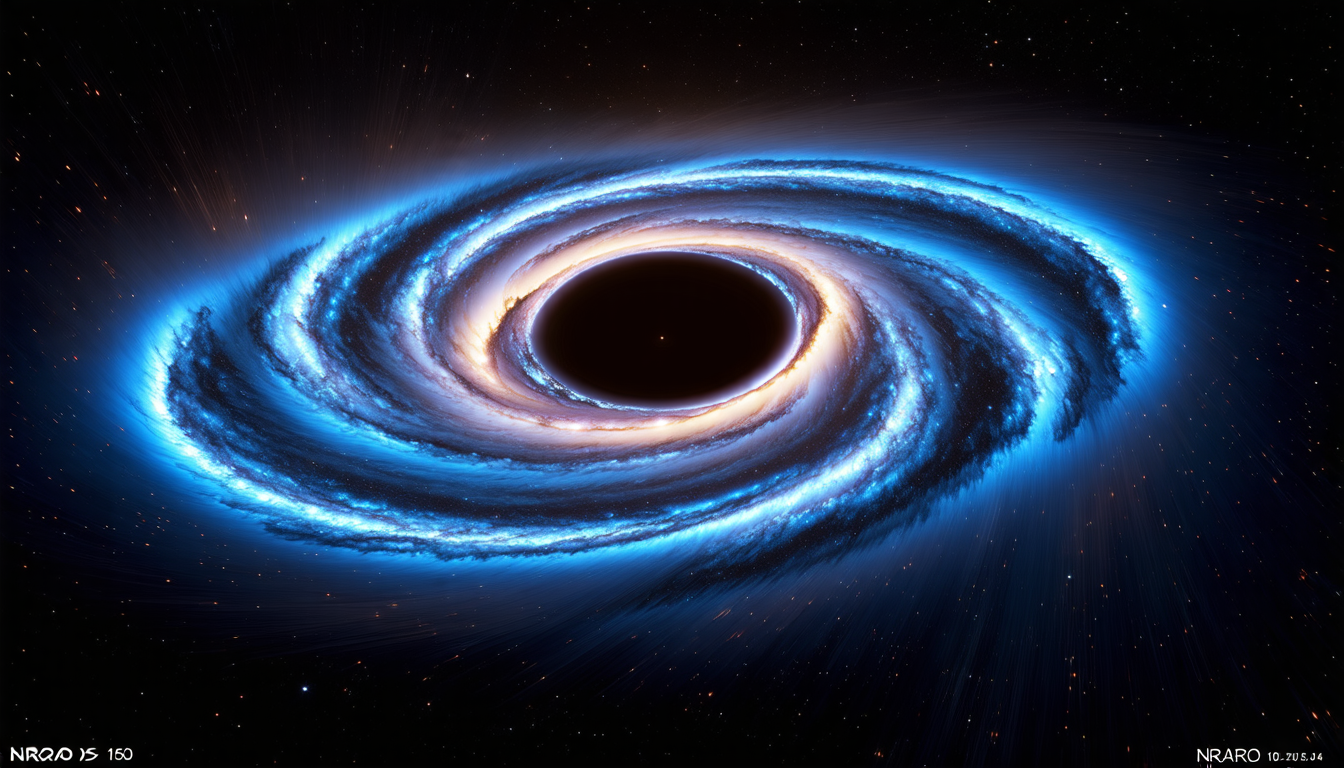
The quasar in question is called NRAO 150 and is located about 9 billion light-years away from Earth. By observing the polarized light emitted by this quasar, scientists were able to map out its magnetic field. The results show that the magnetic field around NRAO 150 is helical, meaning it twists and turns like a spiral staircase.
This finding is significant because it helps us understand how these massive black holes interact with their surroundings. Magnetic fields play a crucial role in shaping the environment around quasars, influencing the flow of gas and energy within them. By studying these magnetic fields, scientists can gain insights into the complex processes that govern the behavior of quasars.
The team used a technique called polarimetry to observe the polarization of light emitted by NRAO 150. Polarization is a property of light that describes its orientation and direction. By analyzing the polarization patterns, scientists can infer the presence of magnetic fields and map their structure.
The data collected from the observations showed a clear pattern of circular polarization, which is indicative of a helical magnetic field. The team also detected Faraday rotation gradients, which are changes in the orientation of the polarized light as it passes through the quasar’s magnetic field. These gradients provided further evidence for the presence of a twisted magnetic field.
The discovery has important implications for our understanding of quasars and their role in shaping the universe. Quasars are thought to be responsible for seeding galaxy formation, and their magnetic fields may play a key role in this process. By studying these fields, scientists can gain insights into how quasars interact with their surroundings and shape the evolution of galaxies.
The findings were published in a recent issue of The Astronomical Journal and have sparked excitement among astronomers and physicists alike. The discovery highlights the importance of continued research into the mysterious world of quasars and their role in shaping our understanding of the universe.
Cite this article: “Unlocking the Secrets of Quasar NRAO 150: A Helical Magnetic Field Revealed?”, The Science Archive, 2025.
Quasar, Magnetic Field, Polarization, Astronomy, Black Hole, Galaxy Formation, Faraday Rotation, Circular Polarization, Helical Structure, Nrao 150





