

Sunday 06 April 2025
As robots continue to advance in their ability to interact with humans, one major concern remains: ensuring their safety in a variety of situations. A new approach has been developed to address this issue, combining artificial intelligence and reinforcement learning to create a safer and more efficient robot policy.
The problem is complex – robots need to be able to adapt to changing environments and make decisions quickly, while also avoiding potential hazards and following rules. Traditional methods have relied on explicit modeling of safety constraints, but these can be limited by the complexity of the environment and the number of possible scenarios.
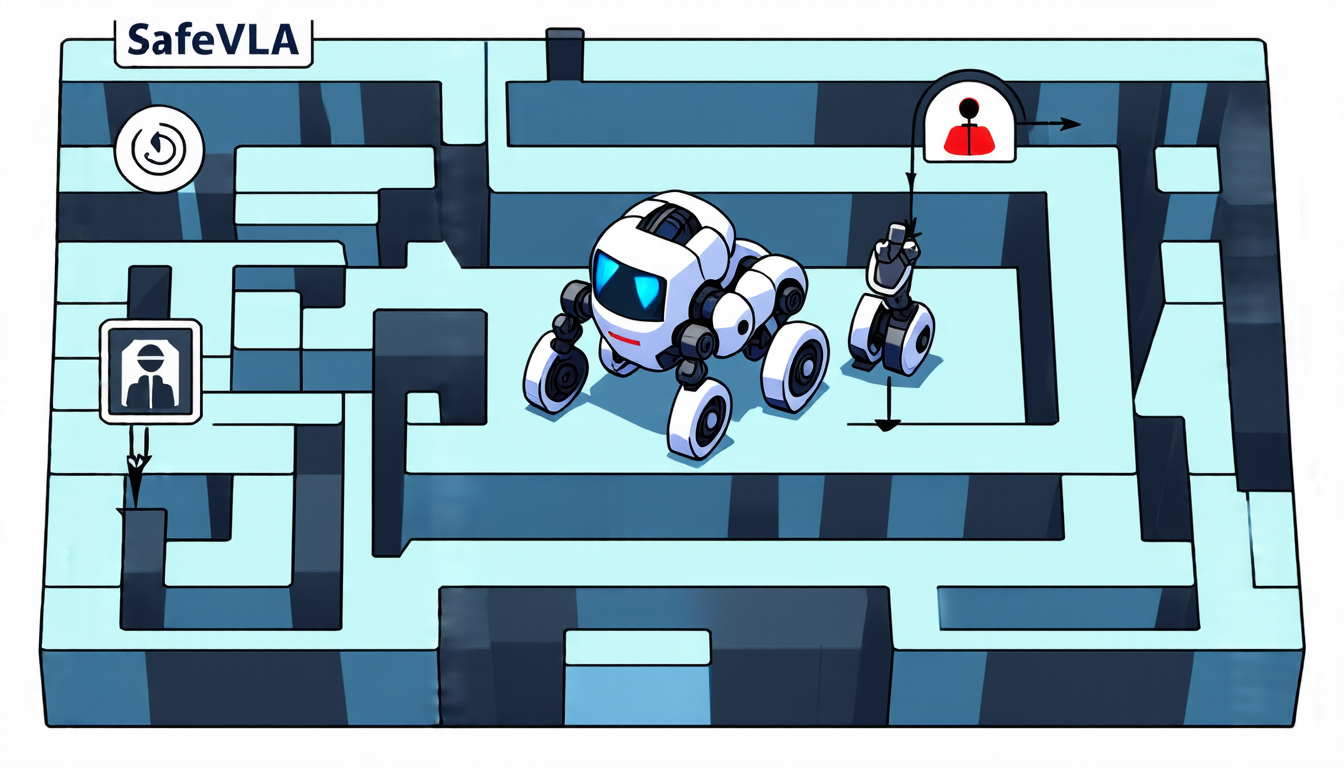
The new approach, called SafeVLA, uses a technique called constrained learning to optimize a robot’s policy for safe behavior. This involves training an artificial intelligence model using a combination of reinforcement learning and imitation learning, with a focus on safety constraints. The model is then fine-tuned through simulation-based testing to ensure it can generalize well to new situations.
The key innovation behind SafeVLA is its ability to balance reward maximization (i.e., achieving the desired task) with constraint satisfaction (i.e., avoiding hazards). This is achieved through a clever combination of mathematical techniques and machine learning algorithms. The model learns to optimize its policy by weighing the trade-off between these two competing goals.
The results are impressive – in simulation-based testing, SafeVLA outperformed existing methods in both safety and task performance. This means that the robots trained with SafeVLA were able to complete tasks more efficiently while also avoiding hazards and following rules.
One of the most significant advantages of SafeVLA is its ability to generalize well to new situations. This is critical for real-world applications, where robots may encounter unexpected obstacles or changes in their environment. By training the model using a variety of scenarios and constraints, SafeVLA can adapt to these changing conditions more effectively than traditional methods.
The potential applications of SafeVLA are vast – from industrial settings where safety is paramount, to service industries like healthcare and education where efficiency and effectiveness are crucial. As robots continue to play an increasingly important role in our daily lives, it’s essential that we prioritize their safety and well-being.
In the future, researchers will likely build upon the foundations laid by SafeVLA, exploring new techniques and applications for constrained learning. With continued advancements in artificial intelligence and robotics, we can expect even more sophisticated robots that are capable of navigating complex environments with ease and precision.
Cite this article: “SafeVLA: A Novel Approach to Vision-Language-Action Models for Ensuring Safety in Robotics”, The Science Archive, 2025.
Artificial Intelligence, Reinforcement Learning, Robot Safety, Constrained Learning, Simulation-Based Testing, Task Performance, Machine Learning Algorithms, Robotics, Industrial Settings, Healthcare





