

Sunday 06 April 2025
A new type of optical fibre has been engineered, one that could revolutionize the way we transmit data and potentially unlock new applications in fields such as quantum computing.
The innovative design of this all-lossy dual-core photonic crystal fibre, or PCF for short, enables it to host a phenomenon known as an exceptional point. This is a unique topological singularity where both the eigenvalues and eigenstates of the system’s Hamiltonian coalesce simultaneously.
In traditional optical fibres, light is confined within a core surrounded by a cladding material with a lower refractive index. However, this design has its limitations, particularly when it comes to achieving precise control over non-hermitian interactions between modes. Hermiticity refers to the property of being equal to its own complex conjugate transpose, which is crucial for ensuring that energy is conserved.
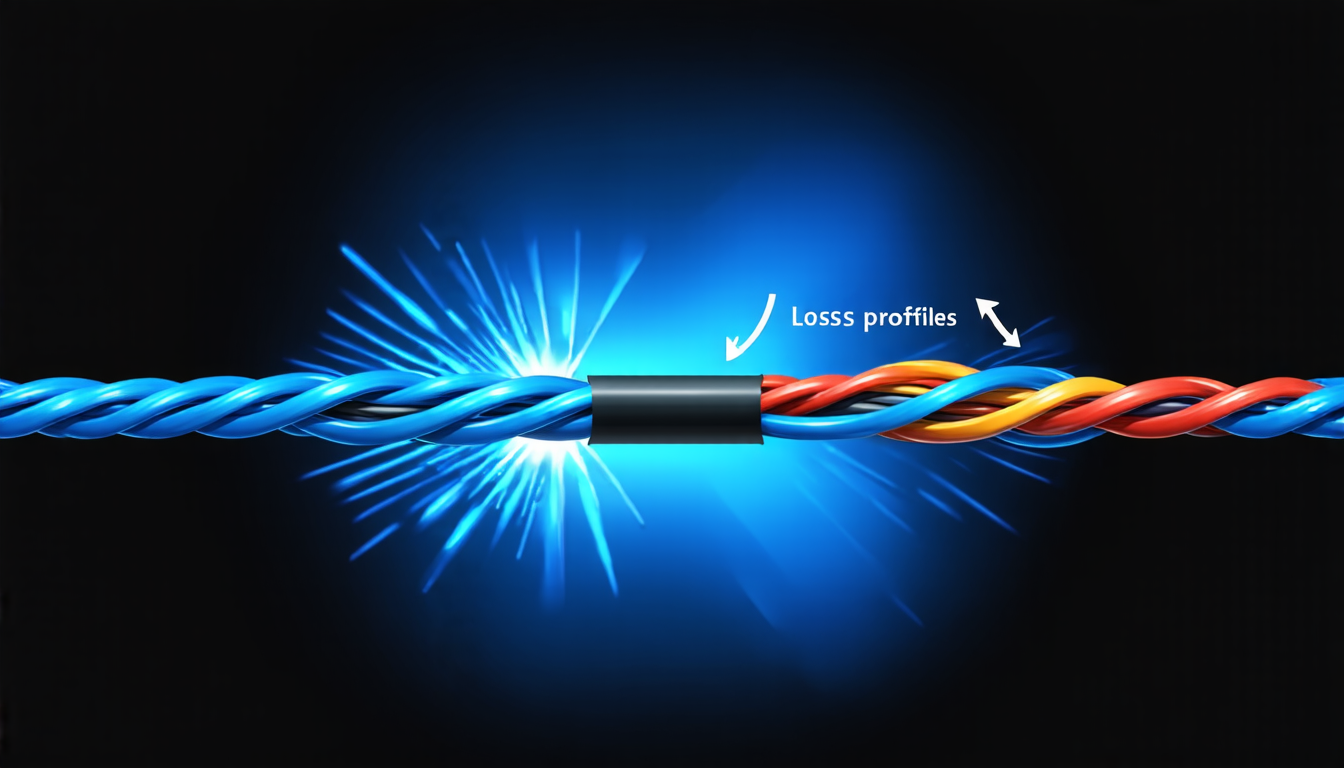
The all-lossy PCF addresses these limitations by incorporating customized loss profiles in both cores and cladding. This allows researchers to manipulate the interaction between modes with unprecedented precision. The loss distribution is modulated by two independent parameters: loss coefficient and fractional-loss ratio.
The exceptional point, which is achieved through a specific arrangement of loss profiles, has far-reaching implications for the manipulation of light. By encircling this point in a closed elliptical trajectory, researchers can induce exotic chiral light dynamics, where one mode switches to another as the fibre’s parameters are varied. This property could be exploited in novel applications such as optical isolators and ultra-sensitive sensors.
One of the key advantages of this all-lossy PCF is its simplicity and practicality compared to traditional gain-loss assisted designs. The latter requires precise doping with active materials, optical pumping, and careful control over gain profiles – all of which can introduce instabilities and noise. In contrast, the loss distribution in the all-lossy PCF can be easily tailored through adjustments to the dopant concentration.
The exceptional point phenomenon has been observed in a range of systems, including photonic crystals and metamaterials. However, this is the first time it has been achieved in an optical fibre with only two guided modes. The implications for quantum computing are particularly exciting, as the all-lossy PCF could potentially be used to create ultra-sensitive sensors that detect even tiny changes in the environment.
The researchers behind this innovation have also demonstrated a new type of mode conversion, where one mode switches to another as the fibre’s parameters are varied.
Cite this article: “Unlocking Exceptional Properties in All-Lossy Optical Fibers”, The Science Archive, 2025.
Optical Fibres, Photonic Crystal Fibre, Exceptional Point, All-Lossy, Dual-Core, Quantum Computing, Non-Hermitian Interactions, Mode Conversion, Optical Isolators, Ultra-Sensitive Sensors.





